
--Jor-El, Superman: The Movie
"For God so loved the world, that he gave his only begotten Son, that whosoever believeth in him should not perish, but have everlasting life. For God sent not his Son into the world to condemn the world; but that the world through him might be saved...And this is the condemnation, that light is come into the world, and men loved darkness rather than light, because their deeds were evil...But he that doeth truth cometh to the light, that his deeds may be made manifest, that they are wrought in God."
--John 3:16-17, 19, 21
 So I geeked out over the "Superman Returns" trailer. In fact, my inner geek was quite disappointed with the fact that they didn't show said trailer when I saw Harry Potter on Saturday. I'm sure I'll catch it on a big screen at some point. But somewhere in the midst of seeing just how cool Routh looks in action and how good the flying special effects are even at this stage, I managed to notice that Jor-El left out a "begotten" in his speech.
 I'm not a religious guy, mind you. I'm a literature geek, and any lit geek can spot a Biblical reference and a Christ figure. A child is sent out from the heavens by his father, raised by humble surrogate parents, discovers he is more than a mortal man, and decides to use his superhuman abilities as a force of good and a saviour of humans. If you came into Superman knowing only that, would you guess that he was created by a pair of Jewish kids?
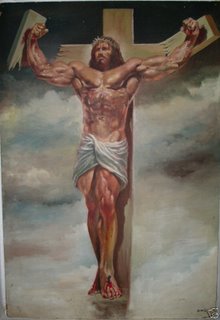 Of course, anyone who knows a little about world mythology will see just how universal that capsulized description can be. It's at the heart of Joseph Campbell's Monomyth, the archetypal hero behind Heracles, Mithras, Aragorn, Luke Skywalker, Gilgamesh, Beowulf, Moses, and Jesus Christ. Superman resonates with us because he comes out of this timeless tradition. He's not just a superhero, he's the superhero, the one who is burned somewhere onto our collective unconscious, who has popped up in every major religion, in every set of fables, since the dawn of human civilization.
 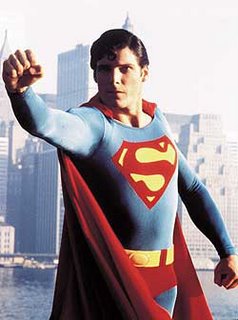 And the folks behind "Superman: The Movie" took that notion and ran with it. Much like the Star Wars trilogy, "Superman" plays out like Campbell's Hero With a Thousand Faces on celluloid. The whole Epic journey is there; the little nods to other Monomythic heroes, like when Jor-El channels the book of John in the above quote. Someone had a copy of Campbell on set, I'd put money on it.
 The Crimson Avenger and the Phantom might have predated Superman when it comes to costumed crimefighters, but there's a reason that Superman is considered the first superhero, and that has more than a little to do with all the history that goes into his character. It's not just Samson, who Siegel and Shuster cited as one of their inspirations for the Man of Steel. Superman was a Monomythic hero from day one, from hoisting that green car over his head. Once they started fleshing out his backstory a little more, the connections to mythology became even more pronounced.
It seems hardly coincidence that Superman's real, Kryptonic name is Kal-El, an apparent neologism by George Lowther, the author who novelized the comic strip in 1942 [actually, the name "Kal-L" was established by the Siegel/Shuster comic strip. Lowther may have added the E, but the sound remained the same]. In Hebrew, el can be both root and affix. As a root, it is the masculine singular word for God. Angels in Hebrew mythology are called benei Elohim (literally, sons of the Gods), or Elyonim (higher beings). As an affix, el is most often translated as "of God," as in the plentitude of Old Testament given names: Ishma-el, Dani-el, Ezeki-el, Samu-el, etc. It is also a common form for named angels in most Semitic mythologies: Israf-el, Aza-el, Uri-el, Yo-el, Rapha-el, Gabri-el and--the one perhaps most like Superman--Micha-el, the warrior angel and Satan's principal adversary.
The morpheme Kal bears a linguistic relation to two Hebrew roots. The first, kal, means "with lightness" or "swiftness" (faster than a speeding bullet in Hebrew?). It also bears a connection to the root hal, where h is the guttural ch of chutzpah. Hal translates roughly as "everything" or "all." Kal-El, then, can be read as "all that is God" or perhaps more in the spirit of the myth of Superman, "all that God is."
--Gary Engle, "What Makes Superman So Darned American?"*
Personally, I think it makes more sense to go with "Swiftness from God," in that he derives his powers, like speed and flight, from a higher entity, from a heritage that, in Siegel and Shuster's time, consisted of a whole race of supermen, demigods from the heavens. One only wonders what "Jor" means in Hebrew. Well, I do anyway. There's a lot more to Superman than red underwear and blue tights. There's several millennia of human literature sewn into that cape. And now, having died and been reborn, deriving his amazing powers from the sun (like Christ-like sun gods Mithras and Apollo), and standing at the head of DC's own Holy Trinity, Superman's links to the Monomyth have only grown stronger.
 Does this mean you ought to worship Superman? Is he the Son of Man of Tomorrow? Our Saviour of Steel? Certainly not. What this means is that comic books as literature, tied into the grand scheme of human literary history, is not new. It's as old as Superman, and Superman consequently is as old as humankind itself.
So, ultimately, it's nice to see Singer and crew taking a similarly literary approach to the new film. Supposedly Superman has gone into another exile (like the 12 years he spent in the Fortress in the first film). Has he gone into the vast deserts of space to be tempted and tested? Seeing this messianic imagery in the trailer makes me wonder how much better Superman III and IV would have been if they'd paid more attention to the character's literary history and less to cheesy comic book filmmaking.

 All this "One Year Later" (OYL) talk has made me want to be the first to make that joke. I'm probably not, but I really don't care.
  Three new links over on da blogroll. I read
 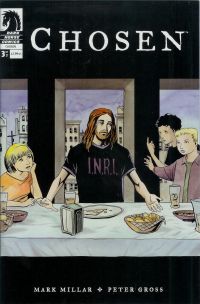 So, I just purchased and read the trade of Mark Millar's Chosen. Maybe it's the deluge of Revelation-inspired media in the popular culture recently, but I found it dreadfully predictable, and more than a little bland.

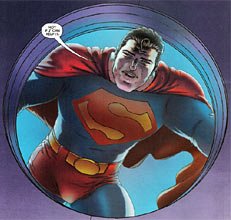

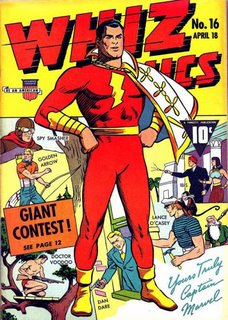

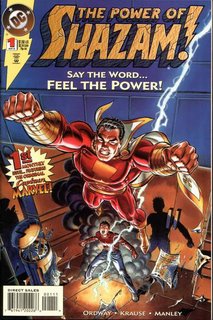
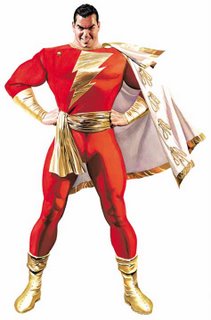
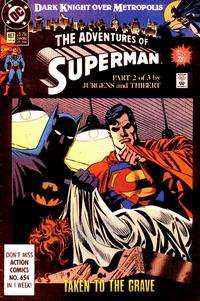 It starts way back in one of the early post-Crisis Superman/Batman team-ups, in which the two heroes are investigating a series of deaths related to Luthor's stolen Kryptonite ring, and a woman who had figured out Clark's secret identity. At the end of the story, Superman gave Batman the Kryptonite ring, in case he ever went rogue or otherwise needed to be stopped. He entrusted Batman with his life, knowing that Batman could stop him if necessary.
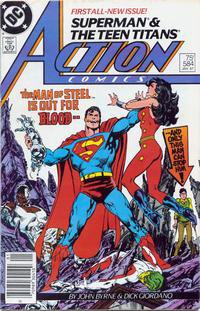 Then, you remember all the times Superman has gone off the deep end. There was the crippled kid who bodyswapped with him and attacked the Teen Titans, there was the time Luthor took control of his superpowers and cut a swath of destruction through Metropolis, there was the time he started moonlighting as Gangbuster because he had a mental breakdown after fights with Brainiac and killing those Kryptonian criminals, the time the Eradicator tried to make him into the perfect Kryptonian, there was the time Eclipso took control of him, and there was the Cyborg Superman who destroyed Coast City (not Supes himself, sure, but a guy with his powers and then some, who did quite a bit to tarnish his image, during "Reign of the Supermen"), then his powers went out of control and he got huge and grotesque and knocked satellites out of the sky, then Brainiac took over his body and put his mind in the head of an epileptic fan in an asylum while he tried to take over the world, then his powers went screwy and he turned blue (not exactly berserk, but he caused some damage and nearly killed the Parasite), then Dominus used him to try to take over the world, then Lord Satanus took his soul and made him act like a jerk, then he and Bizarro swapped bodies, then there was Eclipso (again), which brings us right up to "Sacrifice" and Max Lord, the latest in a long line of people to send big blue off the deep end. And that's just in his own title, not counting all the other books Superman appears in (cough cough "Hush" cough). Is there anyone in the DCU at this point who hasn't taken control of Superman at one point or another? I know I've mentally possessed his body on two nonconsecutive occasions, and had a fantastic time of it.
 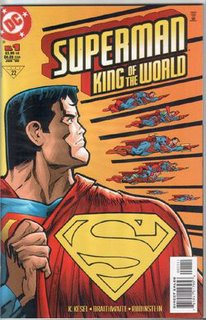 And in some of these occasions (though not as many as you'd think), Batman has had the opportunity to use his Kryptonite ring. I can remember two such occasions. Once, in "Hush," when Poison freaking Ivy took control of Superman, the ring worked with some success, mainly because Superman was fighting Ivy's control. The other time, during the "King of the World" arc, where Dominus used Superman to take over the world, the ring didn't work at all, because Lex Luthor had stolen it and replaced it with a fake.
 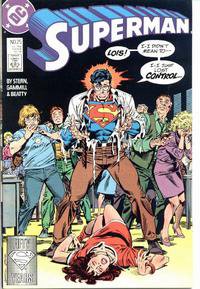 Wait, worldwide surveillance network enforced by super-powerful robots? Superman's not only giving Batman ideas, he's giving them to Max Lord too! And, lest we forget, one of those super-robots went on to kill Donna Troy, setting the stage for her further descent into confusing continuity jumbles and her eventual charge to stop the Rann-Thanagar War, or something.
 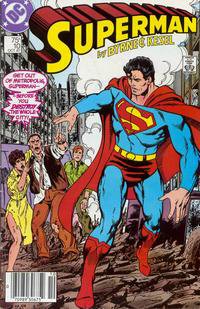 So, Superman originated Batman's anti-rogue-superhero contingency plans, then gave Batman dozens of reasons to use them, came up with the first huge worldwide surveillance network for the "greater good," gave Max Lord the idea and motive to walk into his brain through the back door, and the concept of super-robots to augment the surveillance system. Superman's actions even resulted in the death of Donna Troy. Cite the Satellite-era league and "Identity Crisis" all you want, go after DiDio and Rucka and Johns, but they're not the real culprits. It's all Superman's fault.