Showing posts with label Transformers. Show all posts

Wednesday, July 29, 2009

Revenge of the Fallen

On one hand, the title is a reference to my triumphant return from being in Internet limbo. On the other, it's a reference to my ridiculously late review of the second Transformers movie, which I saw the weekend it opened (or perhaps the week after). It's been a busy month or three. Spoilers ahead.

So since it has been so long since I saw the film, and since I'm still pretty busy, I'm just going to lay this out in bullet points.
  • Starting with the good: the effects, as usual, were very good. I think I would have liked to see a little more use of the alternate modes for most of the robots, but in general the effects were great.
  • One thing I really liked about this is the way it corrected one of the first film's major mistakes: failing to characterize the Decepticons. I thought Starscream and Megatron got some great character moments this time around, and the Fallen was pretty well fleshed-out as well.
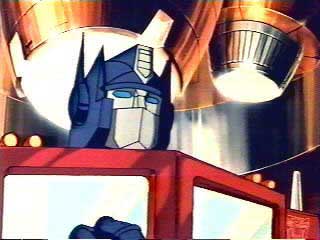
  • Optimus Prime was fantastic. Every moment that he was around was classic. He had great dialogue, his characterization was spot-on, and he got to have some epic fights. Optimus was the highlight of the film. I think the best bit, besides his death-battle, was when he told the government agent flat-out that he and the Autobots would leave if they were presenting a danger to Earth.
  • Which brings me to another positive: the homages. Now, honestly, I haven't watched any G1 Transformers cartoons in quite some time, but I thought there were some plot points that really mirrored some of those early G1 stories. Obviously Prime's death and the Matrix stuff were reminiscent of the original Movie, and Soundwave sounded a great deal like his classic self. But besides that, I thought Optimus's promise to leave if asked was fairly reminiscent of "Megatron's Master Plan," where the Autobots leave Earth after being (falsely) convicted for terrorist acts. Moreover, "Decepticons find a powerful ancient weapon in a pyramid" was also the plot of the G1 episode "Fire on the Mountain." Even Jetfire's sacrifice hearkens back to the various versions of Jetfire (Armada in particular) which could become armor for Optimus Prime. I'm going to assume that this is all intentional, and I approve.
  • And, well, I don't approve of too much more than that. My first complaint, I think, is the amount of military porn. It seemed like there were way too many shots of nameless military personnel ordering things over radios, apparent stock footage of jets flying places, and army guys fighting with some robots wandering around in the background. I actually liked the army guys in the first movie; they were characterized in fairly broad swaths, but they got some good moments and some great dialogue. This time around, I wasn't even sure that Tyrese was back, since he had something like two lines (and neither was "left cheek!"). Major Lennox got in some good scenes, but everyone else was green-shirt filler. Which wouldn't have been such a problem if they weren't apparently the primary focus of the film.

    More succinctly, as I said to someone in the week after seeing it, I thought that "Revenge of the Fallen" was a pretty good G.I. Joe movie. Sadly, I think it'll turn out to have been a better G.I. Joe movie than "Rise of Cobra."
  • The plot felt really, really disjointed; a lot of this was due to setting issues. The movie jumped around from place to place--Japan, Washington, Egypt, the Moon, and so forth--far too much for any kind of coherent continuity. I swear, the traipsing about in Egypt was done solely for the "Hey, remember that other movie Shia LeBouf was in, wink wink?" factor.
  • That excess of settings might not have been quite so bad if not for the terrible excess of characters as well. Sure, we got lots of new Transformers, but I'd be hard-pressed to name most of them--the filmmakers apparently were too. I think maybe a third of the new Transformers got names, and far fewer got characterization to any degree. Lack of distinguishing characteristics was a problem with the Decepticons in the last film; in this one, it plagued the Autobots at least as much. Very few characters got an opportunity to shine at all. And the ones that did, aside from the ones I mentioned before...well, we'll get to that later.
  • I felt more than a little cheated by Alice, the creepy stalker girl who turned out to be a creepy stalker Decepticon. So far in the series, we've seen that Transformers can take the forms of just about any electronic device, but until that point, it was only electronic devices. Now, I've heard there's some backstory which says she scanned an Alice in Wonderland animatronic robot, but that's lame. Find me an Alice in Wonderland robot that looks like that, and I'll find you a really creepy Imagineer. If the movie were going to introduce Pretenders or Beast Warriors, as this kind of sets the precedent for, it should have been alluded to before we met Alice.
  • The scenes with Alice are a good opportunity to bring up one of my biggest problems with the movie. Now, the last film had some strong language, lots of violence, and some T&A, but I wouldn't feel too terrible about watching it with my kid brother. When my parents were going to take him to see this one, though, I strongly advised against it. The amount of lewd humor, T&A, and strong language made me uncomfortable. Okay, the wrecking balls on Devastator were pretty funny, bur I could have done without Jetfire's parachute incontinence. And I certainly could have done without Wheelie humping Megan Fox's leg. Honestly.
  • What's with the obnoxious sidekicks? Wheelie was pretty close to unnecessary, Sam's roommate was useless and whiny (Sam was mostly just whiny this time around), the Decepticon doctor's strange accent made him incomprehensible (and he wasn't the only 'bot with intelligibility issues), and so forth. But it seems like I'm forgetting something relevant here.
  • Oh, yes, the twins. So, the filmmakers picked two Autobots to dominate the screen time in this installment, and then made the bold moronic choice to turn them into robotic minstrels. Now, I'll give Bay & Co. the benefit of the doubt and assume that Mudflap and Skids weren't intentionally really horrible racist stereotypes; I imagine that it was more the Jar-Jar effect, where obliviousness and ignorance conspire to create offensiveness. The "we can't read that" bit didn't help, even if it was pretty clearly implied that none of the modern Transformers could read the ancient language. It was just one more thing to toss onto the unfortunate heap.

    Anyway, not only were they stupid and offensive, but they were incredibly obnoxious as well. Now, I've been a fan of Transformers for a good long time, through the original Wheelie, through Nightscream, through RiD Ultra Magnus, through oodles of annoying characters, and I have never, ever been more disappointed to see a Transformer not die than when Mudflap shot his way out of Devastator's head. Honestly, it'd be as if Jar-Jar were the one to cut Darth Maul in half. Why on Earth would you give the Scrappy a Crowning Moment of Awesome?
  • Hey, how about that climactic battle? You know, the one that was over in thirty seconds? Where the world-destroying superweapon was taken out by a single shot and Optimus tore the Fallen's spark out with almost no effort? Yeah, I could have done without three or four minutes of twin banter and airplanes flying places, if it meant we would have gotten less of an anticlimax.
  • Overall, I was disappointed. I thought the first film was great; about the only misstep there was that the Decepticons got too little characterization. This time around, it felt more like they were trying to do too much of too many things, and consequently there was very little substance. I just hope the third one doesn't confuse "more" with "better."

Sunday, June 21, 2009

SilverHawks Sunday VII: Partly metal, partly real

I've never really given much thought to it, and I wouldn't actually call myself a "transhumanist," but I really don't have a problem with transhumanism. Using technology to improve ourselves and our abilities isn't a very controversial idea to me, but then, I wear glasses.

There are ethical concerns, to be sure, but I'm not certain how much they actually apply to things like cybernetics and bionics. We are already increasingly electronic; how many of us carry around smart phones and Bluetooth headsets*? I think we're a long way away from implants and replacement parts, but these attachments and accessories are a pretty close approximation. I'm not sure how much advantage there would be to a Bluetooth implant (for instance), aside from perhaps greater speed, but I know such concepts are in development (and there are some--like that sonar sensor--which do seem quite useful). And I'd be hard-pressed to see the significant difference between bionic limbs and some of the prostheses we have now. Sure, they're more advanced, and they may eventually mimic things like sensation, but morally and ethically I think they're pretty equivalent.

The real risks come from genetic modification, because there's a slippery slope toward Gattaca and similar eugenics nightmares. That being said, I'm a major proponent of GM with respect to crops and research, and I don't see any problem with the basic concept of applying it to humans in order to eliminate debilitating congenital defects and diseases and to extend and improve the quality of life in general. Obviously there would be details to hammer out, and there would be people who would abuse or try to abuse it, but the minor sorts of modifications that would be realistic and researched would, I think, present very little in the way of ethical issues.

Regardless of the realities, though, the idea that such modifications would result in a loss of humanity (and further, that such a loss would be generally undesirable) is very common in sci-fi, and particularly so in cartoons. I suppose that it's so common in children's stories because it's not only easily understandable, but it's also fairly uncontroversial (largely because it's fairly unrealistic, always a few decades away from any real relevance). It's hard to find stories involving cyborgs or other transhumans that don't either paint the modified characters in a negative light or explore the "machines dehumanize" moral. The only cyborgs I can remember in ThunderCats were the villainous Capt. Cracker and the Berserkers. He-Man had a few (Snout Spout, Mekaneck), but never even acknowledged that they were cyborgs in the cartoon** (as far as I can recall). Examples of this happening in the minicomics (Extendar is a notable example) were generally presented in the same negative, dehumanizing light. She-Ra's protagonists were almost universally the agrarian Rebels, while the only arguable cyborgs (such as Hordak) were members of the industrial Horde. This has always been an aspect of Cyborg's character, so naturally it was dealt with a few times in Teen Titans. Coldstone in Gargoyles suffered from this (also, he was a bit of a Frankenstein's monster), and there were similar sentiments in the Pack when Hyena, Jackal, and Wolf went in for cybernetics and gene splicing. This trope even shows up in some pretty unexpected places--like Transformers. I'm specifically thinking of "Autobot Spike," where having his brain downloaded into a robot body (albeit again, a pretty Frankenstein's monster sort of one) makes Spike violent and crazy. Even more bizarre is how this trope was a bedrock theme in Beast Machines. This one-sidedness is made all the more strange by that other staple moral of kids' sci-fi, that robots are people too. Just about the only

So given the generally negative attitude sci-fi, and children's sci-fi in particular, takes toward cyborgs, it's refreshing and surprising to see SilverHawks turn the trope on its head***. Not only are all the heroes cyborgs, but for the most part, only the heroes are cyborgs. Of the villainous leads, only Mon*Star could reasonably be called a cyborg, and that's only when he's powered up by the apparently mystical energies of the Moon*Star.

I don't know if the "dehumanizing" theme ever comes up in the series, but I doubt it--the series' belittling tagline (quoted in the post title) notwithstanding. I seem to recall the twins' bionic hearts coming up once more later on, but I don't think it's in that sort of negative context. "The Origin Story" treated the bionics as a routine necessity, not entirely desirable, but also not ethically troubling. I'll certainly be keeping an eye on this theme as I continue this series, but it's interesting to see a kids' cartoon--from an era where depth wasn't exactly their strong suit--bucking the general trend of popular science fiction.


*I don't, but only because I don't want to be turned into a Cyberman.
**This may make He-Man, then, one of the most progressive shows with regard to transhumans--that their conditions are unremarkable, except inasmuch as they give them superpowers. Alternately, it could just be that Mekaneck and Snout Spout in their ilk were very minor characters who only appeared in a tiny handful of episodes.
***The only other series I can remember that had major cyborg heroes were Bionic Six and C.O.P.S.--with only one hero (as I recall) in the latter case.

Sunday, June 14, 2009

SilverHawks Sunday VI: Another hit

As I mentioned last week, I was kind of surprised by the depth given to Mon*Star's character in the series' first episode. It was odd enough that they'd spend the entire first act introducing us to the villain; the way he was introduced, though, was even stranger.

Let me remind you a bit about the state of cartoon supervillains in the '80s: they weren't deep. The vast majority of them were evil for no apparent reason. When Skeletor explained his motivation for doing bad things (in "The Christmas Special," where his holiday-induced character derailment actually represented some decent character development), he said "I like feeling evil." Megatron's motivation was apparently the acquisition of power and energy, no matter what the cost. At least Galvatron was crazy. Cobra Commander was a straightforward megalomaniac. Even Mumm-Ra only wanted the power of the Eye of Thundera...it took most of the series before his character developed beyond that. Their characters are almost universally defined in the broadest of strokes: insulting the protagonist, devising elaborately doomed schemes, retreating effectively, vowing revenge. Lather, rinse, repeat, until cancellation.

And to be honest, I don't recall Mon*Star ever rising above the bar set by those contemporaries. It's certainly possible, but I think his prime motivations were still the acquisition of money and power, and revenge on Stargazer. But for that first act, there sure seemed to be some fantastic potential. Mon*Star doesn't begin the series with some grand show of power. The Mutants nearly committed genocide in the first episode of ThunderCats, and even though He-Man never had an origin episode, the first aired ("Diamond Ray of Disappearance") still features Skeletor defeating the Sorceress and nearly banishing our hero to another dimension. Mon*Star starts the series in a jail cell. He comes across as nothing less than desperate, bribing, threatening, and even begging the guards to allow him to see the Moon*Star burst.

That isn't the behavior of a terrifying supervillain, that's the behavior of a junkie.

Imprisoned in Penal Planet 10, it's been a long time since Mon*Star had his last fix. When the guards seal his window, he pounds at it relentlessly, shouting "No! This may be my last chance!" When he finally cracks the barrier, letting a sliver of light fall onto his eye, he quivers for a moment, then says "Yes! Yes! Give me your power, your energy!" Since he first appeared on screen, he's been throwing himself at the bars against his window, clawing at the guards through the bars in the door, and moving continually, frantically. When that light hits him, for the first time since he showed on screen, he calms down. In fact, the camera (such as it is) goes to a slow motion effect as the countdown nears its end and the starburst nears its apex.

Mon*Star speaks the power chant and transforms--and let's consider that chant for a moment. On first glance, it's pretty much exactly what Mumm-Ra's incantation is in ThunderCats--imploring some external entity for its power, which transforms the summoner into a more powerful form (incidentally, now that I think of it, this was an interesting reversal of the He-Man/She-Ra model, where the hero is the one with the transformation sequence--in both SilverHawks and ThunderCats, only the villains seem to have Prince Adam-esque alternate forms). Mumm-Ra's is slightly different; he wants to transform from "this decayed form" into "Mumm-Ra the Everliving." It was years before I realized that the "Everliving" part was actually significant. Sure, he's still Mumm-Ra when he's in the red robe and bandages, but he's not Mumm-Ra the Everliving any more than all the Voltron lions together-but-unconnected are Voltron, or something.

There's no such honorific with Mon*Star. When he summons the power of the Moon*Star, he asks it to give him "the might, the muscle, the menace, of Mon*Star." I'm sure I'm reading a bit too far into this at this point, but the implication is one of incompleteness. The Moon*Star's power doesn't change him from Mon*Star into Mon*Star the Omnipotent or Mon*Star the Destroyer, it just changes him into Mon*Star. It's the children's sci-fi equivalent of the people who take drugs to feel "normal" or "more like themselves," to fill some personal void.

When Mon*Star transforms, he nonchalantly, casually, almost mechanically, tears the wall off his cell. The guards open the doors to stop him, and he merely turns around calmly, implacably, while the robotic one shoots at him. The blast is apparently absorbed and redirected, though Mon*Star stays motionless and aloof, hitting and destroying the robotic guard. He then leaves his cell through the hole where the window was, proclaiming his freedom to a distant Stargazer.

And then we see him effortlessly re-tame his giant space squid.

I remember mentioning that '80s cartoon supervillains, when introduced, tended to get some major demonstration of their power, to show that they actually pose a threat to heroes (so perhaps we can suspend our disbelief for the next 129 consecutive defeats). Watching Mon*Star go from neurotic and desperate to destructively and mercilessly cold over the course of a single act is particularly effective at doing just that. We didn't even need to see him interact with the protagonists at all, Mon*Star acts as his own point of comparison. If the Moon*Star is powerful enough that it can turn a sniveling convict into Darth Vader, then our protagonists are in for an uphill battle.

If there's one thing that all '80s supervillains had in common, it was a desire for power. Mon*Star is the only one I remember who made that desire into a literal addiction. Mon*Star is a power junkie, empty and impotent without the influence of the Moon*Star's energy, but brutally effective with it. If the show followed through with this (and I don't remember it doing so), it would have been downright brilliant. Regardless, this was a magnificent introduction to the character, and in a single act, it provided us with more characterization than most of his contemporaries received over entire seasons.

Sunday, May 17, 2009

SilverHawks Sunday II: The Toys

The SilverHawks toys don't represent any kind of watershed in action figure development the way some of their contemporaries did. He-Man was groundbreaking in developing a series based on a toyline (immediately after the legislation banning that was overturned) and including action features in each figure. G.I. Joes made serious leaps forward in articulation and accessorization, with countless vehicles and sprawling playsets like the U.S.S. Flagg. ThunderCats incorporated lots of early electronic technology, with light-up eyes and infrared sensors. Even lesser-known lines like Visionaries and Super Naturals experimented with holograms, and Captain Power had vehicles that interacted with the TV series. Most importantly, Transformers gave us giant robots that turned into other things*.

SilverHawks didn't have anything quite so innovative. Most of the figures had a standard five points of articulation (shoulders, legs, heads); there were several vehicles produced, a couple of role playing toys, and most of the main characters got a release before the line abruptly ended. Most of the heroic characters featured shiny metallic paint decos and some decent detailing. Almost all of the toys had action features of some sort, and the villains (at least) were particularly sturdy, hefty figures. I had several of the accessories break over the years--nearly every figure came with a companion bird of some sort, and the talons which held said birds to their owners' arms tended to be pretty brittle--but I've never had any issues with any of the bricklike villainous figures. The main characters' metallic paint had a tendency to chip and wear off in places, which is not only unfortunate, but is also a problem that persisted well into the late '90s (if not longer), as it was a major complaint about several waves of Beast Wars figures.

This is not to say that there weren't several nice things about Kenner's shiniest toys. First, they had some superbly detailed sculpting for that era and size. They don't exactly meet modern standards, but I know there are an awful lot of toylines that wouldn't have bothered with the same kind of detail that went into the SilverHawks' armor and facial expressions. Heck, I'm having a hard time imagining another toyline of the era where simple accessories like Tally Hawk could merit their own paint jobs. Heck, the Sword of Omens that came with Lion-O was just red with some silver paint on the blade and hilt; they didn't even bother painting in the Eye of Thundera. SilverHawks even had their tiny chest emblems painted on!

Due in part to that level of detail, they managed to avoid one of the major frustrations of cartoon tie-in toy lines: figures that look nothing like the characters on the show. Maybe it was just my anal retentivity, but I was always bothered by the fact that the toy Lion-O's claw shield was bright red instead of gold, and that there was no reduced-size Sword of Omens to put into it. It bugged me that if you tried to make Mumm-Ra's headdress fit him like it did in the show, he looked like an idiot. I didn't like that Man-At-Arms had no mustache, or that She-Ra's headdress wasn't smaller and bronze-colored. SilverHawks toys bypassed all this: they looked almost exactly like the characters they were based on, with very few exceptions. Most of those exceptions were with the villains--in particular, Windhammer and Hardware, who look fairly goofy--but those villains made up for the looks by being (as I mentioned) very durable and typically having extra articulation--knees!

I said that there weren't many innovations to the SilverHawks line, but one sticks out (especially since I did some research** for this post). By this point, every toyline and its brother included some kind of action feature to the figures, and the SilverHawks are no different. The basic figures all had cloth wings that attached at their backs and wrists. You push the arms down to the figures' sides until they lock into place, then squeeze the figure's legs, and the spring-loaded arms spread the wings***. Now, apparently someone along the way thought "you know, this action feature is cool and all, but won't kids want to occasionally have the figures, like, punch people?" This in mind, the designers made the arm socket in such a way that the figure's arm could rotate in addition to springing up and locking down--a rudimentary ball joint****, which would eventually become standard fare. You might think that's a small thing, but I've had much more recent toys with similar or the same action features that lacked this basic concept of motion along two axes (Masters of the Universe 2002 Stratos comes to mind, and I believe one of the Batman Beyond figures suffered from this). One consequence of this construction was that the arms were detachable (as was the leg which activated the spring mechanism) and could be reattached with minimal effort. There still aren't many toylines where dismemberment is such a minor inconvenience, but it's been a staple of Transformers toys since Generation 2. Most of the moving parts will pop off and on fairly easily, anticipating the kind of wear and tear children put on toys. I'm not sure how intentional this was, but it certainly made the toys more durable, and that's always a plus.

So while SilverHawks weren't really a pioneering line in most ways, they did achieve a pretty high standard of quality and detail. I'll talk more about them in future posts, to be sure--especially the vehicles and accessories.


*Also, Go-Bots gave us robots that turned into other things. Some of those things were rocks.
**I went down to the basement and played with twenty-year-old toys. I was, frankly, surprised that they were in such good condition. Quicksilver could stand to be repainted and to have his joints tightened up, but pretty much everyone else is in fine shape.
***At least in theory. My research** reminded me that Copper Kidd's arms were very difficult to get into the locking position, largely due to his smaller stature (the wing fabric was bunched up in the smaller space between his arms and body).
****And admittedly, ball joints weren't necessarily new; G.I. Joes used them, but with a very different construction, and some He-Man toys (Sy-Klone, for instance) used a system that mimicked what most modern ball joints are capable of.

Sunday, May 10, 2009

SilverHawks Sunday I

It's been awhile since this blog had any kind of regular recurring feature (mainly because Freakazoid! videos are pretty scarce on YouTube and I don't have the capacity to make my own right now). Since I'm finally getting back into comics and into a posting groove, and since I've been somewhat inspired by Kalinara's examination of Adventures of the Galaxy Rangers, I've decided to revisit a different classic series from my childhood: Silverhawks. There aren't, so far as my searches have turned up, many fansites about the Silverhawks--nostalgia-wise, it seems to rank about the same as Bravestarr, another series I dearly loved. Most of the '80s fan energy seems to have been spent on Transformers, G.I. Joe, ThunderCats, and He-Man.

Silverhawks was essentially a more purely sci-fi version of ThunderCats, which usually leaned more toward sword-and-sorcery fantasy*. It featured the same voice cast, the same animation style, and even characters built on the same basic personality types, most obviously Mumm-Ra and Mon*Star, who both transformed from weak old forms into more powerful ones through an influx of external energy and recitation of similar incantations, like so:


Based on some of the stuff I've written, you'd probably think I'd hate Silverhawks. If you have any knowledge of astronomy whatsoever, the show puts a real strain on your suspension of disbelief, and I suspect that if I hadn't been inoculated with it at a young age, today it would set my rational mind screaming and clawing at the inside of my skull, desperate to get out. At the end of each episode, where G.I. Joe and He-Man would have a moral segment, Silverhawks would have a brief quiz about some facts about space or astronomy; this commitment to science education never quite translated to the actual show, where characters would routinely converse unaided, wander around unprotected, and fall in the vacuum of space.

Despite its scientific shortcomings, I have very fond memories of the show, and I plan to spend a little time each week exploring various aspects of the series, my experiences with it, and so forth, until I run out of ideas or interest.


*Incidentally, what is it about the '80s that lent itself so well to meshing sci-fi and fantasy? I suspect it has to do with the desire to repeat the success of the Star Wars films (which had some fantasy elements, mostly due to cribbing heavily from fairy tales and epics), and some of the fantasy/sword-and-sorcery aspects certainly came out of Conan, but I'm curious what particular confluence of factors made barbarians with laser guns in one hand and broadswords in the other as successful a concept as giant robots that turn into cars, and why that zeitgeist seems to have passed us by almost entirely.

Friday, January 02, 2009

Short thoughts in the new year

So, it seems I've been neglecting my blog a bit lately. It's been a crazy few weeks: term papers, graduation, moving out of my apartment, loads of cleaning, and the whole holiday shebang. My Internet access has been somewhat spotty; my time for reading comics has been even spottier.

It's a shame, too: I'd been reading quite a lot of comics before moving. Since then, all I've read is the first Phonogram trade. I'd share my thoughts on it, but I don't know that I have any. I felt most of the time like I was just beyond the horizon of understanding what was going on. Maybe if I knew a little more about the music involved or the whole 80s-90s British goth scene, I would have had an easier time of it. As it is, I didn't like it, and I have a feeling that once I read the appendix of references and re-read the story, I'll have a much better time of it. Anyway, I picked up the trade so I'd have some background for the new series, which I have high hopes for.

I read the first Spider-Man: Brand New Day trade, and it was all right. There was nothing particularly amazing about it, and while I really tried, I couldn't bring myself to buy the second trade. I liked the Mark Waid issues, though.

I finally read through several years worth of Transformers miniseries from IDW, and I've come to the conclusion that I don't really care for Simon Furman's writing. It's great in short bits, especially short bits where it can be really violent and set somewhat west of main continuity, but for the main title he's a poor fit. None of the characters have distinctive voices at all, in part because of the rampant Furmanisms. I haven't gotten around to the newest series or "Stormbringer," both of which I hear good things about, but I'm really left pining for the Dreamwave series, which was fantastic (at least, after the terrible first volume).

I'm avoiding Dark Reign. At some point, I should probably talk about my fantastic disappointment about Secret Invasion.

I don't have any ideas yet for the 30-Second Recap Contest this year. I'd like to come up with something, but it looks like I may be sitting this one out or coming up with it late. I don't feel too bad about that; I wouldn't want to win two years in a row (and I wouldn't imagine it to be possible). Now that I think about it, though, it'd be fun to see Maximum Carnage in crayon form...

Tuesday, July 31, 2007

But the War has Just Begun

So, Erin Palette asked why the Autobots and Decepticons are at war with one another. It's a good question, and I'd like to say that there's a single coherent explanation for it. Sadly, given the sheer number of different Transformers continuities there are, it's hard to find a consistent answer to anything.

So I'll do my best to answer the question from the perspective of the original cartoon series. I thought about tackling it from the Dreamwave comic series as well, but I'm a lot less confident with my knowledge of that stuff right now, and I don't have the issues nearby for reference.

The origin of the Transformers in the original cartoon was somewhat fuzzy; we know that the Quintessons (five-faced robotic villain-types) were somehow involved, but the series wasn't exactly the greatest at keeping its continuity straight. There's some evidence to suggest that the Quintessons built the Cybertronians for specific purposes and sold them to other worlds for use as slaves, but a lot of that is speculation. It's specifically said, however, that the Autobots are built for science and research activities, while Decepticons are built for combat. The two factions come into conflict repeatedly, but eventually there comes the Golden Age of Cybertron, a long era of lasting peace.

The episode that gives us the best insight into this is "War Dawn," where the Aerialbots accidentally travel back in time, where they befriend a young Autobot by the name of Orion Pax. Orion's a good kid with a lot of ambition, and he really admires an up-and-coming revolutionary by the name of Megatron. Megatron's the leader of a new sort of Transformer, equipped with personal anti-gravity devices and outfitted with high-powered weaponry. Megatron is amassing followers, and Orion is keen on joining until the rebel betrays him. Thanks to quick action by Alpha Trion, one of the oldest Cybertronians, Orion Pax is rebuilt--into Optimus Prime. Prime goes on to amass his own army, and the war between the scientists and the soldiers begins once more (albeit seemingly more organized this time around).

The Wisdom/War dichotomy is central to the Autobot/Decepticon conflict. The Autobots seek progress and betterment through the quest for knowledge; the Decepticons seek progress through increasing power and subjugation of others. It's telling that one of Megatron's earliest acts in building his army was to create a device that would permanently reprogram Cybertronians to be loyal to him. Similarly telling is the fact that the Autobots' greatest weapon is an artifact containing the combined power and wisdom of every one of the Autobots' many leaders.

So the Decepticons want power, and will do anything to get it. On Earth, that means elaborate plans to dominate the planet and turn their resources into Energon Cubes. The Autobots seek knowledge and prize freedom, and see it as their responsibility to protect others from the menace of the Decepticons.

Tuesday, July 17, 2007

Top 5 Worst Transformers Ideas Ever

Transformers really is such an elegantly simple concept. Take one thing that kids like--toy cars--combine it with another thing kids like--action figures--and add a dash of simple morality play and simmer over sci-fi space opera, and you've got a recipe for success. Inspired additions like "dinosaurs" and "spaceships" and "combiners" prove that yes, you can improve on perfection. It's hard to screw these ideas up.

And yet, screw them up they have, and frequently. Now, overall, Transformers has been pretty good and increasing in quality from the '80s to the present day. But every once in awhile, a real stinker gets through. These are those stinkers:

5. The Throttlebots: You'd think "motorized Transformers" would be a no-brainer, right? The Generation One line experimented with motorized and mechanized Transformers a few times over the course of the line, to varying degrees of success. The Jumpstarters and Battlechargers had pull-back-and-go motors, and automatically transformed into robot mode as they rolled along (though the Jumpstarters had much more articulation). The Triggerbots and Triggercons had mechanically-rotating parts which would reveal 'hidden' guns in either mode. And then there were the Throttlebots. Like the Jumpstarters and the Battlechargers, the Throttlebots were equipped with pull-back-and-go motors. Like the Battlechargers, they didn't have much articulation (neither group possessed poseable arms or hands). The Throttlebots, however, didn't even have the auto-transformation feature or the snap-on guns possessed by those progenitors. They turned from little brick-like cars into little brick-like robots, whose lack of anything resembling arms (their doors opened outward) and wheeled leg-sleds (the pull-back-and-go motor worked in both modes) caused them to look like the Thalidomide generation of Cybertronians. The fact that poor Bumblebee got saddled with one of these mutant bodies for years is one of the great tragedies of Transformers.

4. The Cybernet Space-Cube: It's 1993. Transformers is enjoying a moderately successful resurgence in popularity, thanks to the Generation 2 line of toys, which mixes updated versions of the '80s figures with all-new toys. You realize that this is the perfect time for a new Transformers cartoon. Unfortunately, you have neither the time nor the resources to put one together. So, what do you do? Well, computers are all the rage, and it seems like they'd be a perfect fit for a show about hi-tech robots from outer space. And, you know, the last Transformers cartoon isn't all that old; in fact, it's perfectly good. So you combine the two, thinking they're two great tastes that taste great together. And you do this with a new, computer-animated opening sequence and the Cybernet Space-Cube, a silver Macguffin that flew through space and showed you old episodes of Transformers on shifting screens within itself. The result: any time there was some sort of interstitial or scene change or camera change, the Space-Cube would show up, shifting screens around mechanically accompanied by machine-like noises that often drowned out the sound of the show. It served no purpose other than to put a gussied-up, intrusive '90s frame around an '80s cartoon. Annoying, useless, and utterly unnecessary. And here it is, in all its opposite of glory:


3. Beast Wars Mutants: Beast Wars started with a good idea: robots that turn into dinosaurs and other animals instead of cars and airplanes. It was kind of a gamble, sure, mainly because it was a departure from the original concept of Transformers and because the animal alt-modes tended not to look very realistic. But after a slightly rocky start and bolstered by a fantastic cartoon series, Beast Wars found its stride. The original Transmetal sub-line remains one of the most consistently awesome incarnations of Transformers ever. But Beast Wars, especially toward the end of the series, had its own share of missteps. The Transmetal II/2 line would have made this list with its easily-chipped metallic paint jobs, its ugly figures that didn't look like anything in either mode, and its decision to change from Roman to Arabic numerals because they didn't think kids would understand what "II" meant. They had no such qualms with the word "Transmetal," however. But, without the TM2 line, we wouldn't have gotten the awesomeness of dragon Megatron, and that'd be a real shame. But there was one subset that had almost no such redeeming qualities: the Mutants. There were only a few of these figures made, and for good reason: they transformed not from animal to robot, but from one animal to a different animal. During the transition, you could see little robot parts inside, to signify that they were trapped between the two animal modes, but they really just serve to remind you that all you really want is to turn it into a dude with a gun. The backstory is actually kind of interesting for these guys, but being totally unable to turn them into something that can hold its own against the average Predacon or Maximal really makes them feel useless. You can take cars out of the Transformers equation, but not robots.

2. Action Masters: Incidentally, something else you can't take out of the Transformers equation is transforming. Yet, someone at Hasbro toward the very end of the original toyline decided that doing just that would be some sort of fantastic idea. Action Masters gave us Transformers that didn't change into anything, who came with weapon or accessory partners that did sort of transform. Strangely "accessory that looks sort of like a robot turns into accessory that looks sort of like a gun" wasn't quite enough transforming for people who bought Transformers because they transform. There's really only two reasons that this isn't number one on the list. First, the figures introduced a feature that would become standard for Transformers from that point onward: articulation. Say what you will about the Action Masters, but at least they had a wide range of motion. The second reason is quite simply because Action Masters doesn't hold a candle to our number one contender.

1. Beast Machines: In every facet of Beast Machines, there's something to hate. The toys were hideously ugly, and often looked nothing like their animated counterparts (something that the series had worked to correct for the last couple of seasons of Beast Wars on both sides of production). The toy sizes were determined (apparently) not by any logic, nor by importance (until this point, Optimus and Megatron tended to be the largest beast characters), but by which characters Hasbro wanted to be popular. Hence, we have a deluxe-sized Optimus Primal, a mega-sized Cheetor, and ultra-sized Nightscream. The toys continued a trend begun by Transmetal II/2, where the character doesn't look like much of anything in either mode (with the exception of some Vehicons, which were moderately okay). The series was almost completely devoid of guns, especially on the good guys' side, apparently due to Story Editor Bob Skir's own personal crusades. And then there's the show, oh dear Primus, the show. While the characters ostensibly continued from Beast Wars to Beast Machines, you'd never know it from their personalities. Nothing stayed constant except names and some alt-modes. Part of this is because Bob Skir and Marty Isenberg, the Story Editing team, are utter hacks. You may remember them from the "Gargoyles" episode about virtual reality, which was just like their "Batman: The Animated Series" episode about virtual reality (with the Riddler instead of Lexington). You probably remember their two-part "Batman" episode that ripped off "2001" and "Blade Runner" right down to the voice actors. In fact, the only good thing I've ever seen come out of that writing team is "His Silicon Soul," which still built out of their earlier plagiarism.

But I digress. Skir and Isenberg introduced into Transformers the ridiculous idea that technology is inherently evil. That might have made for a good series (perhaps a counterpoint to "Jayce and the Wheeled Warriors"), except that it was in a franchise based on robots. Robots, as you may or may not know, are made of technology. So our primary conflict is not between good and evil, as in G1, nor between different factions in a war, as in Beast Wars. Instead, it's between two groups of fanatics who are both wrong: Megatron, who wants to destroy all the sparks so Cybertron is a paradise of machinery with no free will; and Optimus, who wants to turn Cybertron into an organic, plant-filled animal haven, ridding the world of evil technology.

Add into this horrendously pedantic plotline a bunch of muddled references to Transformers series past, where the Key to Vector Sigma behaves like the Hate Plague and the Hate Plague in turn behaves like something completely different, and your result is a series that has almost no redeeming qualities whatsoever. And, as I only recently learned, a lot of the bad can be traced back to one man, who ought to be familiar to the patrons of this blog. This executive at Mainframe, the computer animation production house behind the Beast Machines cartoon, told Marv Wolfman (who co-wrote the series bible) that the show had no ties to earlier series and to do with G1 continuity whatever he wanted. This executive told Skir and Isenberg to completely disregard any previous incarnations of the characters and series, because Beast Wars was too "continuity-heavy." This executive cancelled ReBoot. And the name of this Mainframe executive?

Dan DiDio


Yes, the Dan DiDio. Now, I've met Dan briefly, shook his hand, listened to him talk about the state of the DCU. I've generally liked what he's done for DC, with the exception of his tendency toward turning decent characters into cannon fodder. I've never cared for his writing (his "Superboy" run essentially killed the title), but I don't mind his editing, not nearly as much as some people do. But to learn that he's the voice behind the worst thing ever as far as Transformers is concerned, to have my irony meter explode at hearing him express aversion to continuity...well, my opinion of Dan DiDio dropped quite a bit.

My opinion of Beast Machines, however, can't possibly get any lower. No other idea in the history of Transformers has ever taken the "robots that turn into things" idea and screwed it up in more spectacularly awful ways than Beast Machines. There's a real sort of prescience to giving the series the initials "B.M."

Monday, July 16, 2007

Transformers will return after these messages

Sorry, it's been a busier couple of days than I'd anticipated. I'll have a post or two up tomorrow, and my movie review on Wednesday or Thursday.

In the meantime, YouTube!


Saturday, July 14, 2007

Top 5 GoBots!

Today, I'll address those much-maligned Tonka 'transformers,' the glorious GoBots. They may have been condemned to obscurity by the popularity of their Cybertronian rivals,

Goofy with a capital GOOFY.5. Scooter: The goofy kid sidekick, more or less the Bumblebee of GoBots. Not surprisingly, Scooter transformed into a scooter. Someone in my town has a little red motorscooter that always reminds me of the GoBots' most endearing character.

Gosh, he sure looks threatening.4. Cy-Kill: the sinister leader of the...oh, forget this. You know, I was all ready to go over the Go-Bots, to give them some recognition. I mean, as a kid, I wasn't real discerning when I bought toys or watched cartoons, and I know I watched GoBots. I had some of the figures, and I must have really liked the Rock Lords spinoff, since I ended up with quite a few toys from that line. But I can't even name five GoBots. Not that I'd want to--Leader-1? Cy-Kill? Scooter? No wonder the line failed. Who could take them seriously? Screw GoBots.

Thursday, July 12, 2007

Vox Roboti

You know, you'd think that a civilization of super-advanced robotic life forms, with the highly advanced technology necessary to travel across vast interstellar differences and then alter their bodies so they can disguise themselves as native technology or life forms, would be able to do basic things like voicebox repair. A little rewiring, a little soldering, and any physical or psychological problem should be easily remedied. Unfortunately for some Cybertronians, this simply isn't the case; they're cursed with physiological or psychological speech impediments that range from being annoying to rendering them almost totally incomprehensible. Today, I'm saluting those brave sparks who soldier on in the face of adversity and utter confusion.

No, 'door-hinge' doesn't count. 'Whore-binge,' on the other hand...10. Wheelie: Wheelie's speech is quite distractive;
Though not much of him is attractive.
He's just a child, this Autobot,
Armed with some sort of slingshot.
Compared to his toy, though, he's blessed
Because his head's not in his chest.
But making him rhyme? Why that, methinks,
Makes him Transformers' Jar-Jar Binks.
Still, we should pity, not loathe, this rhyming whiz;
I mean, he can't even say what color he is!

9. Seaspray: Poblbbor Sggleaspray, clbblursed wgith the sgglame impebbldiment as sggo maglgny oggther undllgerwabblter chablbractggers: pglggerpetulglal garglblbling. Sggleaspray's dglglistincllive agglccent aglgnd tigggmbre is shglgared by Hggle-Mallgln vigbgllain Mggler-Maglggn, mggbainly bllgecaggluse bogggth weglre vgllgoiced by Agbblan Obllbppenhlleimer, whlglo yggou maglgy knolllw as Sgbgkeletogglr. Glglod, my spelggglchelglk hblbates this.

8. Bumblebee: And now, it's the top eight at eight! *kxxskt* Number one in the box office this week, the movie Transformers...*kxskxt* A first for the young player--*kxxst*--the next generation Chevy Camaro, priced at--*kxxst*--have trouble speaking? Shortness of--*kxxst*. All we hear is radio ga-ga. *kxsxxt*


7. Shrapnel: Shrapnel has a pretty unique quirk quirk. See, he always repeats the last word, or last few syllables, in his sentences tences. He's the leader of the Insecticons, which makes him a fairly forgettable character character. I'd actually forgotten about his speech pattern when I saw the first Transformers Movie again several years ago ago. He says a line to another Insecticon (Kickback, I think), "a little heavy on the electrons electrons." For quite some time afterward, I wondered why an Insecticon would be named Electron, until I was corrected ected. These days, I like the Insecticons a lot more, even if their toys didn't look very insect-like like.

6. Blurr: Blurr'sparticularspeechimpediment isprettymemorable.Hisspeedy talkingwasprovidedbyJohn Moschita,ZachMorris'shistory teacherandthemanbehindthe MicroMachinescommercials.Blurr alsoseemstohaveabitofaproblemwith attentiondeficitdisorder,or somethingalongthoselines, sincehehasatendencytoramble.Atleastitdoesn'ttakehimanyextratimewhenhe goesoffontangentslikethat.He'sunsurprisinglyveryexcitable andtendstopanicatthedropofahat. Someoneshouldprobablyputhimon theTransformerequivalentofValium.

5. Waspinator: It'zzz almozzzt unfair to call Wazzzpinator'zzz buzzing voizzze a zpeech impediment, bzzz. But if a lizzzp qualifiezzz, then buzzing every time you hit the letter "szzz" hazzz got to be one to, zzz. Dezzzpite, or perhapzzz becauzzze of hizzz idiozzzyncratic way of talking, Wazzzpinator izzz eazzzily one of the high pointzzz of the otherwizzze fantazzztic Beazzzt Warzzz zeriezzz.

4. Warpath You already BLAM! met Warpath in this BOOM! series. The diminutive tank KAPOW! appears to have some sort of cyber-Tourette's, where CRASH! he peppers his speech with '60s-Batman-esque sound effects. POW! ZAP! BANG! He also has a kind of southern accent KABOOM! which is strange, considering he's from another planet. Then again, the same could be said for most PREEEOW! sci-fi.

3. Wreck-Gar: Bah-weep-Graaaaagnah wheep ni ni bong? Wreck-Gar and the Junkions learned English from humans' television broadcasts. As a consequence, they tend to sprinkle classic TV catchphrases in their speech, like "Lucy, I'm home!" or "one of these days, Alice" or "you are the Weakest Link, goodbye." Well, not that last one, at least, not in the '80s. Chances are they've probably worked their way up to "did I do thaaaaat?" and "not the mama!" by now, depending on how far out they are from Earth television signals. Who knows, maybe they've progressed as far as "simmahdahnah" or "who let the dogs out?" One thing's for sure, though: once there's an entire relatively advanced alien planet saying "Git-R-Done," we can reasonably expect a merciful and swift end to the universe.

2. Grimlock: Me Grimlock no have problem talking! Me Grimlock kick butt! Grimlock is strongest Autobot, Grimlock not need fancy words like weak Optimus Prime. Me Grimlock say freedom is right...and Decepticons is wrong! Talking am waste of time, me Grimlock want action! Want to bust Decepticon heads! Me Grimlock bust heads more gooder than anyone!

1. Megatron: I don't know if constant monologuing could be considered a speech impediment, but no one can drag out a three-letter word for four syllables without something being wrong. Yessss.

Wednesday, July 11, 2007

Me and Bumble McBee

Incoming message from Autobot City!Or, "Freedom's just another word for the right of all sentient beings."

Every cartoon, especially the '80s cartoons, seems to have that one goofy comic relief character, usually short and pudgy and clumsy or accident prone, who tended to act as the heart and sense of humor of the main cast. He-Man had Orko, She-Ra had Madame Razz, Thundercats had Snarf, Bravestarr had Deputy Fuzz, and Transformers had Bumblebee. If there were two characters in a series with whom I identified, two characters I'd roleplay in the backyard, it was the heroic leader and the comic relief sidekick. So naturally, when I wasn't blasting invisible bad guys with Optimus Prime's laser rifle, I was saving Spike and Sparkplug as Bumblebee.

So, I've had something of a 20-year love affair with a yellow Volkswagen bug. Aside from perhaps Optimus Prime, there's no Transformer (and few fictional characters besides) that I've felt quite so protective of. I was pissed when they turned him into Goldbug, and not just because the Goldbug figure freaking sucked. I mean, he didn't even have arms. I couldn't have been more thrilled when they came out with the Pretender Bumblebee; not only was it my first non-Goldbug Bumblebee figure (I missed out on the original), but it was more or less show-accurate to boot!

Some time after that, Generation 2 rolled along, and with it, a gold-chrome-styled redeco of the original Bumblebee figure. This remains one of my favorite Transformers, despite being pretty lax in terms of detail and articulation. I even managed to get the "GoBots" G2 Bumblebee figure, who turned into a gold sports car.

Full of win!And since then...silence. While this might be sad, it would make it fairly easy to be a Bumblebee completist. Right up until the Transformers Classics line gave us the best Bumblebee ever. "Tom," you're saying, "how can you call him the best Bumblebee ever? He doesn't even turn into a VW Bug!" And you're right, he doesn't. That's sad; sadder still is that the Alternators Bumblebee got nixed before it ever came to light. Volkswagen has made it clear, in no uncertain terms, that they don't want their distinctive cars associated with war and violence any longer. Given that their product was initially popularized by the Nazis, I can't say I find much fault with their decision. So, accepting the reality of the situation, Classics Bumblebee is the bee's knees. He even has a rubsign! My only beef is that he doesn't have a gun of his own; thankfully, he looks great with Optimus Prime's honkin' smokestack pistol.

And then there's movie Bumblebee. A Camaro? Really? Surely that's more of a disappointment than a futuristic mini cooper, right? I guess you'll just have to wait 'til my Movie review to find out.

Nah, come on. It'd take more than a Camaro to end my love for the mighty minispy. I plan on picking up both of the Movie Bumblebee figures (as soon as the second one comes out). I just hope the '09 Camaro version has Bumblebee's insectoid battle-visor for a head, to change things up. He's a departure to be sure, but no moreso than the sportscar version of Bumblebee we got in Generation 2. I was definitely skeptical to begin with, but given the limitations imposed by VW and the character's portrayal in the film, Camarobee won me over. Not that he really had to try all that hard.

Tuesday, July 10, 2007

Transfandom

I've always been a Transformers fan. To be honest, I'm not sure how I've gone so long on this blog without mentioning them more often. I watched the cartoon as a kid, had several of the toys (mostly Autobots and Micromasters; I get the feeling that TFs were fairly expensive back in the day), and I've followed the series progression ever since. I don't know, maybe I just thought that despite spending all my time talking about comic books and science and such, people might think me just a little too geeky if I started talking about '80s cartoons on top of it.

Or, it might be that I've just fallen out of the loop a little with regards to Transformers and my first '80s-cartoon love, He-Man. The end of the He-Man toyline and the cancellation of the excellent Dreamwave Transformers series put me into something like '80s-cartoon hibernation.

But man, before that? I spent Junior High doodling Autobot and Decepticon insignias in my notebooks and printing out reams of information on the Japanese Transformers series from the Internet. I watched the Movie every day for a month. I wrote fanfic--and lots of it. It took a little while for me to get into Beast Wars, but once I did, I dove in all the way. My first couple of years of High School saw me writing long and involved treatises on the history of Cybertron, the physics of Subspace (the apocryphal place where Transformers shunt their excess mass, weapons, and trailers, or draw more mass when they transform), and the nature of Sparks (Transformer souls). I ended up becoming something of a Transformers connoisseur. I turned my nose up at the Marvel comics for their art and their departures from the cartoon; I worshiped Beast Wars but hated Beast Machines. Robots in Disguise drew me in with the toys, and I warmed up to the cartoon pretty quickly once I decided not to take it seriously. I've grown to demand fairly high standards from my favorite giant transforming robot series, standards that aren't often met.

So, naturally, I've got a lot to talk about: ranting and raving. This week represents two years of repressed Transformers blogging being released like the wisdom and power of the ancients when Optimus Prime opened the Matrix of Leadership to eradicate the Hate Plague.

It begins.

So, to get to the point of this post, I'm declaring an open thread: share your Transformers-related stories and memories. Ask questions, and I'll take them to Vector Sigma for the answers. Comment on your favorite series, favorite moments, and whatnot.

And I swear, the first person to say that the Generation 2 cartoon was their favorite incarnation of Transformers gets slapped with a dead Sharkticon.

Transformers Tuesday!

Tragically, the other Autobots never understood Warpath's cosmic battle with Tourette's Syndrome.BLAM! Howdy folks, I'm Warpath, and I'm here to BAZOW! introduce you to Transformers Week here at The Fortress of POW! Soliloquy! For the next seven days, we'll fire BANG! round after round of steel-jacketed cybernetic commentary your way! ZAP! KABLAM! Tom'll take you through the history of WHOO! Optimus Prime, target some lesser-known BOOM! Transformers, and run down some of the RAM! best and worst ideas in Cybertronian history! All this and a BOOM! review of the new movie! So strap in and brace yourselves for Transformers Week! KRAKADOOM!

Tuesday, December 05, 2006

Monday Monomyth: The Basics (Part 2)

In this mis-named installment of the Monday Monomyth, we'll be looking at the work of Lord Raglan and the model of Jesus Christ. Heavy stuff. By the way, if I accidentally type "Ragnell" instead of "Raglan" at some point, chalk it up to muscle memory.

The Raglan Pattern
Lord Raglan, when reading the story of Oedipus, noticed that the beleaguered king shared many characteristics with the stories of Theseus and Romulus. He followed this pattern through over a dozen other mythological heroes, then put it to the test with several more, to some high degree of success. All told, the Raglan Pattern consists of 22 separate traits, and each hero is given a score based on how well they fit.
In contrast with the Campbell Monomyth, the Raglan Pattern focuses more on the Hero and less on the journey.
The pattern, then, is as follows:
  1. The hero's mother is a royal virgin;
  2. His father is a king, and
  3. Often a near relative of his mother, but
  4. The circumstances of his conception are unusual, and
  5. He is also reputed to be the son of a god,
  6. At birth an attempt is made, usually by his father or maternal grandfather, to kill him, but
  7. He is spirited away, and
  8. Reared by foster-parents in a far country.
  9. We are told nothing of his childhood, but
  10. On reaching manhood, he returns or goes to his future kingdom.
  11. After a victory over the king and/ir a giant dragon or wild beast,
  12. He marries a princess, often the daughter of his predecessor, and
  13. Becomes king.
  14. For a time he reigns uneventfully, and
  15. Prescribes laws, but
  16. Later he loses favor with the gods and/or his subjects, and
  17. Is driven from the throne and his city, after which
  18. He meets with a mysterious death,
  19. Often at the top of a hill.
  20. His children, if any, do not succeed him.
  21. His body is not buried, but nevertheless
  22. He has one or more holy sepulchres.
--Lord Raglan, The Hero: A Study in Tradition, Myth and Drama, p. 174-75
Oedipus, not surprisingly, scores 21. Theseus gets 20. Heracles warrants a hefty 17. Raglan states at the end of his laundry list that:
It may be added that although several of the incidents are such as have happened to many historical heroes, yet I have not found an undoubtedly historical hero to whom more than six points can be awarded, or perhaps seven in the case of Alexander the Great.
So, how about Jesus Christ? Well, depending on who you listen to, he ranks somewhere between 16 and 19. By my count, he satisfies 1 (virgin yes, royal depends on who you talk to), 2 (well, descended from a king, anyway), 4, 5, 6 (Herod), 7, 9, 10, 13, 14, 15, 16, 17, 18, 19, 20, 21, 22. That's eighteen there; you could say that resisting the devil's temptations constitutes a fulfillment of 11, and that being raised in Egypt constitutes fulfillment of the "far country" part in 8, so scores can vary a bit.

The Christ-Figure
Now, if there's one thing we can absolutely, definitely classify Christ as, it's a Christ Figure. Christ figures abound in literature and myth, particularly in Western literature for some reason, but many in fact predate Christ. So, why do we call them Christ figures if he wasn't the first?
Part of it stems from Western-centric thinking, part of it stems from the fact that (for better or worse) Christ is the most well-known of the Christ figures, and thus is an easy reference. You have to do significantly less explanation to say why some character is Christ-like than you would to say someone is Mithras-like or Apollo-like.
Unfortunately, I don't know of any texts dedicated to the study of Christ-figures. I'm sure there are some, but I haven't read them. So, for my hard-and-fast list of Christ characteristics, I turn to the eerily-named Thomas Foster and his ever-useful text How to Read Literature Like a Professor. In this handy-dandy book on literary interpretation, he includes a list of common Christ-like traits. No Christ-figure conforms to all of them, after all, then they'd be Christ, but it's not usually too difficult to tell when it's intentional (and lit crit being what it is, we can always argue that the authorial intention doesn't really matter).
  1. crucified, wounds in the hands, feet, side, and head
  2. in agony
  3. self-sacrificing
  4. good with children
  5. good with loaves, fishes, water, wine
  6. thirty-three years of age when last seen
  7. employed as carpenter
  8. known to use humble modes of transportation, feet or donkeys preferred
  9. believed to have walked on water
  10. often portrayed with arms outstretched
  11. known to have spent some time in the wilderness
  12. believed to have had a confrontation with the devil, possibly tempted
  13. last seen in the company of thieves
  14. creator of many aphorisms and parables
  15. buried, but arose on the third day
  16. had disciples, twelve at first, although not all equally devoted
  17. very forgiving
  18. came to redeem an unworthy world
--Thomas C. Foster, How to Read Literature Like a Professor, p. 119-20
Foster repeats himself a bit with a "you might be" list a little later, but adds a couple more points which were omitted.
  • unmarried, preferably celibate
  • wounded or marked in the hands, feet, or side (crown of thorns extra credit)
  • sacrificing yourself in some way for others (your life is best, and your sacrifice doesn't have to be willing)
--p. 122

That's quite a list. There are all sorts of characters I could subject to this treatment; the classic (who is discussed at length by Foster)is Santiago, the titular old man from The Old Man and the Sea, but I hated that book. So, how about this guy...
Rub this image to see his affiliation!
Optimus Prime!

Good with children? I think Spike Witwicky would attest to that. Self-sacrificing? You betcha; Optimus led a fight against members of his own species to save us poor humans. He tended to use himself as transportation most of the time, that's pretty humble, right? He was as forgiving as any '80s cartoon hero, in that he'd always give someone a second chance, and he'd team up with the enemy if necessary. He (and several other Autobots) drove on water in at least one episode, he had disciples out the tailpipe, and his lack of any apparent genitals means that he was probably celibate, despite the existence of sometimes-girlfriend Elita-One. Wilderness? He led the Autobots into the unknown reaches of space in search of fuel, ending up on prehistoric Earth. Devilish Temptation? In the events that led directly to his rebirth as Optimus Prime, the young Autobot joined up with Megatron's gang, and paid dearly for it. Aphorisms? "Freedom is the right of all sentient beings," "all we need is a little Energon and a lot of luck," and of course, "Autobots: transform and roll out!" And in his final, brutal battle with Megatron, he's wounded twice, in the side.
And the Autobots laid him in a sepulchre, which was a space-barge filled with robot corpses, and set it adrift. But when they visited this gravesite, they found that Optimus's body was missing, and he arose in the third season, and was received unto Cybertron where he ascended to leadership once more.

And, just for the heck of it, how does Prime fare on the Raglan scale?
2: The "father" of Optimus Prime (specifically, the person who gave him the Matrix of Leadership and remade his form from Orion Pax into Optimus Prime) was Alpha Trion, the first of the Cybertronians.
4: He was born of a damaged robot, the first Cybertronian, the computer which made all Transformers, and the Matrix of Leadership, which contained the essences of all past Autobot leaders.
5: Vector Sigma's about as close to god as the original cartoon got.
9: All we know are the events leading directly to his "rebirth."
10: He returns to the surface of Cybertron after becoming Prime,
11: where he defeats Megatron and
13: becomes the leader of the Autobots.
14: Since war is the norm, Optimus's four million year leadership of the Autobots was relatively uneventful.
15: If we can consider "Freedom is the right of all sentient beings" to be a law...
17: He's driven from Cybertron because of the need for Energon.
18: Some time later, he meets his death at Megatron's hands
19: on top of a hill
20: and neither of his successors could be said to be his children.
21: His body is sent into space.
That's about a fourteen, it looks like. Not bad, Optimus! Now, at this point, you might be saying "but, Optimus Prime isn't a Christ figure. He wasn't crucified, and he certainly didn't die for anyone's sins." And you're right, in a way. Prime's not Christ, he's Prime. Of course the details aren't going to match up. But I'll let my doppelganger Mr. Foster explain:
Many times I'll point out that a character is Christlike because he does X and Y, and you might come back with, "But Christ did A and Z and his X wasn't like that, and besides, this character listens to AC/DC." Okay, so the heavy-metal sound isn't in the hymnal. And this character would be very hard pressed to take over Savior duty. No literary Christ figure can ever be as pure, as perfect, as divine as Jesus Christ. Here as elsewhere, one does well to remember that writing literature is an exercise of the imagination. And so is reading it...Whatever we take away from stories in the way of significance, symbolism, theme, meaning, pretty much eanything except character and plot, we discover because our imagination engages with that of the author...At the same time, this doesn't indicate that the story can mean anything we want it to, since that would be a case of our imagination not bothering with that of the author[.]
On the flip side, if someone in class asks if it's possible that the character under discussion might be a Christ figure, citing three or four similarities, I'll say something like, "Works for me." The bottom line, I usually tell the class, is that Christ figures are where you find them, and as you find them. If the indicators are there, then there is some basis for drawing the conclusion.
--p. 123
That's it for this installment. Now that we've covered the basics, we can jump right into the heroes themselves. I may wait 'til next Monday, or I may just make this Monomyth Month instead of Monomyth Mondays. Anyway, we'll visit two characters next time, though I can't quite say who just yet. If you've got suggestions, fire away!