In about forty-five minutes, I'll be heading down to Gen Con Indy for five-ish days of science education and geeky indulgence. As a result, things will probably be pretty quiet around here. If you're in Indianapolis, feel free to drop by our panels; I think you'll be glad you did.
And in the meantime, since I'm missing out on comics this week, try not to break the Internet or spoil "Superman" #714 too badly.

Showing posts with label Science. Show all posts
Showing posts with label Science. Show all posts
Wednesday, August 03, 2011

Monday, August 01, 2011
More Science!
If you'd like a taste of what we're offering at Gen Con, my good friend Don has posted videos from last year. If you enjoy them, then you're sure to love our presentations this year! If you don't enjoy them, then make sure to come by this year and see how much we've improved! Hope to see you there!
Saturday, July 30, 2011
For Science!
Looks like the last time I mentioned Gen Con Indy on this blog was back in 2008, which is almost a shame. After all, I post more here, I have more readers here, and the folks over here are more likely to head out to a gaming convention for its stated purpose.
So here's the scoop: At that trip in 2008, my group went to a panel put on by some Indiana Ghost Hunters. Being of a scientific, skeptical mindset, we figured "hey, we can do that," and put on a panel of our own the next year (which I was only peripherally involved with, owing to the fact that I triple-booked that weekend with weddings). Last year, I returned to Gen Con as part of the Skeptical Gamers, and we put on a pretty successful series of talks about science and skepticism. We also raised $800 for the Indiana Vaccination Coalition, doing some real, tangible good for a state that needs it (not that all states don't need better vaccination rates). I wrote all about it here if you want more detail.
This year, the Skeptical Gamers are back, and while there have been some unfortunate snafus, we're hoping to have just as much fun and success this year. I'll be speaking in various panels over the weekend on Conspiracy Theories, Cargo Cult Science, Cryptozoology, and General Skepticism, and I'm pretty proud of the presentations I've helped put together for the first and last of those. If you're anywhere near Indianapolis next weekend, I highly recommend stopping by and saying hello.
Oh, and the schedule of panels and talks is right here. Hope to see you there!
Friday, March 04, 2011
An open letter to Matt Idelson from a fan of Superman and science
Dear Mr. Idelson,
Let me first say that I'm a big fan of Superman, as even a cursory look around this blog would demonstrate. As a science teacher, I'm also a big fan of science. In most regards, Superman's status as a science-age superhero with ties to pulp science fiction means that I get to enjoy both at the same time. And even Superman's more outlandish abilities at least offer the opportunity for interesting speculation on how they might function.
Recently, I've had particular cause for celebration, since the excellent Chris Roberson brought remarkably accurate and cool physics concepts into his "Superman/Batman" plot. Sadly, I've also had cause for consternation, since J. Michael Straczynski's "Earth One" graphic novel mangled several basic science topics. But a glance at various credits pages suggests that you deserve major kudos for the former and weren't involved in the latter. So your record on Superman's super-science was quite positive, in my estimation.
Until the most recent Ask Matt column at the Superman Homepage. When asked whether or not Superman's X-Ray vision was radioactive, you said:
The conventional wisdom, as stated in (for instance) Mark Wolverton's The Science of Superman, is that Superman’s X-Ray vision is actually a matter of receiving and interpreting a large range of visual input from across the light spectrum, specifically focusing on the wavelengths and frequencies that would pass through solid objects. The ability as typically portrayed is still at least a little farfetched, but at least it doesn't necessarily involve Superman single-handedly increasing the cancer risk all across Metropolis.
I write this not in hopes of being one of those nasty nitpicky folks, but in the interest of promoting good science in comics that, at least recently, have had a pretty good track record in that regard. I hope you accept this in that spirit.
Sincerely,
Tom Foss
Let me first say that I'm a big fan of Superman, as even a cursory look around this blog would demonstrate. As a science teacher, I'm also a big fan of science. In most regards, Superman's status as a science-age superhero with ties to pulp science fiction means that I get to enjoy both at the same time. And even Superman's more outlandish abilities at least offer the opportunity for interesting speculation on how they might function.
Recently, I've had particular cause for celebration, since the excellent Chris Roberson brought remarkably accurate and cool physics concepts into his "Superman/Batman" plot. Sadly, I've also had cause for consternation, since J. Michael Straczynski's "Earth One" graphic novel mangled several basic science topics. But a glance at various credits pages suggests that you deserve major kudos for the former and weren't involved in the latter. So your record on Superman's super-science was quite positive, in my estimation.
Until the most recent Ask Matt column at the Superman Homepage. When asked whether or not Superman's X-Ray vision was radioactive, you said:
It is indeed radioactive, Calvin, but it depends on how concentrated an x-ray Supes is firing at a given moment. He obviously would prefer not to go around irradiating everything he looks at, and makes a concerted effort not to.And that makes me scratch my head. See, I have to wonder why Superman's eyes would fire X-Rays? Sight works not because light comes out of the eyes, but because light comes into the eyes. Were Superman to fire X-Rays from his eyes, he'd only see what was reflected back, which, with X-Rays, wouldn't be much. There's a reason that doctors and dentists put the X-Ray film on the opposite side of the bone from the radiation source, and not the same side. Projecting X-Rays certainly wouldn't account for the full-color, detailed images that we typically see Superman receiving.
The conventional wisdom, as stated in (for instance) Mark Wolverton's The Science of Superman, is that Superman’s X-Ray vision is actually a matter of receiving and interpreting a large range of visual input from across the light spectrum, specifically focusing on the wavelengths and frequencies that would pass through solid objects. The ability as typically portrayed is still at least a little farfetched, but at least it doesn't necessarily involve Superman single-handedly increasing the cancer risk all across Metropolis.
I write this not in hopes of being one of those nasty nitpicky folks, but in the interest of promoting good science in comics that, at least recently, have had a pretty good track record in that regard. I hope you accept this in that spirit.
Sincerely,
Tom Foss
Tuesday, January 25, 2011
Getting it Right
I was pretty harsh on Chris Roberson's first issue of Superman, mainly due to a fairly glaring error. I also have a history of getting quite annoyed when comics mangle basic science in the service of technobabble. There's an art to technobabble, and it's clear that not every writer is the staff of "Star Trek: The Next Generation."
So it's always nice to be able to praise writers when they get it right. And in "Superman/Batman" #80, Chris Roberson got it right.
Frankly, it started with some excellent time travel action in the DC One Million future in #79. I'm a big fan of DC's various futures, especially that one, and I'm similarly a big fan of stories that play around with time travel, so this hits a lot of nice notes for me. I do wish post-DC One Million uses of the 853rd Century characters would recall that their outfits have lens flares associated with them; every damn character commented on the strange fabric of the heroes' outfits in the original crossover, and it's not like lens flare is difficult to add.
But I digress. The point is, the first part of the story is strong, but it's the second part that really makes me happy.
 It starts with Epoch's attack on Superman, using a burst of red sun energy. I've noted before the recent trend in writers treating red sun energy as if it immediately robs Superman of his abilities, as it did in the Silver Age. Since the dawn of the modern age, though, Superman's cells have stored yellow sun energy like a battery, and so exposure to red sun energy alone shouldn't drain that energy. Under red sunlight, Superman's cells simply shouldn't recharge, but they should use the yellow sun energy as usual.
So I'm elated to see Roberson getting that precisely right on this page. Epoch fires red sun energy at him with such intensity that it would cause Superman to burn off yellow sun energy (since invulnerability uses that energy like any of his other powers) while being unable to replenish it. As Superman explains, the attack still left enough yellow sun radiation in his cells that he would have his abilities. It's a small, simple detail, but it's still nice to see.
The real treat, however, comes when Superman, Batman, and Robin are locked in Epoch's "Omega Barrier," a cubic force-field with a barrier "as impenetrable as the event horizon of a black hole." First, there's this excellent bit of characterization:

Maybe it's just me, but that seems like a pitch-perfect Superman line. And the way out of a trap that's as inescapable as a black hole is the same way that energy and information escape from a black hole. As Superman correctly explains, even a vacuum is constantly churning with the creation and annihilation of virtual particle-antiparticle pairs. Normally these quantum fluctuations average out to nearly zero energy, but at the event horizon of a black hole, every so often pair creation causes one particle to appear outside of the black hole's range, and the other to appear within that range, causing one particle to fall into the black hole and the other to escape. The net effect is that energy leaks out of a black hole as Hawking Radiation, and over time that would cause the black hole itself to evaporate.
So Superman focuses his heat vision on the Omega Barrier's wall, hoping to increase the rate of particle-antiparticle pair production, and thus create a buildup of Hawking Radiation, which ultimately knocks Epoch out of the sky and disintegrates the barrier. It's a very clever solution, and any scientific quibbles I might have are minor at best (and at least one of them evaporates faster than a black hole if Hawking Radiation is understood in a context of quantum tunneling). It's an excellent example of how real scientific concepts can be tweaked into interesting superheroics without losing the integrity of the science.
So kudos to Chris Roberson. More than anything else, this issue has me excited to see what he does next with the Man of Steel, and based on this two-parter, I hope he stays on the book beyond the conclusion of "Grounded." Because it looks like he's capable of a lot more than batting cleanup for Straczynski.
Saturday, May 08, 2010
Superman Sunday Saturday: Origins (Part 3)
Sorry for the late post, folks. It's been a long week, and I've alternated between "too busy" and "too sick" to get it finished. I've been working on it all week, though, which means it's extra long and probably quite rambly. Check it all out below the fold!
Update! In the interest of keeping this series as accurate as possible, I'll be making edits when I come across mistakes or new information. The original text will still be preserved, albeit struck out. In this case, I've added a bit more information about the science fiction aspects of the Superman comics.
Last week's installment gave us a detailed look at the science fiction behind Superman's origins. Today, we'll come back down to Earth a bit, as we look at the origin in "Superman" #1 and, for the very first time, meet Ma and Pa Kent.
There are two things to keep in mind as we take a look at this issue. The first is that, at this point, there have been essentially no science fiction aspects to Superman's comic book adventures. Since Action Comics #1, the sci-fi has been limited to that first panel of the rocket leaving (the unnamed) Krypton. Superman' adventures have focused on corrupt politicians, fatcat businessmen, opposing generals, and even an attempt to rig a football game. The closest the comics had come to any other science fiction elements was the introduction1 of the Ultra-Humanite,and even then he just who mentions that a scientific experiment had given him super-intelligence and uses a couple of hi-tech devices (specifically, an car that can turn invisible and a machine that encases Superman in a block of crystal). I don't know enough about the comic book/comic strip landscape of the time to fully understand why Siegel and Shuster chose to confine the exploration of Superman's alien heritage to the newspaper page; it may be that sci-fi comic strips were well-established ("Buck Rogers" had been running for ten years, "Flash Gordon" for five) and the duo wanted to tap into that audience, while the young medium of comic books was home mostly to pulp adventure heroes and funnies (where Superman was already an oddity) and they didn't want to stretch the audience's suspension of disbelief. But I don't know with any certainty.
The second thing to keep in mind is that, until now, Superman has not had a solo title. "Action Comics," despite Superman's status as the breakout hit character, was an anthology series, and Superman's adventures were presented alongside those of Zatara the Magician; Scoop Scanlon, Five-Star Reporter; and Marco Polo, among others. "Superman" #1 is the first time that the Man of Steel gets a book all to himself. Good or bad, the issue is mostly reprinted material from stories in "Action Comics" #1-4 (along with a neat prose adventure). There is one story which gets expanded for the reprint: The opening scenes of "Action" #1. You'll recall that Superman's origin was originally given only a single page, and "Superman" triples that. This allows, most strikingly, for a big splash panel of Superman's rocket leaving Krypton (which is mentioned by name for the first time in the comic books).

That splash panel is still the only mention we get of Superman's birth planet (well, sort of...you'll see). But what follows that by-now-familiar scene is something heretofore unseen. Rather than a "passing motorist" who found (and in the strip, rescued) the baby in the rocket, the infant Kal-L is discovered by an elderly couple, the Kents.
This is our first glimpse of Superman's adoptive parents. We'll see their ages and appearances fluctuating wildly over the next seventy years, and the circumstances of their discovery and what happens afterward will change considerably too. We don't have much detail here--Pa doesn't even get a name!--but what we do get gives us quite a bit of insight into why Superman is who he is. And perhaps it's my bias as a modern Superman fan, but I think understanding Clark Kent's origins provides a better understanding of who Superman is than knowing what Krypton was like.
Mary2 and Pa take baby Kal-L to the orphanage, demonstrating here that they have completely usurped the role of the "passing motorist" from the previous origin stories. On one hand, I'm glad this is the case. The motorist is an unnecessary character, and I don't think he's restored in any subsequent version of the origin. On the other hand, his omission removes a pillar of the reasoning for taking the baby to an orphanage. Now, there's still the justification that the Kents are elderly, and that it would be suspicious for them to suddenly have a child without some sort of adoption process, but I'm surprised that there wasn't an intermediate version where the "passing motorist" takes Kal-L to the orphanage and the Kents are just the lucky couple who pick him up.
By the way, I think this might be the first retcon in superhero comics history. Make a note of it.
The next panel is another familiar scene, Kal-L wreaking havoc in the orphanage, and sadly we've lost my favorite element of that bit: the doctor whose glasses fly off at the sight. It's a shame; I like that bit of slapstick. Incidentally, Kal's lifting a dresser instead of a chair now; I suppose that's probably heavier and more impressive.
The next panel brings the Kents back to the orphanage, where they decide to adopt Kal-L after all. "We couldn't get that sweet child out of our mind," says Pa. For as long as the orphanage is a part of the Superman backstory (spoiler: it fades out considerably as we approach the modern age, making a brief resurgence in "Smallville"), different details get brought in regarding why the Kents left the child, and why they later came to adopt him (and were allowed to do so by the agency). No real rationale is given for their dropping Kal off in the first place, but I don't think one is really needed: what else do you do with abandoned infants? It's not specifically said that they are considered too old to adopt (something which occasionally happens in other versions). But the adoption agent's reasons for allowing the Kents to take the child often revolve around the reason given here: the kid is a menace, and no one knows how to deal with a super-strong infant.
It's also interesting to note something more basic here. Recall that this is still fairly early in the days of comic books (though comic strips as a medium had been around for quite some time), and one thing that hasn't quite gelled is the formatting of the speech and thought bubbles. Sure, the speech bubbles look relatively similar to those today (though 1930s comics sure seem less reluctant to use periods than 1960s comics), but thought bubbles don't even exist! The concept is there, but characters' thoughts are just included in their speech bubble, enclosed in parentheses, quotes, and em dashes (a veritable punctuation overload). Strangely enough, the dashed-line bubble for whispering/asides does exist already.
The next scene is our "Uncle Ben moment," where Mary and Pa set Clark's future in motion. Now, this version of the origin is still relatively short--just two pages of story--so this scene of parental advice is pretty compressed. It's clear that this panel is intended to justify both Superman's strong moral character and his double-life. So, Pa provides the practical point: "You've got to hide [your great strength] from people or they'll be scared of you!" Naturally, this is the origin of the mild-mannered Clark Kent persona, the reason he maintains a secret identity. Mary provides moral guidance and purpose: "But when the proper time comes, you must use it to assist humanity." And so begins the story of Superman, champion of the weak and oppressed.
There are two things I really like about this scene. First, it shows that the admirable qualities of Superman are a matter of upbringing. Stories of heroes often skip over the childhood; it's not the exciting part of the hero's life, and it can often ruin a character's mystique to show them in their formative years (see also: Michael Myers, Anakin Skywalker, Wolverine, etc.). Still, when we miss out on a person's childhood, we miss out on a lot of what makes the person who they are (they're called "formative years" for a reason). In the orphan-strewn world of superheroes, having parents who take an active role in shaping the hero's moral code and life philosophy is still something of a rarity.
The other thing I like about this scene is that it not only establishes Clark's foster parents as good and influential people, but it makes them more important than his birth family--who at this point, have only appeared in the comic strip--right off the bat. There's no "his brain has evolved beyond the desire for power or the urge to discriminate" or "a message recorded by his scientist father played as he traveled to Earth, subliminally instilling in him the desire to do good deeds and help others," or even "his alien physiology allows him to see the auras around all living things, causing him great mental anguish if he sees a living being come to harm"3. No, instead Superman's a hero because of the "love and guidance of his kindly foster-parents." Instead of a mythical, epic, science-fictiony explanation, we get "his parents raised him right," which is about the most down-home salt-of-the-Earth American motivation ever.
Knowing what comes later, I almost put the word "midwestern" or "country" in that hyphen-loaded sentence above, but there's actually no indication of where Clark grew up. In fact, the next page shows him as a child, leaping from rooftop to rooftop among skyscrapers.

Here, we run through the development of Clark's astounding powers. The last two times we saw this sequence, it said rather specifically that he found he could do these amazing things "when maturity was reached." Now, that's changed, and the powers developed "as the lad grew older." It'd be five years before this slight change germinated into full-fledged Superboy stories, and by that point the "development" angle was mostly gone. Still, we see a young Clark jumping across rooftops with a smile on his face.
That smile--the "delight" Clark feels as a result of his abilities--is something else I really like about this expanded origin. This isn't an angsty character; Superman in these stories is downright cocky. Golden Age Superman is the kind of guy who smirks. While I'm glad that his attitude has mellowed somewhat in the intervening decades, I think the "delight" is a pretty core part of Superman's identity. He's shouldn't be the kind of superhero who broods and grieves. When it comes right down to it, Superman enjoys his abilities, has a great life, and knows just how lucky he is. That gets lost now and then, but as far as I'm concerned, Superman's natural state should be flying, with a smile on his face.
That being said, the examples have remained relatively consistent for the last year. Superman can leap over tall buildings and forward an eighth of a mile. He can lift tremendous weights (this time a car, instead of a girder), outrace a train (a "streamline train" now, rather than an "express train"), and still, nothing less than a bursting shell can penetrate his skin. I like this latest panel, because so far the origins haven't tried to picture Superman's invulnerability. The doctor here, having broken six hypodermic needles on Superman's skin, isn't quite as funny as the orphanage doctor with the spring-loaded glasses, but the scene comes pretty close. Clark's casual, smirking "Try again, doc!" is a perfect, succinct example of his cocky, flippant attitude in these days. Those of you who think Superdickery was a Silver Age innovation are about twenty years too late.
In the next panel, we learn sadly--though not unexpectedly, given the Kents' advanced age--that Clark is an orphan twice over. Their deaths strengthen his resolve to help people, and so Superman is created. This is significant for the same reason that the "as the lad grew older" is significant, because it's an explicit statement that Clark became a superhero as an adult, ruling out the Superboy who would debut barely five years later. What really surprises me about this is that it means "Man of Steel" was less radical in its changes than I previously thought. I didn't realize how much of it was just restoring an older status quo.
Finally, we get to the titular hero, in a panel that's fairly identical to its previous incarnations. It does show that Superman is gradually becoming more well-defined, in terms of color scheme and costume design.
After this page, there is a little new story material, redrawing and expanding the beginning of the story from Action Comics #1. The rest of the book is reprinted, with the exception of a short prose story and this page:

It follows from a similar justification back in "Action" #1. There's the same "scientific" justification of Superman's powers by comparison with the proportional strength of ants and jumping ability of grasshoppers, and the same point that Kryptonians had evolved to "physical perfection." Gone, as above, is the note that the native powers of Kryptonians developed when they reached maturity. The key innovation is in the all-new panel on the right. I'm not sure why Earth is orange, or why something like Saturn is so nearby, but this page provides us with the first-ever instance of the idea that Superman's powers derive from more than just his genes. Krypton is considerably larger than Earth, and consequently has a greater gravitational pull4, which "assists Superman's tremendous muscles in the performance of miraculous feats of strength." This addition to the justification for Superman's abilities demonstrates (for the first time) that Superman on Earth is, in fact, more powerful than a normal Kryptonian would have been on Krypton (which is still described as a world of supermen). This paves the way for later justifications (i.e., the yellow sun), which will further widen the chasm between Superman's abilities and those of his native people.
The last panel gives an optimistic view of the potential future of humanity, that one day the Earth "might be peopled entirely by Supermen." History gives that statement a darker connotation, and while I'm sure fascist groups and eugenecists might have used that kind of language at the time, it would still be several months before the Nazi invasion of Poland made that kind of sentiment more palpably ominous on a worldwide scale.
Well, that's a downer. Next time is somewhat more positive, as we delve into Superman's first foray out of the medium of comics. Tune in tomorrow, Superfans!
1. In "Action Comics" #13,released probably a month or two after this issue, as near as I can tell. That issue is dated June, 1939, while "Superman" #1 is "Summer, 1939." "Action Comics" #14 contains a house ad for "Superman" #1, which gives the latter a release date of May 18th, 1939. This, combined with what we already know from earlier considerations, suggests that "Action" #14 was the May issue (and contains a little bit more sci-fi content).
2. What is it with the name changes of Superman's mothers? First Lora, now Mary?
3. But I'm getting about 64 years ahead of myself.
4. There's some quibbling I could do here, though it has little to do with what's actually on the panel. Suffice it to say that Krypton must also be significantly denser than Earth.
Superman Sunday: Origins Master List
Update! In the interest of keeping this series as accurate as possible, I'll be making edits when I come across mistakes or new information. The original text will still be preserved, albeit struck out. In this case, I've added a bit more information about the science fiction aspects of the Superman comics.
Last week's installment gave us a detailed look at the science fiction behind Superman's origins. Today, we'll come back down to Earth a bit, as we look at the origin in "Superman" #1 and, for the very first time, meet Ma and Pa Kent.
There are two things to keep in mind as we take a look at this issue. The first is that, at this point, there have been essentially no science fiction aspects to Superman's comic book adventures. Since Action Comics #1, the sci-fi has been limited to that first panel of the rocket leaving (the unnamed) Krypton. Superman' adventures have focused on corrupt politicians, fatcat businessmen, opposing generals, and even an attempt to rig a football game. The closest the comics had come to any other science fiction elements was the introduction1 of the Ultra-Humanite,
The second thing to keep in mind is that, until now, Superman has not had a solo title. "Action Comics," despite Superman's status as the breakout hit character, was an anthology series, and Superman's adventures were presented alongside those of Zatara the Magician; Scoop Scanlon, Five-Star Reporter; and Marco Polo, among others. "Superman" #1 is the first time that the Man of Steel gets a book all to himself. Good or bad, the issue is mostly reprinted material from stories in "Action Comics" #1-4 (along with a neat prose adventure). There is one story which gets expanded for the reprint: The opening scenes of "Action" #1. You'll recall that Superman's origin was originally given only a single page, and "Superman" triples that. This allows, most strikingly, for a big splash panel of Superman's rocket leaving Krypton (which is mentioned by name for the first time in the comic books).

That splash panel is still the only mention we get of Superman's birth planet (well, sort of...you'll see). But what follows that by-now-familiar scene is something heretofore unseen. Rather than a "passing motorist" who found (and in the strip, rescued) the baby in the rocket, the infant Kal-L is discovered by an elderly couple, the Kents.
This is our first glimpse of Superman's adoptive parents. We'll see their ages and appearances fluctuating wildly over the next seventy years, and the circumstances of their discovery and what happens afterward will change considerably too. We don't have much detail here--Pa doesn't even get a name!--but what we do get gives us quite a bit of insight into why Superman is who he is. And perhaps it's my bias as a modern Superman fan, but I think understanding Clark Kent's origins provides a better understanding of who Superman is than knowing what Krypton was like.
Mary2 and Pa take baby Kal-L to the orphanage, demonstrating here that they have completely usurped the role of the "passing motorist" from the previous origin stories. On one hand, I'm glad this is the case. The motorist is an unnecessary character, and I don't think he's restored in any subsequent version of the origin. On the other hand, his omission removes a pillar of the reasoning for taking the baby to an orphanage. Now, there's still the justification that the Kents are elderly, and that it would be suspicious for them to suddenly have a child without some sort of adoption process, but I'm surprised that there wasn't an intermediate version where the "passing motorist" takes Kal-L to the orphanage and the Kents are just the lucky couple who pick him up.
By the way, I think this might be the first retcon in superhero comics history. Make a note of it.
The next panel is another familiar scene, Kal-L wreaking havoc in the orphanage, and sadly we've lost my favorite element of that bit: the doctor whose glasses fly off at the sight. It's a shame; I like that bit of slapstick. Incidentally, Kal's lifting a dresser instead of a chair now; I suppose that's probably heavier and more impressive.
The next panel brings the Kents back to the orphanage, where they decide to adopt Kal-L after all. "We couldn't get that sweet child out of our mind," says Pa. For as long as the orphanage is a part of the Superman backstory (spoiler: it fades out considerably as we approach the modern age, making a brief resurgence in "Smallville"), different details get brought in regarding why the Kents left the child, and why they later came to adopt him (and were allowed to do so by the agency). No real rationale is given for their dropping Kal off in the first place, but I don't think one is really needed: what else do you do with abandoned infants? It's not specifically said that they are considered too old to adopt (something which occasionally happens in other versions). But the adoption agent's reasons for allowing the Kents to take the child often revolve around the reason given here: the kid is a menace, and no one knows how to deal with a super-strong infant.
It's also interesting to note something more basic here. Recall that this is still fairly early in the days of comic books (though comic strips as a medium had been around for quite some time), and one thing that hasn't quite gelled is the formatting of the speech and thought bubbles. Sure, the speech bubbles look relatively similar to those today (though 1930s comics sure seem less reluctant to use periods than 1960s comics), but thought bubbles don't even exist! The concept is there, but characters' thoughts are just included in their speech bubble, enclosed in parentheses, quotes, and em dashes (a veritable punctuation overload). Strangely enough, the dashed-line bubble for whispering/asides does exist already.
The next scene is our "Uncle Ben moment," where Mary and Pa set Clark's future in motion. Now, this version of the origin is still relatively short--just two pages of story--so this scene of parental advice is pretty compressed. It's clear that this panel is intended to justify both Superman's strong moral character and his double-life. So, Pa provides the practical point: "You've got to hide [your great strength] from people or they'll be scared of you!" Naturally, this is the origin of the mild-mannered Clark Kent persona, the reason he maintains a secret identity. Mary provides moral guidance and purpose: "But when the proper time comes, you must use it to assist humanity." And so begins the story of Superman, champion of the weak and oppressed.
There are two things I really like about this scene. First, it shows that the admirable qualities of Superman are a matter of upbringing. Stories of heroes often skip over the childhood; it's not the exciting part of the hero's life, and it can often ruin a character's mystique to show them in their formative years (see also: Michael Myers, Anakin Skywalker, Wolverine, etc.). Still, when we miss out on a person's childhood, we miss out on a lot of what makes the person who they are (they're called "formative years" for a reason). In the orphan-strewn world of superheroes, having parents who take an active role in shaping the hero's moral code and life philosophy is still something of a rarity.
The other thing I like about this scene is that it not only establishes Clark's foster parents as good and influential people, but it makes them more important than his birth family--who at this point, have only appeared in the comic strip--right off the bat. There's no "his brain has evolved beyond the desire for power or the urge to discriminate" or "a message recorded by his scientist father played as he traveled to Earth, subliminally instilling in him the desire to do good deeds and help others," or even "his alien physiology allows him to see the auras around all living things, causing him great mental anguish if he sees a living being come to harm"3. No, instead Superman's a hero because of the "love and guidance of his kindly foster-parents." Instead of a mythical, epic, science-fictiony explanation, we get "his parents raised him right," which is about the most down-home salt-of-the-Earth American motivation ever.
Knowing what comes later, I almost put the word "midwestern" or "country" in that hyphen-loaded sentence above, but there's actually no indication of where Clark grew up. In fact, the next page shows him as a child, leaping from rooftop to rooftop among skyscrapers.

Here, we run through the development of Clark's astounding powers. The last two times we saw this sequence, it said rather specifically that he found he could do these amazing things "when maturity was reached." Now, that's changed, and the powers developed "as the lad grew older." It'd be five years before this slight change germinated into full-fledged Superboy stories, and by that point the "development" angle was mostly gone. Still, we see a young Clark jumping across rooftops with a smile on his face.
That smile--the "delight" Clark feels as a result of his abilities--is something else I really like about this expanded origin. This isn't an angsty character; Superman in these stories is downright cocky. Golden Age Superman is the kind of guy who smirks. While I'm glad that his attitude has mellowed somewhat in the intervening decades, I think the "delight" is a pretty core part of Superman's identity. He's shouldn't be the kind of superhero who broods and grieves. When it comes right down to it, Superman enjoys his abilities, has a great life, and knows just how lucky he is. That gets lost now and then, but as far as I'm concerned, Superman's natural state should be flying, with a smile on his face.
That being said, the examples have remained relatively consistent for the last year. Superman can leap over tall buildings and forward an eighth of a mile. He can lift tremendous weights (this time a car, instead of a girder), outrace a train (a "streamline train" now, rather than an "express train"), and still, nothing less than a bursting shell can penetrate his skin. I like this latest panel, because so far the origins haven't tried to picture Superman's invulnerability. The doctor here, having broken six hypodermic needles on Superman's skin, isn't quite as funny as the orphanage doctor with the spring-loaded glasses, but the scene comes pretty close. Clark's casual, smirking "Try again, doc!" is a perfect, succinct example of his cocky, flippant attitude in these days. Those of you who think Superdickery was a Silver Age innovation are about twenty years too late.
In the next panel, we learn sadly--though not unexpectedly, given the Kents' advanced age--that Clark is an orphan twice over. Their deaths strengthen his resolve to help people, and so Superman is created. This is significant for the same reason that the "as the lad grew older" is significant, because it's an explicit statement that Clark became a superhero as an adult, ruling out the Superboy who would debut barely five years later. What really surprises me about this is that it means "Man of Steel" was less radical in its changes than I previously thought. I didn't realize how much of it was just restoring an older status quo.
Finally, we get to the titular hero, in a panel that's fairly identical to its previous incarnations. It does show that Superman is gradually becoming more well-defined, in terms of color scheme and costume design.
After this page, there is a little new story material, redrawing and expanding the beginning of the story from Action Comics #1. The rest of the book is reprinted, with the exception of a short prose story and this page:

It follows from a similar justification back in "Action" #1. There's the same "scientific" justification of Superman's powers by comparison with the proportional strength of ants and jumping ability of grasshoppers, and the same point that Kryptonians had evolved to "physical perfection." Gone, as above, is the note that the native powers of Kryptonians developed when they reached maturity. The key innovation is in the all-new panel on the right. I'm not sure why Earth is orange, or why something like Saturn is so nearby, but this page provides us with the first-ever instance of the idea that Superman's powers derive from more than just his genes. Krypton is considerably larger than Earth, and consequently has a greater gravitational pull4, which "assists Superman's tremendous muscles in the performance of miraculous feats of strength." This addition to the justification for Superman's abilities demonstrates (for the first time) that Superman on Earth is, in fact, more powerful than a normal Kryptonian would have been on Krypton (which is still described as a world of supermen). This paves the way for later justifications (i.e., the yellow sun), which will further widen the chasm between Superman's abilities and those of his native people.
The last panel gives an optimistic view of the potential future of humanity, that one day the Earth "might be peopled entirely by Supermen." History gives that statement a darker connotation, and while I'm sure fascist groups and eugenecists might have used that kind of language at the time, it would still be several months before the Nazi invasion of Poland made that kind of sentiment more palpably ominous on a worldwide scale.
Well, that's a downer. Next time is somewhat more positive, as we delve into Superman's first foray out of the medium of comics. Tune in tomorrow, Superfans!
1. In "Action Comics" #13,
2. What is it with the name changes of Superman's mothers? First Lora, now Mary?
3. But I'm getting about 64 years ahead of myself.
4. There's some quibbling I could do here, though it has little to do with what's actually on the panel. Suffice it to say that Krypton must also be significantly denser than Earth.
Superman Sunday: Origins Master List
Wednesday, December 30, 2009
December with the Doctor: Nomenclature
"Doctor Who" has followed many different conventions for naming new alien species. Sometimes it's been adding "oid" to various word parts or random syllables (Krynoid, Mechanoid), sometimes it's been putting together something that just sounds cool (Dalek, Forest of Cheem), and occasionally it's been taking potentially-appropriate words from science and adapting them (Silurians, Adipose). I've collected a small list of other science terms (mostly biological) that I think would make good names for Doctor Who aliens. Steven Moffatt, you can thank me later.
Feel free to add your own!
Feel free to add your own!
Sunday, June 21, 2009
SilverHawks Sunday VII: Partly metal, partly real
I've never really given much thought to it, and I wouldn't actually call myself a "transhumanist," but I really don't have a problem with transhumanism. Using technology to improve ourselves and our abilities isn't a very controversial idea to me, but then, I wear glasses.
There are ethical concerns, to be sure, but I'm not certain how much they actually apply to things like cybernetics and bionics. We are already increasingly electronic; how many of us carry around smart phones and Bluetooth headsets*? I think we're a long way away from implants and replacement parts, but these attachments and accessories are a pretty close approximation. I'm not sure how much advantage there would be to a Bluetooth implant (for instance), aside from perhaps greater speed, but I know such concepts are in development (and there are some--like that sonar sensor--which do seem quite useful). And I'd be hard-pressed to see the significant difference between bionic limbs and some of the prostheses we have now. Sure, they're more advanced, and they may eventually mimic things like sensation, but morally and ethically I think they're pretty equivalent.
The real risks come from genetic modification, because there's a slippery slope toward Gattaca and similar eugenics nightmares. That being said, I'm a major proponent of GM with respect to crops and research, and I don't see any problem with the basic concept of applying it to humans in order to eliminate debilitating congenital defects and diseases and to extend and improve the quality of life in general. Obviously there would be details to hammer out, and there would be people who would abuse or try to abuse it, but the minor sorts of modifications that would be realistic and researched would, I think, present very little in the way of ethical issues.
Regardless of the realities, though, the idea that such modifications would result in a loss of humanity (and further, that such a loss would be generally undesirable) is very common in sci-fi, and particularly so in cartoons. I suppose that it's so common in children's stories because it's not only easily understandable, but it's also fairly uncontroversial (largely because it's fairly unrealistic, always a few decades away from any real relevance). It's hard to find stories involving cyborgs or other transhumans that don't either paint the modified characters in a negative light or explore the "machines dehumanize" moral. The only cyborgs I can remember in ThunderCats were the villainous Capt. Cracker and the Berserkers. He-Man had a few (Snout Spout, Mekaneck), but never even acknowledged that they were cyborgs in the cartoon** (as far as I can recall). Examples of this happening in the minicomics (Extendar is a notable example) were generally presented in the same negative, dehumanizing light. She-Ra's protagonists were almost universally the agrarian Rebels, while the only arguable cyborgs (such as Hordak) were members of the industrial Horde. This has always been an aspect of Cyborg's character, so naturally it was dealt with a few times in Teen Titans. Coldstone in Gargoyles suffered from this (also, he was a bit of a Frankenstein's monster), and there were similar sentiments in the Pack when Hyena, Jackal, and Wolf went in for cybernetics and gene splicing. This trope even shows up in some pretty unexpected places--like Transformers. I'm specifically thinking of "Autobot Spike," where having his brain downloaded into a robot body (albeit again, a pretty Frankenstein's monster sort of one) makes Spike violent and crazy. Even more bizarre is how this trope was a bedrock theme in Beast Machines. This one-sidedness is made all the more strange by that other staple moral of kids' sci-fi, that robots are people too. Just about the only
So given the generally negative attitude sci-fi, and children's sci-fi in particular, takes toward cyborgs, it's refreshing and surprising to see SilverHawks turn the trope on its head***. Not only are all the heroes cyborgs, but for the most part, only the heroes are cyborgs. Of the villainous leads, only Mon*Star could reasonably be called a cyborg, and that's only when he's powered up by the apparently mystical energies of the Moon*Star.
I don't know if the "dehumanizing" theme ever comes up in the series, but I doubt it--the series' belittling tagline (quoted in the post title) notwithstanding. I seem to recall the twins' bionic hearts coming up once more later on, but I don't think it's in that sort of negative context. "The Origin Story" treated the bionics as a routine necessity, not entirely desirable, but also not ethically troubling. I'll certainly be keeping an eye on this theme as I continue this series, but it's interesting to see a kids' cartoon--from an era where depth wasn't exactly their strong suit--bucking the general trend of popular science fiction.
*I don't, but only because I don't want to be turned into a Cyberman.
**This may make He-Man, then, one of the most progressive shows with regard to transhumans--that their conditions are unremarkable, except inasmuch as they give them superpowers. Alternately, it could just be that Mekaneck and Snout Spout in their ilk were very minor characters who only appeared in a tiny handful of episodes.
***The only other series I can remember that had major cyborg heroes were Bionic Six and C.O.P.S.--with only one hero (as I recall) in the latter case.
Sunday, May 10, 2009
SilverHawks Sunday I
It's been awhile since this blog had any kind of regular recurring feature (mainly because Freakazoid! videos are pretty scarce on YouTube and I don't have the capacity to make my own right now). Since I'm finally getting back into comics and into a posting groove, and since I've been somewhat inspired by Kalinara's examination of Adventures of the Galaxy Rangers, I've decided to revisit a different classic series from my childhood: Silverhawks. There aren't, so far as my searches have turned up, many fansites about the Silverhawks--nostalgia-wise, it seems to rank about the same as Bravestarr, another series I dearly loved. Most of the '80s fan energy seems to have been spent on Transformers, G.I. Joe, ThunderCats, and He-Man.
Silverhawks was essentially a more purely sci-fi version of ThunderCats, which usually leaned more toward sword-and-sorcery fantasy*. It featured the same voice cast, the same animation style, and even characters built on the same basic personality types, most obviously Mumm-Ra and Mon*Star, who both transformed from weak old forms into more powerful ones through an influx of external energy and recitation of similar incantations, like so:
Based on some of the stuff I've written, you'd probably think I'd hate Silverhawks. If you have any knowledge of astronomy whatsoever, the show puts a real strain on your suspension of disbelief, and I suspect that if I hadn't been inoculated with it at a young age, today it would set my rational mind screaming and clawing at the inside of my skull, desperate to get out. At the end of each episode, where G.I. Joe and He-Man would have a moral segment, Silverhawks would have a brief quiz about some facts about space or astronomy; this commitment to science education never quite translated to the actual show, where characters would routinely converse unaided, wander around unprotected, and fall in the vacuum of space.
Despite its scientific shortcomings, I have very fond memories of the show, and I plan to spend a little time each week exploring various aspects of the series, my experiences with it, and so forth, until I run out of ideas or interest.
*Incidentally, what is it about the '80s that lent itself so well to meshing sci-fi and fantasy? I suspect it has to do with the desire to repeat the success of the Star Wars films (which had some fantasy elements, mostly due to cribbing heavily from fairy tales and epics), and some of the fantasy/sword-and-sorcery aspects certainly came out of Conan, but I'm curious what particular confluence of factors made barbarians with laser guns in one hand and broadswords in the other as successful a concept as giant robots that turn into cars, and why that zeitgeist seems to have passed us by almost entirely.
Saturday, May 09, 2009
Controlling the Spectrum
 I've been of two minds about the whole "emotional spectrum" idea running through the Green Lantern comics of late. My analytical, scientific mind scoffs at the notion. The electromagnetic (EM) spectrum is vast, ranging from radio waves on up to gamma rays, and the visible spectrum is a tiny sliver of it. Moreover, it's a tiny, arbitrary sliver--that it's the only part of the spectrum which humans can interpret visually is an accident of biology, not some fundamental property of the universe. Other animals just here on Earth can view different swaths of the spectrum--bees, for instance, can see into the ultraviolet. In a universe as densely populated as DC's, with beings that can see well into the X-Ray and Infrared ends of the spectrum, it seems silly to single out light with wavelengths between 380 and 760 nm as having particular cosmic significance. It's the kind of anthropocentricity that makes humanoid the default body design among alien races and makes Earth into an effective weirdness magnet. It's understandable from a storytelling point of view, but not really a scientific one.
However, my comic fan mind thinks the idea is really cool, and can't wait to see how it plays out. The fact that there's an upcoming Blackest Night: Superman miniseries gives me hope that my prediction about the Man of Steel will be coming true.
It's not often that my comic fan and scientist mentalities agree and live in complete harmony. Most of the time, they're pretty well separate, but occasionally one of them screams under the oppressive weight of too much suspended disbelief. So when they actually agree on something, it makes me giddy in a very geeky way.
See, the Controllers recently decided to lay claim to the Orange Lantern and the power of greed. It's a natural choice for them, being the self-serving isolationist cousins of the Guardians of the Universe. But this isn't the first time the Controllers have aped the Guardians' corps concept. They've made two other attempts: the Darkstars and Effigy.
So far, so what? I'm not entirely sure what sparked the idea, but a comic fact surfaced from the trivia sponge that is my brain: the Darkstars' main weapon was a maser, which isn't just a misspelled laser. "Maser" stands for "microwave amplification by stimulated emission of radiation" (laser, is the same acronym, but with "light" instead of "microwave"). What exactly masers do (and what the Darkstars' fictional masers did) isn't important; what is important is that microwaves are a form of electromagnetic radiation, with a long wavelength that puts them between radio waves and infrared light.
Effigy basically had the same powers as a Green Lantern, except instead of green willpower plasma forming his constructs, he used fire. Fire itself isn't a form of electromagnetic radiation, but it does give off quite a bit of it. Most flames give off visible light of various frequencies, in addition to lots of radiant heat in the form of infrared light, which is just outside of the visible spectrum on the low frequency side. Moreover, flames are plasma, and probably the plasma* we're all most familiar with (with lightning and certain HDTVs coming in close behind).
What this suggests to me is that the Controllers have been trying to tap into the emotional spectrum in the same way that the Guardians have, but with less success. Their first attempt gave them troops with weapons based on the low-energy end of the EM spectrum, and no apparent plasma-construct abilities or emotional ties. Their second attempt was closer to the Corps model, with the ability to wield plasma-based constructs, but there was no clear emotional tie. Effigy's constructs would have emitted all sorts of light from the low-energy end of the EM spectrum, primarily red, orange, and yellow--suggesting a mix of rage, greed, and fear. Most of the emission, though, would have gone to infrared light, which is just outside the visible spectrum and apparently outside the emotional one as well. Having failed twice to create their own corps of warriors with the emotional power and purity of the GL Corps, the Controllers (some of them, anyway) abandoned their development efforts and tried to assimilate a ready-made Lantern.
I like the way this all falls together. The Controllers' efforts clearly show some progress toward the Guardians' model, and I suspect that a lot of the Guardians' early success has to do with their dabbling in magic and getting some celestial assistance. I think this is a rich area to mine for further stories about the emotional spectrum: do microwaves and infrared light have emotions associated with them? What about X-Rays and gamma rays? Since the low-energy end of the spectrum seems to be devoted to "negative" emotions (rage, greed, fear), might we see infrared correspond with lust or envy? Could ultraviolet light or gamma radiation be associated with providence or charity or self-sacrifice? As the spectrum stands, the emotions become more personality-altering and consuming as one moves away from the center, with the Red Lanterns and Star Sapphires losing most of their individuality; would we see the same trend continued as one moved beyond those extremes, or would there be some kind of drop-off, or perhaps just a more subtle consumption of individual personality? Could Air Wave, whose powers fall at the extreme low-frequency end of the EM spectrum, be affected by the emotional spectrum?
Like I said, there's some rich material to be mined there, if a bit mired in science geekery. While I think it'd be interesting to discuss the Controllers' previous efforts in terms of the emotional spectrum, the implications would open up several new storytelling opportunities.
There's also the possibility for further connection to other fundamental aspects of the DCU. There are several core principles guiding the DCU--Order and Chaos, the Endless (yes, they're Vertigo, but they get referenced often enough in-universe--see "Identity Crisis," for instance), the Elemental Realms (the Green, the Red, etc.), the Seven "Deadly Enemies"/Seven "Sacred Virtues" of Man, etc.--and I don't think it's too early to suggest that the Emotional Spectrum is another such principle. While I don't know that I'd want to see a Grand Unified Theory of DCU foundational principles, I don't think it would be ridiculous to mesh a few of them together, draw connections, and so forth. The easiest place is with Shazam's "Deadly Enemies"/"Sacred Virtues," since several of them (Greed, Wrath/Rage, Hope, Fortitude/Willpower) are already represented along the Emotional Spectrum. Endless Nights gave us at least part of the connection between the Spectrum and the Endless, and it wouldn't be hard to claim that Order reigns in the center, but Chaos takes over at the extremes. The door to Elemental connection is most clearly open through The Red/Red Lantern connection, since nature is "red in tooth and claw," ruled by base animal instinct and driven by the need to survive.
I'm just riffing here at this point; I don't claim to be able to unite all these, but I think a good attempt to do so would weave the tapestry of the DCU a little more tightly together. This is the task for the Geoff Johns of the next generation, assuming that the Geoff Johns of our generation isn't already working that way.
One last thought: We have the color spectrum, but one ring doesn't fit**. The Black Lanterns presumably represent death; black isn't a color on the spectrum (it is, in fact, the absence of color), and death isn't an emotion. This suggests to me the existence (or climactic discovery) of the White Lantern, which would obviously represent Life. White, as you'll recall from middle school science, is made up of all the colors of the spectrum. Any guesses how Blackest Night is going to end yet? Or who the White Lantern will be?
*Plasma is a state of matter (like solid, liquid, and gas), in which a gas has been partially ionized, stripping the electrons from the component atoms and molecules and allowing them to move around somewhat freely. It's not to be confused with the liquid part of blood, which shares the same name.
**Okay, at least one ring doesn't fit. "Willpower" isn't an emotion, after all. The only reason it makes sense at all is because it's at the center of the group.
Tuesday, July 29, 2008
Supermonth: Supertropes I Hate: Jammies of Steel
Most of these "Supertropes I Hate" posts come from my long history of reading Superman comics. Things build up over time, starting as niggling little annoyances and building up to grating on my every nerve after seeing them used and overused for twenty years.
Not this one. This one has bothered me since the very first time I read about it, at least as far as I can remember: Superman's Indestructible Costume. Why the hell would Superman need an indestructible costume?
Roll it back a bit, since this might come as a surprise to some people. Back in the Silver Age, Superman's parents had the foresight to wrap him in multicolored blankets when they sent him off in his rocket. Space is cold, don'cha know. When the Superbaby got to Earth, wrapped in swaddling blanets, both he and his bedclothes were indestructible. The classic demonstration panel of this has Pa Kent shooting Superbaby's blankets with a shotgun while they're hanging on a clothesline (incidentally, I couldn't find that image, or related ones, through Google; still, I know that there's at least one Silver Age comic that recaps the whole costume origin on a page or two. Anyone able to track it down would be entered into my awesome book).
Ma Kent, who is apparently a miracle-worker with a sewing machine, made baby Clark's clothes out of those blankets (a blue t-shirt and red shorts, as I recall). "But Tom," you may ask, "how in the world could she do that if the fabric couldn't be cut?" Why, it's simple really: Clark separated the fabric into thread with his heat vision (and presumably made the appropriate pattern cuts as well). Now, put it all together: as a toddler, Clark Kent used precision heat vision to make his indestructible blankets into workable material for clothes.
Let's pause there for a moment: why would baby Clark need indestructible clothes? I know that the Kent Farm is traditionally in a perpetual state of financial trouble, but were they so cheap that they couldn't buy cotton fabric someplace? Does this mean that little Clark had only one outfit? Does being indestructible also mean that it never stained or got smelly? Did they make Clark's diapers out of the blankets as well? These kinds of questions kept me from playing sports as a kid.
As Clark grew, skinflint Martha Kent continually altered his clothes to fit his changing frame. Eventually, Smallville must have gotten a Kohl's or something, and Clark's blanket-descended wardrobe was relegated to his work-wear--namely, his Superboy costume. Those poor, abused, oft-altered fabrics were somehow transformed into an indestructible skintight uniform with a cape, complete with boots. The belt, as I recall, was cannibalized from Clark's spaceship. Clark continued to wear this costume, which I recall was merely stretchy enough that it grew with him, into his adult years as Superman.
Somewhere in all that, my childhood B.S. detector went off. I could accept super-dogs and shrunken cities, I could accept translight flight and Matter-Eater Lad, but as a kid reading those old Superman comics, I could never get over the indestructible costume. Why would someone who's indestructible need a costume that was also indestructible? Isn't that totally redundant? Couldn't Superman do just as well by giving the fabric to the army or the Metropolis police station or Batman or someone who actually might have a use for bulletproof fabric?
Not that it would do much good, it seems. If the fabric is so stretchy that it's skintight over Superman's muscles (and may have even simply stretched to fit him as he grew from Super-boy into Super-man), then its bulletproof nature would be kind of useless even to someone who wasn't indestructible. Let's say Batman tries on Superman's costume and goes out to fight some criminals. They take a shot at him, and he figures the bullets will bounce right off, right? Wrong. They're going to plow into the costume just like they'd plow into Plastic Man or Mr. Fantastic. The fabric isn't rigid, it's stretchy, and it's going to stretch right into Batman's squishy chest as if he had been wearing a T-shirt. Depending on how stretchy it is, it might slow the bullet down a bit, or snap back and throw the bullet out (again, a la Plastic Man), but it's not going to make the bullet bounce off Batman's chest like it does off Superman's. Superman's chest is rigid, so the stretchy fabric doesn't give, and the bullets ricochet harmlessly away. Now, held right, the cape might provide some protection, but in the Silver Age Superman's cape was long if it reached his calves. The kind of flowy, Batman-esque cape you'd need to deflect bullets with that fabric simply wasn't possible with Superman's Silver Age outfit.
And then there's the problem of alteration: how much blanket fabric was there? Are there still teeny toddler tank-armor outfits in the Kent attic? Or, as I thought was suggested, were Kal-El's baby clothes reused in making the Superboy/Superman uniform? How does that even work? Is the cape simply meant to cover up the place on Superman's back where his toddler t-shirt has been re-stitched into the larger fabric sample? If the artists were using their noggins, they would have colored Clark's baby outfits mostly in yellow. Then the readers could reasonably assume that the reason there's so little yellow in Superman's costume, despite the blankets being presumably of the same size, is because all the yellow fabric was used in his since-outgrown toddler clothes.
Thankfully, for years, I didn't have to deal with this crap. John Byrne, about whom my feelings are generally fairly negative, gave us some great innovations with the 1986 Superman revamp. Among them was the decision to give Superman's costume a purely Earthly origin. Superman had several costumes, designed by the Kents, all made from conventional fabrics. And it was good.
Then, 2003 rolled around, and Mark Waid (about whom my feelings are generally fairly positive) gave us "Superman: Birthright," a lame unvamp of Superman's origin that restored, among other stupid things, the indestructible costume made from baby blankets. And I wept tears of consternation, since I'd thought that idiocy consigned to the same dusty limbo as Beppo the Super-Monkey. Mercifully, I don't think anyone's actually mentioned this since those early Birthright issues; even Mark Waid apparently forgot, since toward the end of the series, Superman's indestructible costume got largely destructed. The post-hoc rationalization, as I recall, was that Supes had several costumes, but only one was made of the original indestructible material (which leads us to ask...why?).
And why is the question of the day. Specifically, why would the costume be indestructible in the first place? Okay, in the Silver Age, it seems like everything from Krypton, with the possible exception of Kryptonite, was indestructible--the people, the fabric, the plants, the glass and metal in Superman's rocket, etc. But they hadn't really put a whole lot of thought into how the powers worked; gravity and the yellow sun were involved, and that was about it.
Nowadays, that excuse doesn't fly. Granted, the mechanisms of Superman's powers are two parts technobabble and one part handwaving, but there are some things that we understand pretty well. As I discussed in the red sun post, Superman's cells collect and store solar energy, and that energy powers Superman's abilities, including his indestructibility.
So, why would a fabric exhibit the same indestructibility? If it's synthetic, there's no real excuse (unless it's just indestructible as a product of advanced Kryptonian science, but then there's no reason for the common sub-tropes that it's rendered normal by Kryptonite or red sunlight).
If it's natural--made from Kryptonian plant or animal material, like cotton or silk on Earth, then there's some possibility. Kryptonians' solar-absorption might be a trait that goes back as far as the common ancestor of Kryptonian humanoids and the local vegetation (or insects, or whatever the fabric comes from). But if it's dead matter, why would it continue exhibiting the indestructibility?
The possible answer to that lies in the Post-Crisis explanation of Superman's invulnerability--that it at least partially results from a passive skintight telekinetic aura that surrounds Superman's body; the aura kept fabric close to Superman's skin from getting damaged or dirty (except, of course, in situations extreme enough to push back or break through the field). When Superman died, the residual energy stored in his cells kept the aura up and strong enough to keep Cadmus scientists from conducting an autopsy (and cloning experiments). So, dead Kryptonian organisms can keep up the indestructibility. However, as was implied with Superman (though never really stated outright, but it's because of this remaining stored energy that they were able to bring him back to life), this effect is temporary and only lasts as long as the residual energy lasts (and since there's no usage for strength, vision, or other more energy-intensive powers in this case, that could be quite some time). There's no indication that the body continues to absorb new solar energy once dead, though, and to do so wouldn't make sense.
So here's the rub with that understanding: the fabric would never have absorbed yellow sunlight in the first place, having died under Krypton's red sun. Which means it still makes no sense to have an indestructible costume.
And all that can be negated if Superman's costume is alive. And that way lies madness.
Of course, the bigger "why" question is the meta-one: why would anyone think that Superman needs an indestructible costume? The only answer I can think of is that if the costume's indestructible, then the artists don't have to worry about keeping track of damage done to it from panel to panel. That might have been a decent reason in the Silver Age, but it sounds like artistic laziness today. It's also unnecessary; Byrne's solution was the best of both worlds, allowing the costume to stay intact most of the time, but also allowing for costume rippage when it would look dynamic. Any time the "indestructible" costume gets ripped, it makes you wonder why they ever made it "indestructible" in the first place.
No, in order for me to accept an indestructible costume, you'd have to provide some indestructible suspenders so I can hold up my disbelief.
Thursday, July 10, 2008
Supermonth: Supertropes I Hate: Icecube Breath
Super-breath is easily one of Superman's lamest powers in the modern age. Unlike other ridiculous abilities, from super-kissing to super-ventriloquism to super-weaving, which have mostly been mercifully forgotten, super-breath is pretty much constant.
And you know, it makes a good deal of sense. Someone with Superman's strength and his increased lung capacity should be able to blow things with a great deal of force (no snickering!). And I won't dispute that. It's a lame power, but it's also really only a corollary power; it's not a primary ability like "super-strength" or "flight," it's an ability that results naturally from a combination of primary abilities. It's a side-effect power. And I don't really have a problem with that--in fact, I think comic writers ought to be more aware of side-effect powers. If I ever end up writing a Barry Allen Flash book, there would be a lot of exploration of that sort of thing--but that's a "Comics I'd Write for Free" post that I haven't written yet.
Getting back to the point, my problem is less with the "moving air with great force" aspect of super-breath and more with the "flash-freezing things by blowing at them" aspect of super-breath.
See, on the surface it makes sense. When you have a hot cup of coffee, or a hot spoonful of soup, you blow on it to cool it off. Similarly, when you're hot and lack air conditioning, you turn on a fan, which blows air at you, which cools you off. Therefore, blowing on things cools them off. And if you have someone who can blow really hard, then they ought to be able to make things really cold, right?
Yeah, not quite. There's a reason you don't hear about towns being frozen solid after a tornado plows through. See, when something (soup, coffee, skin) is hot--specifically, hotter than the air around it--it transfers heat to the surrounding air. This cools the hot object and heats the air. Of course, now the air is warmer, so the temperature differential between the hot body and the air is smaller, so there's less heat transfer.
The solution: move the warm air out and replace it with cool air, which will then absorb more heat from the body. Repeat. It's called convection, and it's the principle behind blowing on food and buying fans in the summer.
There's a limit, though: you won't be able to cool the hot object any lower than the temperature of the cool air you're blowing at it. I imagine we've all been in the situation where you've got the fan on, but it just feels like it's blowing hot air around. If the air's too hot to allow any significant heat transfer from your body, then the fan won't do much good.
So, if I'm recalling my thermodynamics correctly, Superman's ability to freeze people is somewhat limited by the temperature of the air around his target. Unless it's a really, really cold day, he probably won't be able to make the person more than a little chilly. Even if it were twenty below zero, he'd be blowing for quite awhile before they froze to the degree of solidity that Superman routinely accomplishes.
Please, feel free to correct my science if I've made a mistake.
I can think of some technobabbley ways to get around this--some sort of biological internal super-cooling mechanism (I think The Science of Superman suggests that he has a superconducting nervous system, which would likely require just such a mechanism) that cools the air close to boiling point before it leaves his lips--but it seems a bit unlikely, desperate, and rife with undesirable side-effects (what's Superman's normal body temperature? Can he control the temperature of his breath? Does he have some really hot organ processes to balance this out so he feels normal to the touch?). Which will make it kind of odd when I say that even this--Superman freezing villains in their tracks--doesn't particularly bother me. If I'm reading a comic and he freezes someone/thing by blowing at them, I rarely even bat an eye at the implausibility.
No, what I started this post to talk about, what really grates on me, is when Superman's using his freeze-breath on some hapless foe, and somehow they end up encased in a block of ice.
The exact situation varies; sometimes it's a jagged ice sculpture in the rough shape of the villain's body, other times it's a full-fledged ice cube, a solid rectangular block straight out of a (Pup Named) Scooby-Doo cartoon.
I can suspend my disbelief for villains flash-frozen solid by convection alone. I can suspend my disbelief that someone could somehow survive that sort of treatment. I can't quite see some crook frozen into the middle of an ice cube without wondering where the heck did all the ice come from? Is it normal ice, frozen water? If so, where the heck did that much water spontaneously appear? There's certainly not enough water vapor in the surrounding air to create that much ice; are Superman's lungs filled with vast amounts of fluid for just this purpose? Or is he somehow freezing the gases in the air through convection alone? Besides this seeming absurd on its face, why isn't there a solid stream of frozen gas leading from his lips to far beyond the trapped criminal? Nitrogen (which makes up 70-some percent of the air) has a freezing point just above 63K--63 degrees above absolute zero. Is Superman really able to bring atomic motion to a near-standstill by exhaling?
These are the kind of thoughts that keep me up at night.
Tuesday, December 04, 2007
Quick Medical Question
Regarding H.R.G., doesn't a blood transfusion require, you know, a heartbeat?
I've got a No-Prize answer or two ready, sure, but that seems like a pretty basic error. I wonder what Polite Scott would say.
I've got a No-Prize answer or two ready, sure, but that seems like a pretty basic error. I wonder what Polite Scott would say.
Wednesday, August 08, 2007
Oh dear, this won't do at all
So, on a whim today (because I ended up in a comic shop and don't like leaving empty-handed), I bought Metal Men #1. Everything was going fine, quite well actually, for the first 2/3 or so. We got some crazy action, a neat little Julie Schwartz-esque bit of science for the villain-takedown, and even some tie-in material to "The Obsidian Age." Last time I checked, I was the only person in comics blogging who liked that story, so you'd think this comic might be written directly at me.
Then, I got to page...okay, so the pages aren't numbered. I got past the iffy mad scientist-type science without bristling too much. I grumbled a little over Platinum's statement--"where an element can change its atomic structure as easily as a girl can change her shoes"--since technically to change the atomic structure of the element would turn it into a different element, or at least an isotope or ion, but figured there's enough ambiguity in the term "atomic structure" that she might be talking about spin number or orbitals or something. Then, I rammed headlong into this brick wall:
No, no, no. Oh man, I haven't even been able to finish the comic because of that line. Every time I try, my eyes just slide off the page; it's like the book's equipped with an SEP field. First, Newton had laws of Mechanics, not Thermodynamics. The law which became the Second Law of Thermodynamics was coined by Sadi Carnot. Second, the Second Law of Thermodynamics states that all closed systems tend to move toward greater entropy; an important distinction. While the universe as a whole is a closed system and thus the overall system of the universe is moving toward greater entropy, I still count this as a mistake; Magnus seems to suggest that no system can result in greater order, which is patently false. And "decay" is really a terrible term to use there, because it really doesn't describe the concept of entropy. Entropy is a measure of disorder, usually in the form of heat or otherwise useless energy.
It only gets worse from there. Oh, Will Magnus, what the hell is your doctorate in? Certainly not Quantum Physics, Chemistry, or Particle Physics. Were the Metal Men crafted by a mad dentist with delusions of grandeur?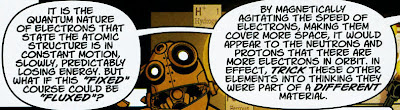
In any case, there's no "fixed" course; electrons don't travel in orbits like planets, but are confined to specific orbital clouds until energy enters or leaves the system (in which case the electrons may jump up into higher orbitals, or drop down into lower ones) or until a chemical reaction occurs (in which electrons may be shed to or shared by another atom). To ask if the course could be "fluxed" is nonsense.
Anyway, there's no way, so far as I know, to make an electron faster, or to make it cover more space. Again, in an orbital cloud electrons behave more as waves and probabilities rather than discrete particles. They don't "cover space" in any meaningful way, and even if they could, what Magnus suggests here would require that the nucleus somehow be capable of being fooled. Being entirely devoid of sentience, this is rather impossible.
To pare down what Magnus suggests here to the real science, he's suggesting that by increasing the speed of the electrons (whatever that means), he could fool the nucleus (whatever that means) into thinking there are more electrons in the cloud around it. This isn't nearly so groundbreaking as Magnus thinks; when an atom has more electrons in the cloud around it than it should (in order to remain electrically neutral), it becomes an anion, a negatively-charged ion. Usually, this entails the creation of some cation, a positively-charged ion, and the two form an ionic bond.
Chemistry 101 here, folks: a neutral Sodium atom has one electron in its outer electron shell (its valence shell). A neutral Chlorine atom has seven electrons in its valence shell. When the two combine, the sodium loses an electron, which the Chlorine gains. The result is a positively-charged sodium ion attracted electrically to a negatively-charged chlorine ion, and they form NaCl, or common table salt.
Now, it's entirely possible to have an ion outside of an ionic bond; when you dissolve salt crystals in water, the ionic bonds are broken by the polar water molecules. All Magnus is suggesting is the roundabout way toward ionizing elements, which, while it has some effect on the element's properties (usually resulting in greater stability), is not all that amazing, and doesn't require increasing electron speeds.
So, in fact, having more electrons doesn't "trick" the atoms into thinking they're part of a different material, it jst makes them less reactive. What determines the material properties of an element is the number of protons (and to a lesser degree, neutrons). Altering the number of electrons or neutrons really just makes the atom more or less stable or reactive; altering the number of protons changes the element entirely. The main difference between inert gas helium and metallic lithium is a single proton.
Which is where Magnus makes his next big blunder:
Now, there are two ways in which you can alter an atom's atomic weight: you can change the number of neutrons, or you can change the number of protons. When you change the number of neutrons, you create new isotopes of the element. Larger, heavier isotopes tend to be unstable, and thus tend to be radioactive. Different isotopes of an element may have different properties from the common isotope, but aside from some differences in reactivity and radioactivity, they're pretty similar.
Changing the number of protons, however, changes the element; an element is determined by its number of protons. Given the other content of Magnus's speech, this seems the most likely conclusion of what he's trying to say: using his crackpot hypothesis, you could transmute one element into another. Unfortunately, he thinks this process A) is novel and B) might somehow leave the element's "essence" intact, or somesuch. No, Will, you can't make lead behave like gold while still being lead; not by changing the atomic mass, anyway. The only way you'll make lead behave like gold is by subtracting three protons and making it into gold.
And this process is not a new one; it's called nuclear fusion. Yes, yes, I know you have some crazy scheme about tricking the nucleus, but that's insanity. What you're suggesting is no less than fusion and fission, the real-world equivalent of alchemical transmutation. All fusion is is the addition of protons to an atom's nucleus; it's going on in every star in the sky all the time. It's just a little difficult to get that sort of thing going in the laboratory.
Toward the end of the issue, Will is despondent that the scientists were more impressed by his robots than his ramblings. T.O. Morrow tells him that the mumbo-jumbo went over their heads; I tend to think Morrow just didn't have the heart to tell him that his grasp on basic scientific concepts is tenuous at best, and he really ought to stick to his strength: engineering.
Then, I got to page...okay, so the pages aren't numbered. I got past the iffy mad scientist-type science without bristling too much. I grumbled a little over Platinum's statement--"where an element can change its atomic structure as easily as a girl can change her shoes"--since technically to change the atomic structure of the element would turn it into a different element, or at least an isotope or ion, but figured there's enough ambiguity in the term "atomic structure" that she might be talking about spin number or orbitals or something. Then, I rammed headlong into this brick wall:

No, no, no. Oh man, I haven't even been able to finish the comic because of that line. Every time I try, my eyes just slide off the page; it's like the book's equipped with an SEP field. First, Newton had laws of Mechanics, not Thermodynamics. The law which became the Second Law of Thermodynamics was coined by Sadi Carnot. Second, the Second Law of Thermodynamics states that all closed systems tend to move toward greater entropy; an important distinction. While the universe as a whole is a closed system and thus the overall system of the universe is moving toward greater entropy, I still count this as a mistake; Magnus seems to suggest that no system can result in greater order, which is patently false. And "decay" is really a terrible term to use there, because it really doesn't describe the concept of entropy. Entropy is a measure of disorder, usually in the form of heat or otherwise useless energy.
It only gets worse from there. Oh, Will Magnus, what the hell is your doctorate in? Certainly not Quantum Physics, Chemistry, or Particle Physics. Were the Metal Men crafted by a mad dentist with delusions of grandeur?

In any case, there's no "fixed" course; electrons don't travel in orbits like planets, but are confined to specific orbital clouds until energy enters or leaves the system (in which case the electrons may jump up into higher orbitals, or drop down into lower ones) or until a chemical reaction occurs (in which electrons may be shed to or shared by another atom). To ask if the course could be "fluxed" is nonsense.
Anyway, there's no way, so far as I know, to make an electron faster, or to make it cover more space. Again, in an orbital cloud electrons behave more as waves and probabilities rather than discrete particles. They don't "cover space" in any meaningful way, and even if they could, what Magnus suggests here would require that the nucleus somehow be capable of being fooled. Being entirely devoid of sentience, this is rather impossible.
To pare down what Magnus suggests here to the real science, he's suggesting that by increasing the speed of the electrons (whatever that means), he could fool the nucleus (whatever that means) into thinking there are more electrons in the cloud around it. This isn't nearly so groundbreaking as Magnus thinks; when an atom has more electrons in the cloud around it than it should (in order to remain electrically neutral), it becomes an anion, a negatively-charged ion. Usually, this entails the creation of some cation, a positively-charged ion, and the two form an ionic bond.
Chemistry 101 here, folks: a neutral Sodium atom has one electron in its outer electron shell (its valence shell). A neutral Chlorine atom has seven electrons in its valence shell. When the two combine, the sodium loses an electron, which the Chlorine gains. The result is a positively-charged sodium ion attracted electrically to a negatively-charged chlorine ion, and they form NaCl, or common table salt.
Now, it's entirely possible to have an ion outside of an ionic bond; when you dissolve salt crystals in water, the ionic bonds are broken by the polar water molecules. All Magnus is suggesting is the roundabout way toward ionizing elements, which, while it has some effect on the element's properties (usually resulting in greater stability), is not all that amazing, and doesn't require increasing electron speeds.
So, in fact, having more electrons doesn't "trick" the atoms into thinking they're part of a different material, it jst makes them less reactive. What determines the material properties of an element is the number of protons (and to a lesser degree, neutrons). Altering the number of electrons or neutrons really just makes the atom more or less stable or reactive; altering the number of protons changes the element entirely. The main difference between inert gas helium and metallic lithium is a single proton.
Which is where Magnus makes his next big blunder:

Now, there are two ways in which you can alter an atom's atomic weight: you can change the number of neutrons, or you can change the number of protons. When you change the number of neutrons, you create new isotopes of the element. Larger, heavier isotopes tend to be unstable, and thus tend to be radioactive. Different isotopes of an element may have different properties from the common isotope, but aside from some differences in reactivity and radioactivity, they're pretty similar.
Changing the number of protons, however, changes the element; an element is determined by its number of protons. Given the other content of Magnus's speech, this seems the most likely conclusion of what he's trying to say: using his crackpot hypothesis, you could transmute one element into another. Unfortunately, he thinks this process A) is novel and B) might somehow leave the element's "essence" intact, or somesuch. No, Will, you can't make lead behave like gold while still being lead; not by changing the atomic mass, anyway. The only way you'll make lead behave like gold is by subtracting three protons and making it into gold.
And this process is not a new one; it's called nuclear fusion. Yes, yes, I know you have some crazy scheme about tricking the nucleus, but that's insanity. What you're suggesting is no less than fusion and fission, the real-world equivalent of alchemical transmutation. All fusion is is the addition of protons to an atom's nucleus; it's going on in every star in the sky all the time. It's just a little difficult to get that sort of thing going in the laboratory.
Toward the end of the issue, Will is despondent that the scientists were more impressed by his robots than his ramblings. T.O. Morrow tells him that the mumbo-jumbo went over their heads; I tend to think Morrow just didn't have the heart to tell him that his grasp on basic scientific concepts is tenuous at best, and he really ought to stick to his strength: engineering.
Subscribe to:
Posts (Atom)