Showing posts with label Cartoons. Show all posts

Saturday, January 24, 2026

Tuesday, July 29, 2025

The Terrible Destruction Plaguing Our Planet

The new Captain Planet and the Planeteers series...is bad.

I know it's only two issues in, and I'm going to give it a fair shake, at least until the end of the first arc here, but it's not looking good.

And look, let's not be unrealistic here. It's not entirely surprising that a reboot of Captain Planet would turn out bad. The original cartoon wasn't exactly Citizen Kane. It wasn't even Gargoyles. It was perhaps the most incredibly early-'90s series that could possibly have existed, down to a multicultural cast that looked like the Burger King Kids Club and an opening narration that had to be hastily redubbed after the fall of the Soviet Union. The series was Oops, All Very Special Episodes, which is honestly admirable to a degree, even if they approached every issue, from air pollution to The Troubles to AIDS with the exact same degree of didactic bluntness and simplistic liberal moralizing. If you'd asked me to lay money on which cartoons from this era were least likely to rate a revival in one form or another, Captain Planet, despite its popularity at the time and enduring legacy, would have landed somewhere between Wild West C.O.W. Boys of Moo Mesa and C.O.P.S. in my ranking.

Actually, it seems I was about right.

But also... now is precisely the right time for a Captain Planet revival. There's a lot about the show that didn't age well, but the core concept—that the world is in peril, and that the only real solution to that is for young people from around the world to band together and take on the polluters who are actively making things worse—is far more salient now than in 1990. At the time, the monstrous, one-dimensional villains clear-cutting forests for fun and polluting for profit seemed unrealistic, but now? 

Now there is an entire subculture dedicated to damaging your expensive truck so that it will produce more smoke in ways that make it less efficient, and blowing that smoke at electric cars and bicyclists. Now, the world's richest man built an artificial intelligence that he turned into a Nazi and wants his eugenic progeny to live on Mars while the rest of us die on the hollowed-out husk of Earth. Now, the President of the United States is a doddering germophobic rapist who appointed a Secretary of Health and Human Services who does not believe in germ theory and is actively dismantling the federal apparatus dedicated to tracking and fighting disease. The EPA just released an order to "make gas cans great again" reversing nearly 20 years of regulations designed to reduce emissions and danger to children. The entire tech industry is currently dedicated to replacing the entire working and creative class with a pathological liar machine that runs on drained aquifers and uses more power than entire countries. 

Verminous Skumm spreading panic about AIDS so he can take over the world seems entirely reasonable by comparison.

It would be so easy to do a new Captain Planet series, one that draws from the examples of Greta Thunberg, from the Water Protectors who stood against the Dakota Access Pipeline, from Little Miss Flint Mari Copeny who raised awareness about the Flint water crisis, and those are just the first three examples I could come up with off the top of my head. You could look to Extinction Rebellion, Just Stop Oil, Greenpeace, and other similar organizations; I may not always agree with the actions those groups take, but they would be easy fodder for stories about modern Planeteers. 

And that's without touching on issues of environmental justice, something any reasonable Captain Planet revival ought to be doing in the 21st century. One of the biggest problems with the original series is that its multicultural cast is a thin veneer pasted over a very white, liberal, America-centric view of the world. A Captain Planet who addresses how climate change hits the global south hardest, how communities that are already stressed by poverty and oppression become further marginalized as the temperatures and waters rise, how the capitalist drive for endless growth and cheap labor and resource extraction is ultimately the driving force behind all of this planetary degradation, is necessary to communicate concepts more complex than turning off the lights when you leave the room.

I take it back. It wouldn't be easy to do that Captain Planet series. It would require courage and research. It would likely require multiple writers and sensitivity readers. It would ruffle feathers. It would anger YouTubers. 

But it would at least be easy to tell a story there, one that meets the moment, one that has a solid foundation, one that feels timely and relevant. 

Instead, there's what David Pepose and Eman Casallos have chosen to do in Dynamite's Captain Planet and the Planeteers, which is to write a book that feels ashamed of every aspect of its source material. It's got all the hallmarks. Looten Plunder? That name's too silly, like "Victor Von Doom." Gotta change it, now he's "Lucian Plunder" and "Lootin'" is just what the protesters call him. While the original series was a goofy Saturday morning cartoon, this series is serious and grown-up and violent. The first issue kicks off with Plunder's paramilitary goons hunting Gaia with assault rifles from helicopters, and the second issue starts with her in restraints. Linka is a Pussy Riot-styled rocker who fights cops, and some fake cops kidnap Gi and Kwame when they arrive in New York City. 

Oh, and don't you dare think about making all the old jokes about this Captain Planet series. Because Ma-Ti, he's not the useless kid who talks to animals anymore. No, he's a deadly eco-terrorist who threatens loggers with jaguars. And Captain Planet himself? Well, if you ever thought that his tight midriff top and briefs ensemble with a mullet was a threat to your masculinity, don't worry, this Captain Planet is butch as hell, with a beard and way more of that blue skin covered, so you can rest assured in your mostly unassaulted heterosexuality. 

Panel from the end of Captain Planet and the Planeteers #2, showing Captain Planet in his new costume, standing in front of the Planeteers. The costume has a full shirt, with cutouts that expose his lats and biceps, and something like skintight chaps that blend into his boots. His dialogue bubbles read "And by your powers combined...I am Captain Planet! So if you people want to hurt these kids...you'll have to get through me first."

Everything about the aesthetics and execution of this book feels twenty years out of date, like it was printed in the same "what, were you expecting yellow spandex?" swaggering, irony-poisoned era that gave us Transformers with testicles and sex slave ThunderCats. 

That feeling extends to the guiding politics of the series, which feel like some kind of Bush-era, South Park-tinted centrist cynicism. Kwame is a former soccer star whose career ended due to an injury, seeking to recapture his glory days. Linka is not just an anarchist punk rocker, but a child of immense privilege, whose activism is framed as petulant teenage rebellion against her wealthy father. Wheeler is a Union auto worker whose carelessness with his new power ring causes his plant to burn down, amidst layoffs and protests driven by green EV initiatives. And while they've added a smidge of additional diversity by making Gi textually queer, they've also turned Wheeler's womanizing dialogue up to eleven. The overall effect feels like sneering at the idea of people sincerely fighting for the environment; instead, they're mostly deeply flawed and compromised, much like the environmental protesters we're shown in a couple of occasions. Our villain doesn't provide much contrast. While Plunder is clearly bad, he's not bad in a realistic way. He wants Gaia's magic power for himself, and his goons have robotic exo-suits. The only time this comic feels genuine is when cops apprehend our two heroic immigrants for no reason at JFK International Airport, but even they turn out to be fake cops, presumably to give some plausible deniability to all those readers with blue line flags on their SUVs. 

I don't think this cynical approach can work for Captain Planet. The original series was earnest to a fault, and I think the only way you can make Captain Planet work for a more grown-up, sophisticated audience is to lean right into that earnestness by having him tackle all the same problems that the original series tackled, and then some, but with added complexity and nuance. Not to demean our heroes or to humanize our villains, but to illustrate the realities of the world around them. There's no need for Wheeler to be sexist or for Ma-Ti to be violent, any more than there's need for Looten Plunder to be driven by something other than greed and lust for power. What's needed is a story that explores how the Looten Plunders of the world operate, and what a team of idealists could do if they were given the power to take them down. We can roll our eyes and suspend some disbelief when Superman says that it's not his place to step in and reverse climate change or dismantle capitalism. Captain Planet doesn't have an excuse. 

Yesterday, a person with a high-powered rifle murdered an executive of Blackstone (among other people), an investment firm whose holdings have been involved in logging the Amazon rainforest, making children work in slaughterhouses, and collaborating with ICE, and that's just what's in the Wikipedia controversies section. Now, I'm not suggesting that Captain Planet and the Planeteers should be about five teens and a glittering Pride float dancer gleefully using elemental powers to Luigi their way through the Forbes billionaire list.

But that would be a better book than this one.

Saturday, March 05, 2022

My Revelations

I want to talk about "Masters of the Universe: Revelation." But I can't. Not yet. Because as I made my way through Part 2 of the series a few weeks months ago, I figured out why it wasn't quite clicking with me. And in order to talk about that, I'm going to have to tell a story. 

Way back in 1998, my eighth grade English/Language Arts teacher, the late great Mr. McKissick, assigned us a project: Write a pitch for a TV series. I'm sure it will surprise you to learn that I was just as much of a dork-ass nerd at 14 as I am now, so naturally my pitch was...
The words "The Power of GRAYSKULL" written in way too many Windows 95 fonts.

"The Power of Grayskull," a weekly hour-long animated series that would serve as a sequel to the original He-Man and She-Ra cartoons, while also introducing the adventures of He-Ro, the hero of Preternia, who fought King Hiss long before the time of He-Man. "The Power of Grayskull" was designed as a kind of anthology series, where each hour-long block would include two to three shorter stories following one of the three main casts, with the Sorceress and the Book of Living Spells as a framing device.

It's worth remembering that in 1998, reviving a cancelled cartoon felt considerably more outlandish than it does today. There were a handful of soft-sequel reboots like "Beast Wars" and "Extreme Ghostbusters" (and "The New Adventures of He-Man" a few years earlier), but they rarely had much connection to their predecessors, for obvious reasons. 

To cast this series, I relied heavily on the original casts, with John Erwin and Melendy Britt reprising their roles as He-Man and She-Ra, respectively, and I filled in the rest of the roles as best I could with the information available on the pre-IMDb Internet. 

But not every character I wanted to use had a consistent voice actor in the original series, and not every voice actor was still around (RIP, Linda Gary). So to flesh out the cast, I looked to other prominent voice actors (i.e., the cast of "Beast Wars"). And when I exhausted that resource, I pulled a "Gargoyles" and filled in the rest with actors from "Star Trek."

In the end, I think I made some ambitious choices (Leonard Nimoy as King Hiss? Sure!), some inspired choices (Nana Visitor and Dana Delaney as Evil-Lyn and Teela? Sounds good!), some choices so on-the-nose that even a Wizard Magazine Casting Call would consider them lazy (Brent Spiner as Roboto? Didn't have to think too hard about that one, did you?), and some really, really ill-considered choices (Jennifer "Kes" Lien as the Sorceress? Oh honey, no). 

Oh! And of course I included Mark Hamill...as Tung Lashor and Twistoid.

I even started writing a pilot script, which I guess would have been one of my earliest pieces of He-Man fanfic. It's clearly an attempt to be a more mature take on the characters, beginning on the eve of Prince Adam and Princess Adora's 25th birthday, with Adora and her OTP Sea Hawk expecting twins. Adam and Teela are in a romantic relationship, and Skeletor returns after a long absence to an Evil-Lyn who is infatuated with him since he magically transformed her hate into love. 

So. Spoilers for "Masters of the Universe: Revelation" follow.

Wednesday, August 11, 2021

Guttor #5 - You Can't Do That on Television!


As someone whose main connection to the Masters of the Universe franchise is through the original cartoon, it was a breath of fresh air to be able to crack this first Marvel/Star issue and read dialogue that felt like it was in those familiar character voices. It's not completely consistent on that front, but the characters feel right to me in a way they didn't in the earlier stories. 

But, like the DC Comics, this series exists in its own strange liminal space. Sure, it draws mostly from the cartoons in terms of characterization and design, but occasionally a location or a character looks like the toy version instead of the animated version. 

Toy Snake Mountain...

...and cartoon Eternos...

...and a kind of hybrid Grayskull, with the toy playset's handle visible.

This series started in 1986, while new episodes of He-Man and the Masters of the Universe had ceased production the year before, and instead She-Ra: Princess of Power was the spotlight series for new toys in the sibling lines. As a result, the new characters introduced in this Filmation-inspired setting—which is to say, the new toys that get a spotlight—are ones that only showed up on She-Ra's cartoon, if at all. Which results in strange things like stories that reference Etheria, She-Ra's adopted homeworld, but not the Princess of Power herself.

And, to be clear, that's how it was in the toy pack-in minicomics as well. Hordak and the Horde come from Etheria, but any other denizens of that world are unmentioned. That’s one of several reasons why this series feels like extended versions of the minicomics—right down to getting more creative with the storytelling and continuity just before they end. 

The consequence is that characters like Hordak, Stonedar, and Rokkon get three separate introduction stories between the Marvel/Star comics, the minicomics, and their spotlight episode of She-Ra. Meanwhile, Extendar’s appearance in these pages feels like a follow-up to his minicomic origin. 

Basically, if you think Donna Troy and Hawkman are complicated, try making sense out of He-Man’s continuity.

These first issues follow a story structure that would be familiar to viewers of the cartoon: there’s a scene early on with Prince Adam and Orko, where Orko demonstrates some childish character flaw, the inciting incident occurs, and then the resolution requires Orko to acknowledge and overcome his mistakes. With that in mind, these should go fairly quickly. 


Issue #1 introduces us to Hordak, and does a pretty solid job of making Hordak seem like a serious threat—Skeletor is afraid of him, and decides he needs to break into Castle Grayskull so he can increase his power to keep Hordak away. To do this, he breaks out the Terror Claws!


Which are considerably less impressive than their toy counterpart. 


Though using them to basically try to dig through the wall of Grayskull like a skull-faced mole certainly is an interesting application of the accessory. 


Meanwhile, Adam and Teela are training, and this is one of those instances where Adam is the one being irresponsible. Orko’s magic goes wrong, endangering Adam when he tried to help, but there’s no time to dwell on that because the Sorceress shows up in her guise as Zoar to summon He-Man. 


One thing that really stands out about Ron Wilson’s art in these issues is the transformation sequences; being freed from the confines of Filmation’s budget restrictions means we get to see new variations on the transformation, and every one of them is stunning. 


He-Man, Battle Cat, and Orko race to stop Skeletor, and the interaction is actually pretty good, with Skeletor treating He-Man as an annoyance rather than a threat. For once, his plan to take over Castle Grayskull isn’t so he can defeat He-Man, which changes the dynamic. 


Skeletor manages to capture Zoar, and Orko uses a spell to summon additional help, which turns out to be exactly the boost Hordak needs to break through Skeletor’s protective magic. 


The Horde attacks He-Man and Skeletor, which puts them both in the unfortunate position of being on the same side.


Orko eventually puts his spell from earlier to better use. 

This is notable, because the structure of subsequent issues will make “Orko learns a lesson” pretty central to each plot, but it doesn’t quite gel here in that same way. We come back to his original problem here and at the end of the story, but not in a way that feels like a problem’s been resolved. 


Skeletor challenges Hordak to one-on-one combat, so Hordak teleports everyone else to the prison in the Fright Zone on Etheria, where no one has ever gotten out alive! But apparently no one had thought to just cut through the wooden bars of the prison cell before.

It’s implied that maybe the further traps our heroes encounter are the really deadly threats, but they’re all dispatched fairly quickly, and then Orko teleports them back to Eternia. 

Skeletor and Hordak battle…


…but Hordak gets the upper hand, until our heroes—including a cavalry in the form of Man-at-Arms and Teela—arrive to turn the tides. 


Hordak runs away, and Skeletor follows suit, but we haven’t seen the last of them. 


Next!

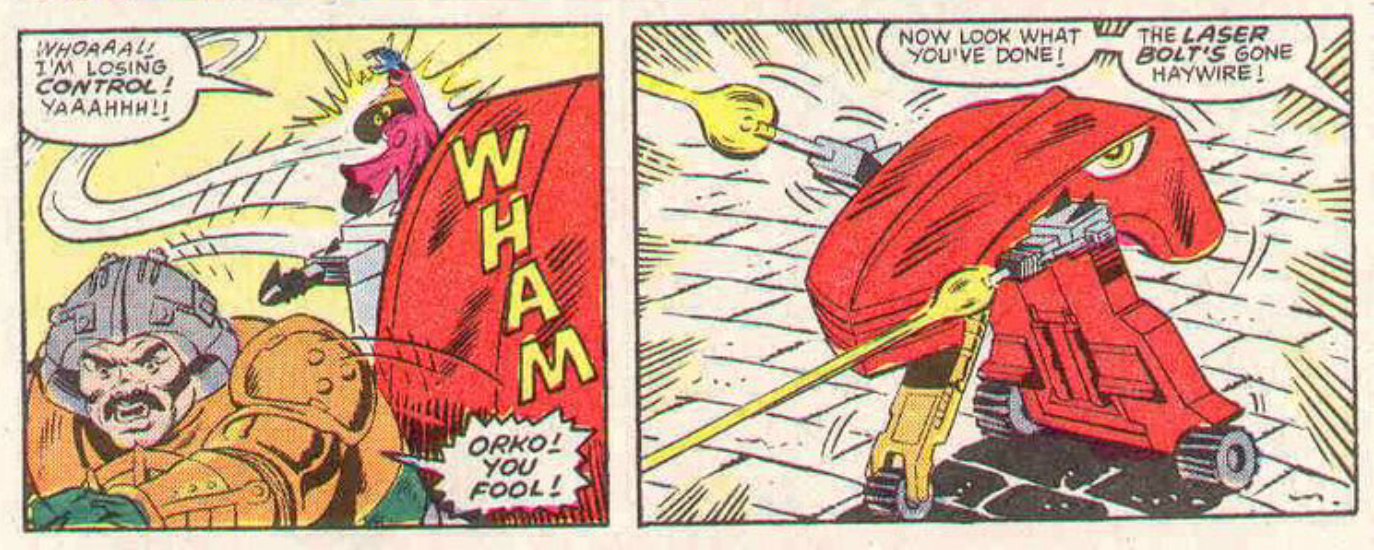
In issue #2, Orko screws around and causes the Laser Bolt (one of my personal favorite He-Man vehicles) to go haywire, which shoots a meteor out of the sky. Adam, Cringer, and Orko investigate, encountering the Evil Meteorbs for the first time.


I like Gore-illa's little pirouette.

It is wild to me that two entirely different toy companies decided in 1986 that the best way to compete with Transformers was to introduce figures that turned into rocks or eggs. Were the Rock Lords the direct inspiration for that scene in "Big" where they have a skyscraper Transformer? Both the Meteorbs and Rock Lords use Bandai figures, but He-Man's Rock Warriors are their own thing. 

And the thing that Orko shot out of the sky is secretly the Rock Warrior Rokkon, a real "4:59 on Friday" name. 


Turns out Rokkon, like Orko, just loves to fool around and have fun, and that's what got him hurt. He-Man sends the Rock Warriors and the Heroic Meteorbs to a rendezvous at the Palace, but Skeletor and the Evil Meteorbs are invisibly lying in wait, and attack the newcomers. They retaliate, thinking the attack came from the palace, and Man-at-Arms re-retaliates, escalating things until He-Man arrives. Neither side will relent until Rokkon and Orko use their combined abilities to reveal the actual threat, uniting the heroes against a common foe. 

It's at this point that I should probably point out that all these rock creatures come from a planet they call Granite, which I have to imagine was only in order to make this joke:


The villains are defeated, and we get a nice sitcom ending. 


Issue #3, inexplicably titled "The Garden of Evil," begins with Adam and Orko sparring. Orko expresses jealousy about the Power Sword, especially after Adam is able to use it to turn his magic back on him. 


Meanwhile, Hordak is assembling an army of robotic Horde Troopers to travel to Eternia and bring back He-Man. Instead, they capture Adam, which leads to a very interesting scene that I don't think happens elsewhere in the mythos:


So, first, we have direct confirmation that despite appearing similar to the viewers, He-Man and Adam look nothing alike. But we also have confirmation that He-Man's sword is distinctive enough to be recognized by Hordak.

Back in the day, I proposed two different headcanons about these issues, the first somewhat tongue-in-cheek, the second very serious. For the first, I suggested that cultures on Eternia and Etheria both lacked commonplace stories about characters with secret identities, or even characters in disguise. For whatever reason, it just wasn't part of their shared story traditions. This would help to explain why every disguise on either world, no matter how flimsy, always seemed to be almost completely effective. It would also fit nicely with my belief that Queen Marlena definitely knew that Adam and He-Man were the same person, since she's from Earth where we are all about people in disguise.

The more serious theory is that the reason no one notices that He-Man and Prince Adam have the same sword is because the Sword of Power is so plain, like the Holy Grail in "Indiana Jones and the Last Crusade." While we don't see any swords exactly like He-Man's in the series, the basic sword design we frequently see is similar enough that you could understand why someone would mistake the two, especially if they've only seen it in fast-paced battle situations. 

The Sword of Power

Similar to, but legally distinct from, the Sword of Power

Hordak tries to take the sword, but it defends itself, so he sends Adam to the Slime Pit, a torture chamber where...eventually he'll be covered in slime!


Like, the slime isn't poisonous or anything as far as I can tell. Adam just gets to experience what it's like to be to be on the Nickelodeon Kids Choice Awards. For comparison, here's what happens when He-Man gets slimed in the mini-comic:


That red-eyed mind-controlled He-Zombie is burned into my brain. According to the footnote in the Mini-Comic Collection, this was the intent for victims of the Slime Pit. 

Meanwhile, only Cringer and Orko know what's happened to Adam, but Orko knows that they don't need help to save him. They travel to Etheria and find Adam trapped, but Adam tries to warn Orko not to touch the sword. 


Orko, though, has other ideas...


...but instead he decides that his magic is good enough, and levitates the sword over to Adam, who gives very little thought to his secret identity. 


Or Cringer's, for that matter. 


Not that it matters, because Hordak is kind of an idiot. He shows off a couple of additional toys, but there aren't enough pages left, so Orko teleports our heroes back to Eternia. He-Man compliments Orko on making a mature decision, and the story ends. 


To sum up these first issues, I think the strong focus on spotlighting several specific toys each issue—the Terror Claws, Horde members, and Fright Zone in #1; the Rock Warriors, Meteorbs, and Laser Bolt in #2, and Hurricane Hordak, the Mantisaur, the Slime Pit, and Horde Troopers in #3—is a big part of what makes these stories feel more like the mini-comics than the cartoon. While the cartoon certainly existed to sell toys, most episodes were less transparent about it, or at least wove them into the plot more naturally. Some of that is down to the amount of space for storytelling, some of that is from animation budget restrictions that limited how many new designs a given story could have, but I think it ended up working in the show's favor.

Next time, issues #4-6!

Tuesday, July 20, 2021

Guttor #1 - Prototypes

A new He-Man series premieres on Netflix this week, and I'm cautiously optimistic about it, despite being pretty disappointed by the first issue of the new prequel series. But that comic got me thinking about the history of He-Man comics, and how despite being published by six different American companies—DC, Marvel/Star, Image, CrossGen, MV Creations, and now Dark Horse—there aren't actually that many He-Man comics. Or at least, there aren't that many if we exclude the minicomics, the newspaper strips, the magazines, and the foreign stuff.

And, well, while I've been a life-long fan of the Masters of the Universe properties and of comic books, I haven't actually read many of the MOTU comics. I've read the DC miniseries before, but I've never had all of the Star comics issues, and I fell off the MV Creations series around the same time I fell off the 200X cartoon (that Snake Armor just didn't do it for me). I read the first of the recent DC Comics minis, and I read Masters of the Multiverse, which was pretty great. 

So I've decided to read them all, which should prove to be a much less onerous undertaking than reading Mark Gruenwald's Captain America run, which I am also doing. And, since I am perpetually stuck in the past, I'm going to write about it here, in a series I'm going to call... 

A Masters of the Universe toy cardback that reads "GUTTOR: Heroic master of comics" and "Figure substitutes SPACE for TIME!"

To kick things off, I read the first four minicomics—which, to be clear, are not comics but illustrated prose. I won't be reading all the minicomics for this series, but I think these represent an interesting time, because it's before any of the He-Man concepts had really been fleshed out. These extremely rough stories became the foundation of the Masters of the Universe Series Bible, which I also read for this project. 

In my head, there's basically three eras of early He-Man: before the Series Bible existed, the transitional period that borrows from these original stories and the Series Bible, and the stuff that takes its cues from the cartoon. I'm taking a look at the first chunk today, as well as the Series Bible, because just as it's interesting to see how the Superman origin has changed over the decades, it's interesting to see He-Man before he was He-Man. 

The first four minicomics-storybooks—He-Man and the Power Sword, King of Castle Grayskull, Battle in the Clouds, and The Vengeance of Skeletor—were written by Donald F. Glut and illustrated by Alfredo Alcala. Alcala is very probably the first comic book artist I knew by name, and it's because of his work on the MOTU minicomics. I was born in '83, so I didn't have access to these stories as a kid, but Alcala's art on some of the other minicomics, like Siege of Avion and Dragon's Gift, always stood out. His art was so much more detailed and grotesque—and to a kid, kind of terrifying—compared to the other frequent minicomics artists like Larry Houston and Bruce Timm. 

As someone whose main entry point into the franchise was the FILMation cartoon, Alcala's art always seemed weirdly off-model. But looking at these booklets, Alcala may be the only artist who's ever really captured the ludicrous musculature of the He-Man action figure on the page. His He-Man is squat and thick, a mass of muscles who continually loses most of what passes for his clothing. And his Skeletor is monstrous, with lurid red points in his eye sockets and too many teeth. 


His action sequences are dynamic, with great physicality that reminds me of those great Sal Buscema punches. And the detail he puts into even minor character designs or environments is shocking for booklets that were basically wallet-sized.


The art is often good enough to obscure the almost complete lack of continuity, not just from story to story, but from page to page and even between the art and the text. Teela and the Sorceress bear the brunt of the story-to-story lack of continuity, owing to the decision to try to get two characters out of one figure, a problem that extends into the next wave of minicomics and MOTU's answer to "Who is Donna Troy?"

But even within stories, Teela's hairstyle changes, He-Man loses his vest without acknowledgement, and there are other fairly simple errors that you wouldn't expect from an experienced artist like Alcala. So I would be fascinated to hear how these were put together. Based on the interviews in "The Toys That Made Us," I would guess that the turnaround time was pretty tight, but I wonder if something close to Marvel Style was going on, where Alcala worked from Glut's rough outline and Glut filled in the detailed text afterward. It would help to explain some of the spots where Glut seems to be trying to fill in gaps between images, but it wouldn't really account for all the places where Glut's writing seems to be at odds with the art.
Maybe snow is just yellow on Eternia.

Overall, the story is pretty simple, stitching together a variety of sword and sorcery tropes with the established toys. He-Man is an extremely strong barbarian who leaves his tribe to fight evil. He rescues a powerful Sorceress who gives him weapons, including an axe, a shield, and a harness, which were designed by technologically-advanced ancients. His allies include Battle Cat, a fierce giant tiger; Man-at-Arms, a hero from a society who keep and develop advanced weapons and vehicles; Stratos, the bird-man (who initially is shown working for Skeletor, though not named); and Teela, a beautiful warrior-goddess who becomes the protector of Castle Grayskull. Grayskull is a fortress full of powerful magic, dangerous traps, and advanced technology, overseen by a skull-faced spirit. 

Skeletor is a powerful wizard from another dimension who seeks the two halves of the Power Sword in order to take the power of Grayskull for himself. His ultimate goal is to open a portal back to his home and bring the rest of his people through. Skeletor is aided by his henchmen Beast-Man and Mer-Man, the latter of whom has ambitions of his own. 

What struck me about reading this now is how similar Skeletor's plan here is to Hordak's plan in She-Ra and the Princesses of Power, down to there being a whole horde of people identical to the villain, just waiting in some other dimension.

Three of the four stories have the same plot structure: Skeletor seeks the Sword and makes an attack on Castle Grayskull, followed by a battle in which He-Man seems to be defeated, but through the help of his friends he's able to recover and they send Skeletor packing. The only one that deviates significantly from this is Battle in the Clouds, where Mer-Man defeats He-Man and takes his strength-enhancing harness, so He-Man must enlist the help of Man-at-Arms to retrieve it and his other weapons. This story just...ends, with He-Man describing the things he needs to do to resolve the plot now that he's got his vehicle back. It's a shame, because otherwise this is the most interesting of the books. 

Beyond the plot, the stories...well, again, I suspect that there wasn't a lot of time for second drafts or editing. They tend to read like a small child who loves Conan telling a story with a list of SEO keywords peppered in. He-Man has a harness that generates a force field, but he accidentally shuts it off when he gets shot by a ray gun. But he has another harness, which looks exactly the same, which gives him super strength. Mer-Man takes his super-strength harness so he can fight Skeletor but then he never uses it or fights Skeletor and he takes the Battle Ram which can fly and has lasers but can also teleport, and He-Man has to find Man-at-Arms to take the Wind Raider which can fly up the mountain where Teela is but Mer-Man attacks them and they smash head-on and Man-at-Arms is thrown from the Wind Raider but then Stratos shows up and whoops we ran out of pages. 

There's a lot of what you'd expect from stories designed to sell toys, with descriptions of how the action features of the toys work, how the characters relate to each other, what the main conflicts are, so kids at home have a framework to build their play sessions on. But there's also descriptions of the kinds of things you could pretend the characters are doing, like Stratos shooting lasers from his hands or Mer-Man's sword firing blasts of seawater. It's strange, but in an interesting way. 

Then we come to the Series Bible, written by Michael Halperin. What's surprising to me is how much of the document is basically like a pilot episode that the animated series never had, detailing much of Eternia's backstory in prose. Here is where we introduce the idea that He-Man is secretly Prince Adam, son of Eternia's King Randor and Queen Marlena, and Battle Cat is secretly the cowardly talking tiger Cringer. We learn that Marlena was originally an astronaut from Earth, and that Teela is secretly the daughter of the Sorceress, who was adopted by Man-at-Arms. The characters who would become Orko, Webstor, Jitsu, and Kobra Khan are all introduced here as well. 

And then there are the ideas introduced here that never took hold, such as Skeletor's base being on Infinita, a counter-Eternia orbiting on the other side of its sun, or Beast-Man, Evil-Lyn, and Tri-Klops originally being members of Marlena's shuttle crew (Biff Beastman, Evelyn Powers, and Dr. T. E. Scope, respectively), transformed by Infinita's dark magic. Mer-Man and Trap Jaw are mentioned, but are not part of the shared origin for some reason. 

The Bible also jettisons a lot of what little we learned from the four storybooks. The Power Sword is no longer the key to Castle Grayskull, nor is it broken into two pieces. He-Man is not a barbarian with a hi-tech harness, but a carousing Prince who can transform into a mythical hero with a magic phrase. Teela is not the guardian of Castle Grayskull but the Captain of the Royal Guard, and it's the Sorceress who protects Grayskull's secrets. And Eternia itself, which in those first four stories often seems like a barren place inhabited by a handful of named action figures, becomes a fleshed-out setting with different landmasses and environments. 

And it's those changes from the earliest media that make the next section so interesting. DC's MOTU Comics, including the second wave of minicomics (or, technically, the first wave of minicomics since the previous four weren't actually comics), exist in this weird transitional state, borrowing both from the Series Bible and these early concepts to create something that's not quite as rough as those first four stories, but not quite as polished and kid-friendly as the cartoon. 

Oh, and Superman shows up. Check it out next time!