Showing posts with label Jesus Christ. Show all posts

Thursday, June 14, 2007

I'm tired of General Zod

Kneel before--ah, I give up.General Zod is not a good Superman villain.

People have such fond memories of "Superman II," of how awesome Terence Stamp was as the villainous Kryptonian mastermind, of how bone-chillingly cool it was to hear him spit out those three infamous words, "Kneel before Zod."

People also think that Tim Burton's "Batman" was the pinnacle of celluloid superheroics. If people would actually go back and watch those movies, they'd find just how unreliable memory can be, particularly when blinded by the primary-colored glare of superheroes on screen.

The line "Kneel before Zod" has a lot of cool potential. Jay proved that in "Mallrats." It's just a shame that only Jay has ever used that potential. It's not that Terence Stamp is a bad actor, he was just working with what the script and director gave him, which was a catchphrase. I don't think a scene goes by where he doesn't say "kneel before Zod" or "kneel before me." Used once, it's "Luke, I am your father." Used twice, it's "Snakes. Why'd it have to be snakes?" Used as often as Zod uses it, it becomes "Yeah, that's the ticket!" or "Simmer down now." A cool line becomes watered down into a lame catchphrase.

So people remember Zod as a badass, when he was actually kind of lame and one-dimensional; I think people recall the cold, calculating, menacing villain from the first few minutes of "Superman: The Movie" as if he retained that sort of power throughout the sequel. I wish he had.

Now, the Donner Cut of "Superman II" remedies quite a lot of this. Zod doesn't overuse the phrase, and comes across as a stronger villain because of it. But until a year ago, the only person who'd ever seen the Donner Cut was Richard Donner, and yet Zod's reputation as a menacing, intimidating villain, rather than an impotent pull-string doll, has persisted for twenty years, against all logic.

In the post-Crisis universe, especially in recent years, it seems like every writer with a major storyline has tried their hand at recreating Zod. There was pocket universe Zod, Phantom Zone fake Krypton Zod, confusing Pokolistan Zod, and even more confusing Phantom Zone "For Tomorrow" Zod. More recently, Busiek and Johns mentioned Admiral Dru-Zod in "Up, Up, and Away," and now Donner and Johns have introduced Zod and his cronies yet again (but we'll get to those later). I guess there's been a Zod in "Smallville," as well, but since I'm still somewhere in the last episodes of the Fourth Season, I haven't quite run into him, and don't particularly care. Each of our previous Zods had some potential for coolness, each one got their requisite "kneel before Zod!" speech bubble, each one turned out lame. I personally thought that Pokolistan Zod was pretty cool, but they decided to kill him rather than have an evil superpowered monarch running around in the DCU. I guess that would horn in on Black Adam's schtick.

Three dead Zods, one left floating out in the Phantom Zone, and who knows which ones are still in continuity? Why is every Zod, at least in the modern era, a miserable failure?

It's a combination of factors, really. The first is feasibility: a murderous villain with the exact same powers as Superman is too dangerous to keep around, too hard to write stories about. You know, it's the same complaint that you hear about Superman so often, except with a little more reality behind it. Superman is among the most powerful people on the planet. He has taken over the world on at least one in-continuity occasion. What would stop an evil Superman from doing it himself? How many people would he kill? What could the DCU do to stop him? As cool as the idea is, it just defies a little too much logic. We saw what happened with this scenario in the four-color abortion that was "World War III," and even there Black Adam was bound by some sense of honor and morality, eclipsed though it was by his rage. Imagine if instead of anger, he'd gone about his task with cold ruthlessness and calculating intelligence. It'd make for a (potentially) fantastic story, but not for an ongoing character. They'd have to depower him (as they did in "Superman II" and with Black Adam in "52"), kill him (as they did with Pokolistan Zod) or imprison him where he can't escape...for now (as they did with the Phantom Zone criminals, Cyborg Superman repeatedly, Doomsday repeatedly, and Superboy-Prime). Essentially, we'd end up with a villain that you can only pull out every once in awhile, who is super-powerful and causes a major universe-wide event every time he escapes. Such a villain either becomes tedious (because every takedown ends up being roughly the same) or watered-down to the point of uselessness (see: Cyborg Superman, Doomsday).

This isn't to say that you can't have powerful villains. After all, Zod's whole point is that he's a dark mirror of Superman, with the same powers and an evil streak. We've got that character in Bizarro, with one caveat: Bizarro's lack of intellect and backwards thought process are enough of a hindrance, and his intentions usually aren't so much "evil" as "poorly-conceived," that he doesn't become difficult to accept as a character. We recognize that there are reasons why he hasn't made a bid for world domination, why he doesn't rampage through Metropolis on a mindless killing spree (or at least, he didn't until Johns and Donner got hold of him). Such reasons don't exist in Zod. The super-powerful evil characters tend to require some obvious flaw or defining character trait that keeps them from being unbelievable; Doomsday was mindless, Cyborg was enraged and vengeful and relatively fragile, Black Adam has a strict code of honor, Darkseid doesn't concern himself with the petty affairs of mortals, etc. Zod, given his powers and intellect, given his defining drive to kill Superman and rule the universe, given his ruthless efficiency and his complete lack of ethics, has no such restrictions on his behavior, and our disbelief-suspenders break under his weight.

The second problem is Superman's rogues gallery. There's Lex Luthor, Brainiac, Metallo, the Parasite, Bizarro, Kryptonite Man, Mr. Mxyzptlk, uh...Toyman, Prankster, Silver Banshee...Live Wire...Bloodsport...and we're already into C-List territory. Superman's list of enemies has always been kind of anemic if you omit the Fourth World characters. There's the mental villains (Luthor, Brainiac) the physical villains (Metallo, Parasite), the magical villains (Silver Banshee), and few (if any) who can provide both a mental and physical challenge to Superman. Sure, Luthor keeps pulling out the armor, but when's the last time Superman and Brainiac got into a fist-fight? When's the last time Metallo displayed something like intelligence? Mr. Mxyzptlk comes close, but he can only show up every 90 days, and he lacks ambitions beyond screwing with Superman. These days, Mxy's not even really malicious (and don't get me wrong here, I hope the Rucka characterization sticks, because it's the best development Mxy has seen since the Simonson/Bogdanove days).
So, the writers exhaust their story options with the A- through D-listers in the first few issues, consider reviving Intergang, consider a trip to Apokolips, and eventually settle on General Zod. Why not? He's a smart guy, but with the same powers as Superman! How can you lose?

Then, inevitably, they do lose, because bringing in an iteration of Zod paints the story into a corner. He has to die, get depowered, or get banished to the Phantom Zone, or to some equally out-of-the-way prison, all of which has been done before, recently and repeatedly. And then you're left with trudging out the A-list villains again and repeating the cycle.

The other problem is nostalgia. Nostalgia has built General Zod into not only a cool character, a badass, but also a major part of Superman's rogues gallery. Before "Superman II," he was a footnote in Superman history. Even afterward, thanks to Byrne's purging of the Kryptonians, Zod didn't show up until Superman killed him, and then stayed a ghost and a memory for years after. Recently, for whatever reason, people have started seeing Zod as an essential part of the Superman mythos, and a character that every writer has to put his spin on. Maybe it's because of the fact that, at any given time, there is no Zod running around active in the DCU (since they always end up killed or Phantom-Zoned), or because of the limited nature of Superman's villains. Maybe it's because the Cyborg Superman has been gone for several years, except for the recent appearances in Green Lantern.

There's a thought. Pre-Crisis, there was a steady stream of Phantom Zone villains to menace the Man of Steel. Post-Crisis we had an early Zod, whose visage haunted Clark for a few years. Then Cyborg hit the scene and became the evil Superman du jour. Cyborg was another character who they set up as a "big story" villain, but who invariably had to be taken care of in a relatively permanent fashion at the end of the story. He was destroyed in Engine City, he was tossed into a black hole, he was merged with the Source Wall, he was trapped in the Elite's spaceship and dropped to the bottom of the ocean...I'm blanking on how they 'killed' him at the end of "Superman/Doomsday: Hunter/Prey." It's a shame that so many of their fights have gone the same way, because he's a villain with a lot of potential. They've never really done much with the fact that his fleshy parts have Superman's DNA, and they've barely examined the extent of his ability to control and inhabit electronics. The best story I can remember featuring him, except for the whole Reign of the Supermen saga, was one where he disguised himself and started teaching art at some high school. No supervillainy, except that he told the students how much he disliked Superman, and more or less why. Then, of course, big blue busts in and 'rescues' the children, looking more than a little like the villain that Henshaw made him out to be.

Anyway, at least Henshaw always had an out. He could be imprisoned or whatever, sure, but his ability to transfer his consciousness to electronic devices allowed him a perfect escape clause. One that the Zods simply don't have. We can accept "my consciousness hitched a ride on a passing space cruiser" a lot more easily than "a black hole/nuclear explosion/transdimensional warp breached the Phantom Zone, and we just happened to be there!" Who needed Zod when you had the Cyborg?

But, the Cyborg got overused to the point of severe lameness. By the time he showed up in "Ending Battle" he was a joke, and was dispatched without fanfare. With Cyborg out of the picture, writers turned to the next best option for a dark mirror of Superman: Zod. And so we ended up with a long and meandering plot about the superpowered ruler of Pokolistan, which ended in a weird and anticlimactic battle and the revelation that the Metagene is powered by the yellow sun, which has been mercifully forgotten.

So, when it comes down to it, is there anything salvageable about General Zod? I'll admit, I had high hopes when the newest version showed up. See, one thing I like about Zod is that he fits in well with the Superman-as-Christ-Figure Monomyth model. See, Zod is only Superman's enemy by default; his real beef is with Jor-El. The things that seem to stay fairly consistent between versions of the Kryptonian General Zod are the fact that he was a high-ranking officer--perhaps even the highest-ranking leader of the Kryptonian military--and he led a rebellion against the ruling body of Krypton, hoping to usurp the council's rule. With his rebellion thwarted, Zod and his cohorts are punished, condemned by Jor-El to eternal living death in a realm that he discovered, that he essentially made, the Phantom Zone. Once Zod escapes, he finds that he is unable to exact his revenge upon Jor-El or to seek the thrones of Krypton, so the sins of the father are visited instead upon the Last Son.

So, if I haven't made it obvious enough, Zod is a Lucifer figure in our little allegory here. Lucifer, the left hand of God, rallies a third of the angels to do battle with God and usurp his position. God condemns Lucifer and his angels to Hell for eternity. Eventually Lucifer ends up trying to tempt Christ in the desert, offering him the world. Following this model, the perfect Zod story would feature the General offering Kal-El a space in his dominated world, and Kal-El naturally resisting.

And now, we've got a return of our Lucifer figure, and this time he has a son, who has been effectively adopted by Superman, who has recently returned from a lengthy absence. We've got a rather interesting Armageddon scenario here, or we would if the writers and artists would ever get their act together to finish the damn story.

Anyway, that's my favorite thing about Zod, that it ties in so perfectly with the whole Monomyth thing, which is one of my favorite things about Superman in general. I know people probably get kind of uneasy when I talk about this sort of thing, if only because of how clear it is that Superman is a Moses figure, especially given his Jewish origins. I'll have to do a post on that, delving deeper into the Monomyth and the various connections between Moses and Jesus (and Superman, natch). Short answer: you can't be a Christ figure without being a Moses figure; Moses is a Monomythic hero, and all Christ figures are a subset of the Monomyth. I've seen some pretty convincing cases made online for the idea that Superman is less "Christ figure" and more "Jewish concept of the Messiah," and while I have yet to do the requisite research there, it seems pretty solid.

I've gone off on a tangent again, haven't I? Back to the main thread, I think it would be interesting to increase the similarities between Zod and Superman, to make Zod more of a "through the glass, darkly" character. Imagine, for instance, that Superman defeats Zod and his cronies, and turns the Phantom Zone projector on them. Ursa and Non are condemned to eternal nothingness, but something goes wrong with Zod. Perhaps he's got a shard of Jewel Kryptonite in his pocket. He vanishes and awakens to see a world of stark, empty whiteness around him. He sees Ursa and Non with him, floating in the empty void, but then has a seizure, a sudden spasm, and finds himself in Siberia, alone and freezing. His essence is split between two worlds, the Phantom Zone and our realm, just as Kal-El's essence is split between humanity and his Kryptonian heritage. Earth-Zod suffers from partial amnesia, and his powers are greatly diminished (Golden Age Superman levels, or slightly less). Phantom-Zod blacks out for long stretches of time, and remembers his time on Earth only in a haze. But split though he is, forced to walk among humans and Kryptonians, he is still driven by the same megalomaniacal desire, the same zealous quest for dominance and revenge, even if he can't quite remember what he wants revenge for, or who from. Zod uses his abilities to gain prestige and recognition in the small, isolated, decimated towns in which he has found himself. He begins building an army, gaining territory, developing his own tiny nation-state. General Zod could be something like DC's Dr. Doom, I think, pulling a few ideas from Pokolistan-Zod. And while Superman remains more or less oblivious to the fact that his most powerful enemy is still active on Earth, Zod is beginning to put the pieces together. And meanwhile, this split between realms is threatening to tear both our universe and the Phantom Zone apart.

I think a story like that could salvage General Zod's character, turn him into something other than a one-trick pony. I like the idea that floated somewhere near the edges of the Action Comics Annual story, where Zod is something of a religious fanatic (persecuting Jor-El for heresy, for instance), and it would be interesting to see a semi-amnesiac Zod forming a militant vaguely Kryptonian cult, especially one with a mad-on for Superman. But in any case, this kind of story would introduce some weaknesses into Zod's character, allowing him to remain active in the universe without being a total disbelief-breaker. And we could build some new rogues out of it; some kind of creature might be spawned from the breach between realms, an entity of Phantom Zone energy with wisps of personality from Zod and other criminals in the Zone, for instance.

And I'd write it for...oh, sorry. Wrong type of post. Anyway, to sum it all up, Zod's not the great badass villain that everyone seems to remember. In fact, he's really pretty lame. He's got some potential, but it doesn't quite outweigh the fact that he's too powerful and too belligerent to be a regular recurring villain. He needs some characterization and some weaknesses if he's going to be anything more than an Event-villain.

And it would be nice to bring him up to "regular recurring villain" status. Superman has enough Event-villains, and even counting them, his rogue's gallery sucks. It is, quite frankly, one of the worst in comics. Superman needs some new villains, and good ones this time. Ones that aren't so-mysterious-that-no-one-cares, like Ignition, or vixens-with-hearts-of-gold, like Encantadora and Scorch. Obsession was nice, while she lasted, and there are a few other recent creations who could reasonably become recurring villains, but we need some new blood in the Superman Revenge Squad, because characters like Riot and Barrage simply don't cut it, and never really did.

But please, if you must use General Zod, try your best to do something new with him. Because we've all seen "Superman II," and we don't need to see it all play out the same way again.

Monday, December 25, 2006

Monomyth Month: Happy Holidays!

Isn't it always the way it goes...you make all sorts of grand plans for the holidays, and eventually they all peter out? Well, at least one thing's going well: I've got two holiday-themed Monomyth entries for you here today! Both ought to be familiar, both have been the subject of songs and television specials, and both are Christ figures! How about that?

Of course, I'm talking about Jesus of Nazareth and Frosty the Snowman!

Such a groovy guy.Let's hit up ol' J.C. first. Away in a manger, no crib for a bed, Jesus was born to yon virgin Mary and her husband Joseph, who apparently had fairly little to do with the proceedings, comparatively. His birth was heralded by a multitude of angels, who appeared to certain shepherds in fields where they lay. This son of God by name was born under a star of wonder, which guided three kings from the orient (as well as a small boy with a drum) to pay tribute to the infant king. Meanwhile, King Herod of Judea, feeling threatened by the childlike emperor, orders the massacre of all the children in and around Bethlehem under the age of two. Joseph proves his worth by spiriting his family away to Egypt before this slaughter, after being warned by an angel. Jesus grew up fairly inauspiciously, except for an incident in a temple when he was seven, and we don't hear anything about him until he's a grown man.

He is baptized, whereupon he is told by a spirit (in the form of a dove) that he is the son of God (Call to Adventure). This incident is presided over by John the Baptist (Supernatural Aid), and Jesus promptly heads off to the desert for forty days. There, he is tempted by the devil, but he does not give into temptation (Crossing of the First Threshold). He returns (Rebirth) and performs the occasional miracle before heading back to his hometown, where he is driven out by an angry mob (leading him to the Belly of the Whale). He meets up with some apostles (including an Ally/Shapeshifter by the name of Judas Iscariot) and travels around, preaching the word and performing miracles. At some point, he meets Mary Magdalene (Meeting with the Goddess) who achieves a special position among Christ's followers. Some time thereafter, he shares a last supper with his men, then went into the garden of Gethsemane to pray for guidance ("I only want to say" that it's the Atonement with the Father and Apotheosis). He is betrayed, tried and beaten (The Ordeal). He is crucified and dies (Crossing of the Second Threshold), after which he is buried, but is resurrected a few days later, after which he ascends bodily into Heaven, fully man and fully god (Master of Two Worlds), promising to return someday.

I realize having written that that the cycle might work better if the "First Threshold" were set at his arrival in Jerusalem on Palm Sunday, so just pretend I said that instead.

On the Raglan scale, Jesus's score really depends on who you talk to. His mother is a virgin (1), his father is supposedly descended from King David (2), he is conceived without sex or Original Sin (4), is the son of a God (5), Herod makes an attempt on his life at birth (6), but he is spirited away to Egypt (7). We are told almost nothing of his childhood (9), but upon maturing he goes to his future kingdom (10), where he becomes king (13), reigns uneventfully for a little while (14), prescribes laws (15), loses favor with his followers (16), is driven from the throne (17), and meets with a mysterious death (18) at the top of a hill (19). He is not succeeded by any children (20), and his body is placed in a tomb, not buried, and disappears later (21), but there are loads of holy sepulchres and other places in his name (22). That's a solid 18, but one could argue that he satisfies #8 (reared by foster parents in a faraway kingdom) because of his childhood in Egypt, and #11, after foiling Satan's plans. I guess there could be dispute over 2 and 22 as well, but in any case, he's got a pretty high hero score.

And on the Christ figure traits, I think we can safely say that Jesus satisfies most of 'em. A heroic hat trick! Rock on, Jesus!
Be excellent to others, as you would have them be excellent unto you.

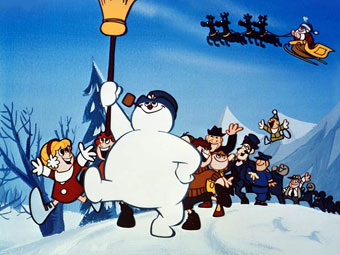
Thumpitty thump thump.On to our next hero! Frosty's story is a little easier to compress, thanks to the fine folks over at Rankin-Bass. On December 24th, some children start building a snowman, using a corncob pipe, a button nose, and two eyes made out of coal. They top it all off with a top hat discarded by the terrible magician Professor Hinkle. There must have been some magic in that old silk hat they found, because when young Karen (1) put it on his head, he began to dance around (4, The Call to Adventure). Professor Hinkle takes back the hat (6), but Hinkle's magic rabbit, Hocus Pocus (Supernatural Aid), steals the cap back and returns it to Frosty. Frosty comes back to life, though he is incredulous that a snowman could be alive (Refusal of the Call). He comes to terms with this new status quo, but realizes that the sun is hot, and begins to melt. The children suggest that he go to the North Pole, where he won't melt (7), and they head off to the train station. On the way, they encounter a traffic cop who impedes their path, but they pass by (Crossing the First Threshold). Frosty, Karen, and Hocus get on the train in a refrigerated boxcar (Belly of the Whale), with Hinkle in hot pursuit. Frosty takes his friends out when he realizes that Karen is freezing, and they trudge through the harsh forest (The Road of Trials) searching for someplace warm. They encounter woodland critters, who are preparing for their Christmas celebration and Santa's arrival, and the critters build a fire for Karen (14). Hinkle catches up with them and blows out the campfire, demanding his hat (The Ordeal). Frosty and Karen flee (17, Flight) and come upon a greenhouse, where Karen can stay warm. Hinkle locks them inside the hot greenhouse, hoping to retrieve his hat after Frosty melts. Meanwhile, Hocus brings Santa to find Frosty and Karen, though the snowman has melted into a puddle (18, Apotheosis). Santa explains that because Frosty was made of Christmas snow, he can't ever really disappear. To demonstrate this, he opens the door, and a Christmas wind blows in (Rescue from Without). Frosty reappears outside the greenhouse (Crossing the Second Threshold), and Santa defeats Prof. Hinkle. Santa takes Karen back home, and takes Frosty back to the North Pole, though the snowman returns for a parade every year thereafter (20, 21, Master of Two Worlds).

And Christ parallels? Wow, are there Christ parallels. Frosty is in agony (melting), good with children (naturally), self-sacrificing (to save Karen), uses humble modes of transportation (marching here and there, all around the square), spent time in the wilderness (with the woodland critter Christmas!), created some aphorisms ("If I spend too much time in here, I'll really make a splash"), died but was resurrected, had 'apostles' (the group of children), was very forgiving (he didn't harbor any ill will toward Professor Hinkle), and was unmarried. Not to mention that he was born on Christmas Eve, persecuted, and ascended bodily into the North Pole, promising that he would return again someday. People sometimes consider the difficulty of teaching children about the gruesome story of Christ's persecution and death, and I think Frosty makes a pretty good introduction to that. Either way, he makes a darn good hero, and a perfect end to this Christmas post!
Happy birthday!

Happy Holidays, everybody!

Tuesday, December 05, 2006

Monday Monomyth: The Basics (Part 2)

In this mis-named installment of the Monday Monomyth, we'll be looking at the work of Lord Raglan and the model of Jesus Christ. Heavy stuff. By the way, if I accidentally type "Ragnell" instead of "Raglan" at some point, chalk it up to muscle memory.

The Raglan Pattern
Lord Raglan, when reading the story of Oedipus, noticed that the beleaguered king shared many characteristics with the stories of Theseus and Romulus. He followed this pattern through over a dozen other mythological heroes, then put it to the test with several more, to some high degree of success. All told, the Raglan Pattern consists of 22 separate traits, and each hero is given a score based on how well they fit.
In contrast with the Campbell Monomyth, the Raglan Pattern focuses more on the Hero and less on the journey.
The pattern, then, is as follows:
  1. The hero's mother is a royal virgin;
  2. His father is a king, and
  3. Often a near relative of his mother, but
  4. The circumstances of his conception are unusual, and
  5. He is also reputed to be the son of a god,
  6. At birth an attempt is made, usually by his father or maternal grandfather, to kill him, but
  7. He is spirited away, and
  8. Reared by foster-parents in a far country.
  9. We are told nothing of his childhood, but
  10. On reaching manhood, he returns or goes to his future kingdom.
  11. After a victory over the king and/ir a giant dragon or wild beast,
  12. He marries a princess, often the daughter of his predecessor, and
  13. Becomes king.
  14. For a time he reigns uneventfully, and
  15. Prescribes laws, but
  16. Later he loses favor with the gods and/or his subjects, and
  17. Is driven from the throne and his city, after which
  18. He meets with a mysterious death,
  19. Often at the top of a hill.
  20. His children, if any, do not succeed him.
  21. His body is not buried, but nevertheless
  22. He has one or more holy sepulchres.
--Lord Raglan, The Hero: A Study in Tradition, Myth and Drama, p. 174-75
Oedipus, not surprisingly, scores 21. Theseus gets 20. Heracles warrants a hefty 17. Raglan states at the end of his laundry list that:
It may be added that although several of the incidents are such as have happened to many historical heroes, yet I have not found an undoubtedly historical hero to whom more than six points can be awarded, or perhaps seven in the case of Alexander the Great.
So, how about Jesus Christ? Well, depending on who you listen to, he ranks somewhere between 16 and 19. By my count, he satisfies 1 (virgin yes, royal depends on who you talk to), 2 (well, descended from a king, anyway), 4, 5, 6 (Herod), 7, 9, 10, 13, 14, 15, 16, 17, 18, 19, 20, 21, 22. That's eighteen there; you could say that resisting the devil's temptations constitutes a fulfillment of 11, and that being raised in Egypt constitutes fulfillment of the "far country" part in 8, so scores can vary a bit.

The Christ-Figure
Now, if there's one thing we can absolutely, definitely classify Christ as, it's a Christ Figure. Christ figures abound in literature and myth, particularly in Western literature for some reason, but many in fact predate Christ. So, why do we call them Christ figures if he wasn't the first?
Part of it stems from Western-centric thinking, part of it stems from the fact that (for better or worse) Christ is the most well-known of the Christ figures, and thus is an easy reference. You have to do significantly less explanation to say why some character is Christ-like than you would to say someone is Mithras-like or Apollo-like.
Unfortunately, I don't know of any texts dedicated to the study of Christ-figures. I'm sure there are some, but I haven't read them. So, for my hard-and-fast list of Christ characteristics, I turn to the eerily-named Thomas Foster and his ever-useful text How to Read Literature Like a Professor. In this handy-dandy book on literary interpretation, he includes a list of common Christ-like traits. No Christ-figure conforms to all of them, after all, then they'd be Christ, but it's not usually too difficult to tell when it's intentional (and lit crit being what it is, we can always argue that the authorial intention doesn't really matter).
  1. crucified, wounds in the hands, feet, side, and head
  2. in agony
  3. self-sacrificing
  4. good with children
  5. good with loaves, fishes, water, wine
  6. thirty-three years of age when last seen
  7. employed as carpenter
  8. known to use humble modes of transportation, feet or donkeys preferred
  9. believed to have walked on water
  10. often portrayed with arms outstretched
  11. known to have spent some time in the wilderness
  12. believed to have had a confrontation with the devil, possibly tempted
  13. last seen in the company of thieves
  14. creator of many aphorisms and parables
  15. buried, but arose on the third day
  16. had disciples, twelve at first, although not all equally devoted
  17. very forgiving
  18. came to redeem an unworthy world
--Thomas C. Foster, How to Read Literature Like a Professor, p. 119-20
Foster repeats himself a bit with a "you might be" list a little later, but adds a couple more points which were omitted.
  • unmarried, preferably celibate
  • wounded or marked in the hands, feet, or side (crown of thorns extra credit)
  • sacrificing yourself in some way for others (your life is best, and your sacrifice doesn't have to be willing)
--p. 122

That's quite a list. There are all sorts of characters I could subject to this treatment; the classic (who is discussed at length by Foster)is Santiago, the titular old man from The Old Man and the Sea, but I hated that book. So, how about this guy...
Rub this image to see his affiliation!
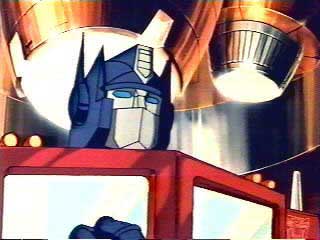
Optimus Prime!

Good with children? I think Spike Witwicky would attest to that. Self-sacrificing? You betcha; Optimus led a fight against members of his own species to save us poor humans. He tended to use himself as transportation most of the time, that's pretty humble, right? He was as forgiving as any '80s cartoon hero, in that he'd always give someone a second chance, and he'd team up with the enemy if necessary. He (and several other Autobots) drove on water in at least one episode, he had disciples out the tailpipe, and his lack of any apparent genitals means that he was probably celibate, despite the existence of sometimes-girlfriend Elita-One. Wilderness? He led the Autobots into the unknown reaches of space in search of fuel, ending up on prehistoric Earth. Devilish Temptation? In the events that led directly to his rebirth as Optimus Prime, the young Autobot joined up with Megatron's gang, and paid dearly for it. Aphorisms? "Freedom is the right of all sentient beings," "all we need is a little Energon and a lot of luck," and of course, "Autobots: transform and roll out!" And in his final, brutal battle with Megatron, he's wounded twice, in the side.
And the Autobots laid him in a sepulchre, which was a space-barge filled with robot corpses, and set it adrift. But when they visited this gravesite, they found that Optimus's body was missing, and he arose in the third season, and was received unto Cybertron where he ascended to leadership once more.

And, just for the heck of it, how does Prime fare on the Raglan scale?
2: The "father" of Optimus Prime (specifically, the person who gave him the Matrix of Leadership and remade his form from Orion Pax into Optimus Prime) was Alpha Trion, the first of the Cybertronians.
4: He was born of a damaged robot, the first Cybertronian, the computer which made all Transformers, and the Matrix of Leadership, which contained the essences of all past Autobot leaders.
5: Vector Sigma's about as close to god as the original cartoon got.
9: All we know are the events leading directly to his "rebirth."
10: He returns to the surface of Cybertron after becoming Prime,
11: where he defeats Megatron and
13: becomes the leader of the Autobots.
14: Since war is the norm, Optimus's four million year leadership of the Autobots was relatively uneventful.
15: If we can consider "Freedom is the right of all sentient beings" to be a law...
17: He's driven from Cybertron because of the need for Energon.
18: Some time later, he meets his death at Megatron's hands
19: on top of a hill
20: and neither of his successors could be said to be his children.
21: His body is sent into space.
That's about a fourteen, it looks like. Not bad, Optimus! Now, at this point, you might be saying "but, Optimus Prime isn't a Christ figure. He wasn't crucified, and he certainly didn't die for anyone's sins." And you're right, in a way. Prime's not Christ, he's Prime. Of course the details aren't going to match up. But I'll let my doppelganger Mr. Foster explain:
Many times I'll point out that a character is Christlike because he does X and Y, and you might come back with, "But Christ did A and Z and his X wasn't like that, and besides, this character listens to AC/DC." Okay, so the heavy-metal sound isn't in the hymnal. And this character would be very hard pressed to take over Savior duty. No literary Christ figure can ever be as pure, as perfect, as divine as Jesus Christ. Here as elsewhere, one does well to remember that writing literature is an exercise of the imagination. And so is reading it...Whatever we take away from stories in the way of significance, symbolism, theme, meaning, pretty much eanything except character and plot, we discover because our imagination engages with that of the author...At the same time, this doesn't indicate that the story can mean anything we want it to, since that would be a case of our imagination not bothering with that of the author[.]
On the flip side, if someone in class asks if it's possible that the character under discussion might be a Christ figure, citing three or four similarities, I'll say something like, "Works for me." The bottom line, I usually tell the class, is that Christ figures are where you find them, and as you find them. If the indicators are there, then there is some basis for drawing the conclusion.
--p. 123
That's it for this installment. Now that we've covered the basics, we can jump right into the heroes themselves. I may wait 'til next Monday, or I may just make this Monomyth Month instead of Monomyth Mondays. Anyway, we'll visit two characters next time, though I can't quite say who just yet. If you've got suggestions, fire away!