Saturday, September 16, 2006

Walkin' on, walkin' on broken gla-a-ass

Yep, that's right, I'm going to make myself look like an ass again. Thankfully, due to the recent brouhaha, I ought to look like a much smaller ass by comparison.

So, for some reason I ended up looking at one of Kalinara's old posts, which I somehow overlooked the first time around. First things first, it's a fantastic post, clearly describing what Kalinara would like to see in terms of female comic characters, and doing so in a very grounded, fair-minded manner. I agree wholeheartedly with her thoughts, (especially those regarding costumes and body types, two topics where I have a difficult time articulating my thoughts) and I wish I'd caught this thread back when it first popped up. So, thanks for a fantastic and enlightening post, Kalinara. If you ever decide to permalink your "best of" posts in the sidebar, I recommend this for the list.

The reason for this post, however, is not to praise a months-old thread on feminism; it really has very little to do with Kalinara's post at all. No, something in the comments section stuck out to me:
At 11:59 AM, Ferrous Buller said…
[...]
"At least what *my* brand of feminism is really about."

Well, that's part of the trouble, though, isn't it? Put ten feminists in a room and you'll get ten different definitions of "What Feminism Means." Apart from agreeing that the point of feminism is to make the world a nicer place for women, you'll hear very different ideas about what matters and how we should go about changing things. E.g., I'm sure there are plenty of feminists who would argue that wardrobe and body image are central issues.
[...]
Put another way: you'll never please all the people all the time - and that includes feminists.

Good post overall, though: you articulate your stance pretty succinctly. :-)

Emphasis mine. See, Buller makes a good point: there's no consensus on just what "feminism" is, beyond treating men and women equally (and even then there's disagreement on just what "equal" means). I wouldn't argue for such a consensus; there's no one philosophy that will work for all women in all places, at least not one more specific than "equal treatment." You can't take a specific statement and make it apply to a large general population, it simply doesn't work.

Tangent alert: this, I think, is the root of many of the problems with communication between the sexes. People take generalizations (for instance, "women are generally less violent than men") and try to apply them axiomatically ("all women are less violent than men") or individually ("it's a good thing you're a woman, and thus less violent than men, honey. What are you doing with that knife?"). The problem with this is that those generalizations, whether they are biological, psychological, hormonal, sociological, or traditional, fall apart at the individual level. Regardless of those predispositions, everyone is wired differently, everyone thinks and acts differently, and no one conforms to all the norms. I saw part of BBC's Secrets of the Sexes program, which demonstrated this fairly well. They showed that, on average, the participants conformed to what was expected, but depending on the parameters of the test the positions of the individual men and women on the male/female continuum line differed wildly. In some cases, it was a matter of one factor conflicting others (as I recall, one of the women had an unusually high testosterone level, a hormonal predisposition, which worked against some of the other factors), in other cases, it was something less quantifiable. The truth is that everyone is a product of nature and nurture, and everyone is affected by all of these factors--biological, psychological, hormonal, sociological, and traditional (among others; the waters are far muddier than this)--it's the combination of these factors in different amounts, along with upbringing and life experiences, that shapes people into unique individuals. Which predisposition wins out at any given time is the product of any number of variables. Trying to pin down any one factor that determines behavior, or trying to say that one factor outweighs all the others, simply shows ignorance regarding the complexity of human behavior and motivation. Tangent over.

Anyway, I started thinking that if ten feminists will each have a different opinion of what feminism is, then they'll also have ten different opinions about what misogyny is. Like feminism, everyone can agree on the basics of misogyny: hatred of or contempt for women (thank you, Oxford English Dictionary). There are situations where pretty much everyone can agree on the blatant misogyny (husband beating his wife? Pretty clear), but what about more subtle situations?

For instance, I didn't manage to see "My Super Ex-Girlfriend," though I wanted to. I'll probably rent it (come on, she throws a shark at someone, that's gotta be worth the price of admission. That's better than a gun that shoots swords). But I saw a review on some blog which called it misogynistic. Now, it's entirely possible that there are misogynistic elements which didn't make it into the previews, and I'll certainly concede that. But, I'm assuming here that the charges were made against the portrayal of Uma Thurman's character, G-Girl, a superheroine who is, among other things, clingy, emotionally unstable, manipulative, and prone to jealousy, all traits stereotypically associated with women. It looks like the plot revolves around her human boyfriend's quest to dump her and move on, while she's playing the role of super-stalker.
Before I get to my point, let's play the gender-reversal game. G-Guy is an emotionally unstable, clingy, jealous superhero who uses his superpowers to stalk, threaten, and attack his human ex-girlfriend. Isn't this premise just as misogynist? Wouldn't this be "My Date with Major Force" or something? Doesn't this end up the sort of spousal abuse misogyny about which we can all agree?
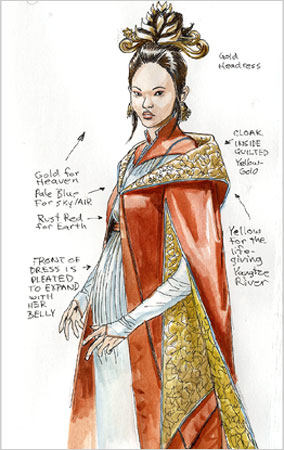
Standing womb onlyOr, for a better example, how about the Mother of Champions? I think people are more hesitant to call Morrison a misogynist, given his prestige and body of work, but no one's pulling their punches over the pregnant lady. She's been called misogynist and racist (a double-whammy), and it's easy to see why. As one of the two female members of China's superhero team, The Great Ten, the Mother of Champions has the ability to give birth to twenty-five super-soldiers every three days. She is carried around in an insect-legged robot bed, since she can't move around too well in her state of perpetual pregnancy. The stereotypes are obvious: the Chinese reproduce like rabbits, and women should stay barefoot and pregnant.
And yet...China's not exactly the most progressive nation in the world when it comes to gender equality. The government and society still actively discriminate against the female population. Why wouldn't a team created and run by a sexist government have a token female who represented what the government expects of its females?
Incidentally, if MoC represents the Chinese government's expectations of Chinese women, then the Ghost Fox Killer, an exotic femme fatale, represents the outside world's expectations of Chinese women. Her ability to control the ghosts of the men she has killed makes her, like MoC, dependent on men for her special abilities.
The point here is that, if I were writing (for instance) a Confederate super-team, organized and run by their (shady, Black Adam-aligned) government, I certainly wouldn't fill it with black and female characters who were treated as the equals of the white men on the team. I'd stock the team with characters who represented what the government expected of its people. Is it racist to recognize the prejudices of foreign cultures?

So, back to G-Girl, is it more sexist (and I realize that sexism and misogyny are different things) to craft a female character who has real negative traits stereotypically associated with femininity, or to refuse to attribute such traits to female characters? I discussed the whole chivalric sexism/noble savage/"positive" stereotyping before, and how it ends up being just as discriminatory as the more obvious variety. It seems to me that calling a female character misogynistic, based solely on the fact that she's portrayed in a negative light, is really restricting what kind of characters may be deemed acceptible.
And just how is it that the Super Ex-Girlfriend plot ends up being equally misogynistic no matter what the gender of the jealous super-stalker is?

Here are the long-awaited answers, as I see them.
First, on the problem of G-Girl, I think the character is only misogynistic if the stereotypical traits are the only traits she has. When a well-developed female character gets jealous at her ex-boyfriend or shows herself to be emotionally unstable (assuming, of course, these traits aren't huge departures for the character), it's going to be much harder to get charges of misogyny to stick.

For example, Cassandra "Wonder Girl" Sandsmark, thanks to exposure in Wonder Woman, Young Justice, and Teen Titans, was a very well-rounded character. When she attacked Supergirl in a jealous rage in the early issues of the new series, it seemed wildly out of character. However, her current emotional instability seems like a natural progression given her established personality and all the crazy crap that has happened to her in the last year or so, mainly the death of Superboy. It doesn't seem like the writers are saying "she's lost without a man," it's more like "she has lost everything and everyone--after that, you'd feel lost too."

So if G-Girl was, in fact, stereotype stacked on stereotype with no depth, then the accusation of misogyny seems apt. If she was a three-dimensional character, who also happened to be a bit insane, then I think it's unfair, unrealistic, and antifeminist to make such a claim. Equality means taking the good and the bad, including "equal capacity to be a maladjusted nutcase."

For the problem of G-Guy, I think it's a matter of where the misogyny lies. G-Girl may be a misogynist character in that she embodies a negative female stereotype. Pitting a superpowered stalker against a powerless female is more of a misogynist situation, in which we have a violently dominant male figure and an unwillingly submissive female character. I suppose G-Guy himself might be a misogynist, though that's more of a jump; 'being prone to jealousy' and 'hating women' don't necessarily go hand in hand.
As far as the writers, I think the misogynist charges might be more suited to the G-Girl story than the G-Man one. Assuming every other plot point (so far as I understand them) is the same, then "My Super Ex-Boyfriend" would portray the woman as the protagonist, fighting against a clearly-nutso superhuman. She'd be the underdog, and the story would be more about a lone woman fighting an unbeatable foe than an abusive boyfriend stalking his ex. It might even be an allegory for feminism--women taking control of their lives (symbolized by the girl-initiated breakup) and becoming independent, but having to fight the all-powerful patriarchy to do so.
Whereas in the story-as-is, we have a female stereotype and a doofy male re-enacting the clichéd story of amazon anxiety (stereotypical male fear of strong women). Given that, I'm not convinced that the film wouldn't be misandric as well--Luke Wilson's character looks like just about every clueless, goofy milquetoast slacker in romantic comedies.
This leads us, however, to a new question: does writing about a misogynistic situation or misogynist characters (like Major Force) or stereotyped characters make the writer a misogynist? How do you judge the difference between "sexist writing" and "using gender stereotypes to make a point about gender roles (or society or stereotypes or whatever)"?

But, back again to the first point, if these two characters manage to be well-rounded, if their personalities and circumstances are developed beyond the stereotypes, then I think the charges of misogyny should fall apart. Unless every woman in the film is some insane bitch, up against Luke Wilson's flawless knight in dorky armor, having an unstable jealous female villain shouldn't be enough to warrant the m-word. People, regardless of gender, can be and are jealous, petty, clingy, and emotional, and including or excluding those traits in a character, solely on the basis of gender, is sexist and ought to be avoided.

I recognize that there is a long history of those stereotypical characters, enough so that any female character who displays traits like jealousy and clinginess and moodiness is walking a tightrope, where one wrong step will turn them into a terrible caricature. I recognize the impulse to judge such characters immediately, to want a moratorium on those traits in female characters, but that seems like that would only skew the trend toward the 'chivalric' stereotypes. As Kalinara requested above, we should be working for well-rounded, well-developed female characters, regardless of what their traits might be. We shouldn't decry jealous women unless that jealousy is unfounded or is the only real trait they have. If there's a real motivation for it, a reason behind it, a personality that supports it, then why should it be excluded.

With the Mother of Champions, I'm reserving some judgment until the Great Ten become more developed. I think there are a few things to consider when judging her, though. First, the Chinese government is being set up as being involved in some shady dealings, not the least of which is their alliance with Black Adam and their adamantly nationalistic control of their borders and airspace. Furthermore, the Great Ten is meant to be under government control, and is also supposed to be the product of some shady dealings. Like Captain America or Uncle Sam, these characters are each meant to represent some aspect of their culture or society, but at this point none of them have developed characteristics beyond "being Chinese" and possibly "harboring a secret agenda." If Mother of Champions is meant to represent the Chinese government's ideals of woman/motherhood--subservience, silence (since she appears to be a behind-the-scenes player), and complete devotion to the country--then I can't really fault Morrison and crew for her portrayal. I guess the matter hinges on what her character ends up being like, whether or not she's shown to be more than a babymaker (or if her stereotypical nature is explored in-story), and what the Great Ten's story arc ends up being.
Consider this: what if the Chinese government, developing their own version of Luthor's metagene treatment (or perhaps using his--definitely something they'd want to keep secret), went through far more than ten test subjects before they found the right combination of acceptable power sets and controllable subjects. What if MoC and Ghost Fox Killer were chosen specifically because their predecessors were too uppity? What if MoC discovers this, or begins to resent her treatment, her status on the team, the sacrifices she has made for the country with none of the prestige afforded to her teammates. They call her "Mother," but she isn't really, she's a factory, squeezing out two dozen superpowered automatons twice a week to become cannon fodder for the glory of China. She's been denied motherhood in any real sense, she's been denied a sex life, relationships, self-mobility, even her freedom, to languish in the Great Wall, listening to the snickers and chuckles of the staff and her team. Eventually, as would anyone, she tires of this. And what happens when an oppressed woman, with an ever-growing army of superpowered soldiers on her side, decides she's had enough?
A Great Ten miniseries, that's what happens, or so I hope. I mean, it seems to me that the answer to her current apparent status as "racist, misogynist caricature" would simply be remedied by some attention and characterization. Am I wrong? Would she still be an -ist character in the above scenario? Sure, it's a lot of "what ifs," but we haven't really seen her do anything yet. It seems premature to pass judgment before they get a chance to develop her character.

I said above that this would have very little to do with Kalinara's post on well-rounded female characters, and after all that, it turns out that I'm advocating just that. I started out by trying to examine misogyny, and I guess I'm still trying to understand it. The conclusion ends up being obvious: the way to eliminate prejudice is with understanding. In storytelling terms, the way to eliminate stereotypes is with depth and development. That's what, in the beginning, separated Cassandra Sandsmark from every other tomboyish teenage rebel. That's what separates Raquel Ervin from the stereotypical unwed black teenage mother. When you give a character personality and motivation, the traits they share with stereotypes no longer seem so offensive. It's okay for an Irishman to fight, it's okay for a Korean to be good at math, it's okay for a woman to be jealous, as long as it fits with their characters, as long as there are reasons for those traits, as long as single traits doesn't define them.
And, as a corollary to that, understanding and development take time and patience. It's unfair to judge a character before they get a chance, whether it means looking at Power Girl and thinking "big boobs and blond hair, must be some bimbo adolescent fantasy woman," or looking at the Mother of Champions and thinking "Chinese, barefoot, pregnant, and endlessly procreating: thanks for setting back race and gender relations sixty years, Grant." I'm not saying you should stick with a character for ten years before passing judgment, I'm not saying you should wait until some writer decides to flesh out what used to be a stereotype, I'm not saying that you ought to stick with a character who spends his or her first panel going "Ah so, me get you flied lice chop-chop!" I'm saying that you can't judge a character from a sketch and power description and a couple of cameos, any more than you can judge a person from such cursory meetings. Everyone deserves a chance.

In conclusion, it took me three times the space to come to the same point Kalinara started with. Hopefully, there's been some sort of insight and interesting content along the way, hopefully I can get some of my questions answered, and hopefully I didn't make myself look like too much of an ass.
I hope I haven't misrepresented the culture and/or government of China; I did some cursory searching for "China" and "gender equality" before writing about it, and came up with the UN site on the subject. If there are serious flaws in my judgments or information, please let me know.
I hope I haven't come across as a passive-aggressive jerk who thinks he knows more about feminism and the female condition than those who experience it first-hand. I've spent enough time mocking just that sort of attitude in the past couple of days that I certainly wouldn't want to emulate it. Everything I've said has been in the interest of honest, open discussion, and I've meant everything with the utmost sincerity. I don't presume to tell women (or anyone else, for that matter) what to think, how to act, what's acceptible, etc. The only advice I'm giving is that no one should make snap judgments. Well, and that people should make their characters three-dimensional and well-rounded. The bottom line, so far as I see it, is that everyone benefits from equality, not just the oppressed party. Conversely, discrimination of one segment of the population comes at the detriment of the whole society. Feminism can only accomplish good things, but rushed judgment works against that spirit of equality and understanding. A little patience never hurt anyone.

If you've read this far, I think you've demonstrated just that sort of patience. Feel free to comment.

Edit: I've read at least two more posts on the subject since writing this post, and the possibility of "My Super Ex-Girlfriend" featuring three-dimensional characters who rise above common gender stereotypes and the conventions of pedestrian romantic comedies and don't just exist to make the male protagonist look like a flawless god, is looking pretty slim. I won't pass judgment for myself 'til I see it, naturally, but the volume of criticism suggests that my ideal "what if" scenario simply isn't the case. That's really a shame.


Keep walkin'!

Baa

I started a LiveJournal. I think this means I lose my street cred. Anyway, I expect it to be updated about as often as Movies Schmovies. Despite that, feel free to friend me. Because, you know, "friend" is a verb now.

God, I am such a tool.

Friday, September 15, 2006

Friday with Freakazoid!

Hm...I sure have been light on posts this week. Hopefully I'll have another one later tonight. Anyway, recently this Scribbler cover showed up on Comics Should Be Good's monthly review of Image solicitations.
Nobody understands me. I'm sooooooo deep.

Notice the tagline: "Unzip your head." As I mentioned in the comments section, that line was much awesomer when Freakazoid was saying it. But you don't have to take my word for it; see for yourself.

"Say 'Grandma Moses makes munchy meat most Monday mornings'!"

Wednesday, September 13, 2006

This is just too funny

So, James Meeley has been recently linked both by Kalinara on Blog@Newsarama's Meanwhile column (something I look forward to every week) and When Fangirls Attack! and he's thrown something of a fit in the comments sections both times. In both cases, he's asked the site to "cease and desist" linking to his page, because "he doesn't need the help" getting an audience. Naturally, because of Blogger's system, every time he comments about getting rid of the link, his name becomes a link to his profile, and thus back to his blog. Perhaps he should send a "cease and desist" letter to Blogger, so that they stop linking to his blog through his profile, and through that pesky "next blog" link.

I'm not sure what the funniest part of all this is. It could be that this guy not only thinks that people linking to him is to help give him an audience, but that he has some say in whether or not such linkage occurs. It could be that he thinks using legal language like "cease and desist" holds some kind of intimidation power on these here Internets. It could be that he's so wrapped up in his metaphor of "Internet=Real place" that he thinks the rules of the Internet conform to the rules of the outer world. It could be that a man who claims to be 32 is throwing a hissy-fit on two of the most prominent comic blogs around.

Or it could be, as Mike Sterling noted, that he's totally "unclear on the concept of 'the internet.'"

In any case, I find it freakin' hilarious.

Also, the undersigned (heretofore referred to as "I"), in pursuance with the general rules of Internet etiquitte, hereby issue to the comic blogohedron (including but not limited to weblogs, websites, and online journals involving topics of comic books, manga, comic-based movies, manga-based movies, and other media forms of the characters and plotlines involved in such sources) an order to cease and desist all refusal to link to The Fortress of Soliloquy on the basis of race, creed, gender, sexual orientation, or content. Failure to link to The Fortress of Soliloquy shall constitute a breach of contract, and may result in the loss or suspension of said offender's Comics Blogging License, the loss of the offender's blog security deposit, eviction from the Comics Blogohedron, and/or fines not to exceed $5,200.00. The blogohedron is hereby given seven (7) days to comply with this order, starting from the date on which this message is received. By reading the previous sentence, the reader has agreed to the conditions of this order, and has forfeited all rights to refer to the aforementioned The Fortress of Soliloquy or its employee(s) as "petulant," "immature," "fat," etc.

The Fortress of Soliloquy assumes no responsibility for injuries sustained in accordance with the normal actions of reading or commenting on this post, or subsequent to said actions, nor does it assume responsibility for any accusations that the above joke is "too long," "tedious," "not funny," etc.

Sincerely,
The Undersigned

Sunday, September 10, 2006

Happy (belated) Bloggiversary, Written World!

I'm terrible about keeping up with these things; perhaps it slipped my mind, perhaps I've simply been lax with checking, but I somehow allowed Ragnell's One Year Bloggiversary to go by without posting. Ragnell's one of the most prolific comic bloggers around, working not only on Written World, but also on When Fangirls Attack!, Zamaron, and Blog@Newsarama (though you won't find her under a nom du blog there). Of course, it's the former which is cause for success here.
The Sound of Music had a good point: the beginning is a very good place to start. Marvel at how someone who approached the blogohedron with such trepidation could end up with one of the most widely-read and highly-regarded blogs around. It's a real rags to riches story. Then, you could move on to her early comparison of the Green Lanterns to the Arthurian Knights, or you could discover her deep love for Donna Troy. Keep reading and you might find where I subconsciously stole my "things I'd like to see" post idea.
I could direct you toward her precise predictions regarding a particular veridian vixen, which led in part to this controversial take on that infamous refrigerator. Seeing her thoughts on Seaguy makes me want to re-evaluate that particular miniseries; I'll make a mental note of that.
I'd be remiss if I didn't direct you toward her Favorite Women of the DCU. That, my friends, is essential reading.
You might be sad to know that Ragnell is afflicted with a terrible disease, one which affects mostly English Majors; I have a variant strain myself, Millifaceted heroicus connectivitis or Joseph Campbell's Disease. I think you'll find that, as with many with mental ailments, it really only helps her writing.
One of her most widely-known contributions to the world of comic blogging is the Depressing or Damned List, a collaboration with Kalinara, which acts as a macabre companion to the above-mentioned Refrigerator List. If you're looking for something in a similar vein, you might want to check out Monday Misogyny, a feature which we all wish was less recurring than it is.
I may not always agree with her, but there's no denying that Ragnell consistently offers intelligent posts which approach both current events and classic criticism from a fresh point of view. She may have an unhealthy obsession (or two, depending on how you look at it), yet she still manages to run one of the best blogs around, no ifs, ands, or butts about it.

Happy Bloggiversary, Ragnell. It's been a fantastic year, and you've managed to cram several years worth of high-quality blogging into it. I think we all owe a debt of gratitude to your sister for "bothering [you] to create a blog or live-journal or something like that" in the first place. So thank you Kim, and thank you Lisa, for such a vital, fantastic contribution to the blogohedron. Here's to another wonderful year!

Friday, September 08, 2006

Friday with Freakazoid!

I've decided, in light of the new favicon, to begin this new feature here on the Fortress of Soliloquy. My posting's gotten a lot more regular lately, so something like Fridays with Freakazoid! is finally possible. Now, without further ado, your weekly dose of awesome:

Huggbees!

Wednesday, September 06, 2006

Wholesome

There's a neat conversation raging in the comments on this post over at Pretty, Fizzy Paradise (why don't conversations ever rage in my comments?), over some things that I've been considering quite a bit lately. There's a good deal of disagreement regarding the current Supergirl, her portrayal, and what the character ought to be like. The word "wholesome" keeps popping up, and how this Supergirl, with her midriff-baring, tattoo-wearing, cousin-kissing, naked-prancing, cigarette-burning ways, falls far short of that description.

I thought of that criticism for a moment, trying to develop a response, when I recalled my own disappointment in a changing-of-the-Kara. I was an unabashed Kara-purist as a kid. I tolerated Matrix, but I even wrote a backstory (long before I ever heard of 'fanfic') detailing how Supergirl could have survived the Crisis (having not read the story in question). I don't recall how the story went, but I remember it involving a super-criminal Khund/Kryptonian hybrid.
Yes, I had a lot of time on my hands as a kid.
Naturally, I was really, really excited when I saw the new Kara pop up in Superman vs. Aliens. There was some buzz at the time about how the character would become important, but that buzz was nowhere to be found by the time I heard about Peter David's Supergirl series. I read about it in Wizard (and probably Comic Shop News), and I was incensed. Clearly, this new ersatz Linda Danvers would preclude the return of the real thing.

And oh, how far this new "Supergirl" was from the real thing. I refused to read the series, and the more I read about this nasty Linda Danvers and her dealings with demons, her sordid past, and eventually, her weird angelic powers, the more secure I felt in my boycott.

Then, I actually picked up an issue. Sure, I was thoroughly confused (sampling a series at issue #50 doesn't always work out), but hey, maybe she wasn't so bad. Eventually I picked up the series again (as part of collecting Our Worlds at War in its entirety--an expensive and not altogether unrewarding venture) and got hooked. When the series ended not too long after, I had already honed my love for Linda, and I was quite sad to see it go.

When Cir-El showed up, a little month, or ere that cape was old with which she followed my poor Linda's series, I naturally felt many of the same outrages as I had with Kara's elimination, since it sure looked like Linda was shoved aside to make way for Cir-El, a fact only increased by the fact that Linda didn't garnish so much as a mention throughout the Cir-El storyline. Of course, with Cir-El, most of that reaction was justified, especially since she never really justified her existence. She was a plot contrivance given form.

To the point, then: a wholesome Supergirl, over the course of the last thirty years, is not the norm. In brief:
  • Naïve protoplasmic entity with an identity crisis.
  • Slightly less naïve protoplasmic entity engaging in a naïve and vaguely Electra-ish relationship with the evil alternate-universe (well, alternate to her) version of her creator (masquerading as his own son, making him at least an estranged stepbrother of sorts), at least until she flips out and tries to kill him.
  • Protoplasmic entity merged with a troubled girl after her attempted suicide, who later turns out to be an Earth angel, engaging in a complicated relationship with a demon, and romantic-but-complicated relationships with a gender-bending update of a Silver Age character and a female Earth Angel who turned into a male horse-person.
  • Young, relatively normal woman trying to be a superhero despite a major power downgrade.
  • Future daughter of Superman who may or may not be evil, but turns out to be a Brainiac-developed trick clone thing.
  • Superman's seriously messed-up cousin from Krypton.

Go back to the beginning, and you find that Supergirl was the first super-character to operate completely in secret, and eventually the only one (outside of Superboy) to have living parents. I can't say for certain if she operated superheroically before revealing her identity to her foster parents, but she'd be the first to have operated under parental radar as well. Apparently she was also the first to have her Kryptonian parents turn up alive and well, too (the things you learn through Wikipedia). Details, perhaps, but significant details.

Increasingly since her debut, Supergirl has been the 'experiment' character in the Super-franchise. No matter what changes happen to Superman, everyone knows he'll eventually be back in the blue-and-reds with the cape and whatnot. Superman is a constant, with a well-established history and supporting cast. Supergirl came onto the scene as a tabula rasa, and years as Superman's 'secret weapon' did little to ameliorate that. She languished when her adventures were 'Superman lite' or 'the adventures of Superboy when he was a girl,' and so writers were forced to find new avenues and options to distance her from her cousin. She's been a college student, a news anchor, and a soap opera actress; she's changed costumes repeatedly, all in order to give her some distinct identity of her own. When Kara was wiped from the timeline and the "only one Kryptonian" order came down from on high, making Supergirl a viable, distinct entity became the only way to fit her in the new universe. Since that point, the character has increasingly been the platform for experiments with the Super-family. Maybe you can't introduce religious dilemmas into Superman comics without Editorial watching you through a microscope, but writing Supergirl allows you a bit more freedom, since the desire to tell new and different stories with the Super-family dovetails nicely with the need to distinguish Supergirl and justify her existence (or at least her own title).

So, while I can see the argument for wholesomeness, I also see that Supergirl's lengthy history doesn't always point in that direction.

That being said, "Bratz" Supergirl is about the last thing I ever want to see. I think Jeph Loeb fell into several traps with Supergirl, which are really kind of the tics that detract from his work in general. First, he gave her inflated importance by ignoring the history of the character in continuity, by suggesting that she was more powerful than Superman, by connecting her intimately to the other two members of the Trinity, and by pitting her against the two biggest villains in the DCU early in her career (see also: Thomas "Hush" Eliot). Second, he gave her a mediocre mystery, which was all build-up and no resolution: 'nope, she isn't that powerful. Forget what we said' (see also: Hush, Dark Victory, the President Luthor storyline). Third, he fell prey to visitor vomit, where guest stars are thrown up all over the place, diluting the story and diverting attention from the supposed star or focal point. The attention is spread among the special guests and regular cast, either to drum up sales or as a deliberate attempt to cover a lack of characterization and plot depth with flashy panels chock full of characters (see also: Hush, every issue of Superman/Batman). Finally, he ended both arcs with Status Silverization, the tendency to, no matter what the story or character logic might dictate, no matter what might be more interesting, restore a Silver Age status quo (see also: President Luthor storyline, Return to Krypton).

So Supergirl got immediately involved with Darkseid, as guest stars from the New Gods to the Amazons to Harbinger showed up to fill out the storyline. The mystery of her true nature developed and got at least one mention from its inception up to the 'big reveal' (or 'big anticlimax') in Supergirl #5. Then, at the end of the Superman/Batman arc, she faked her death...only to immediately introduce herself to the assembled superhero community, despite the fact that keeping her in "secret weapon" status would have been far more interesting than her first story arc ended up being. The deadly Loeb combo killed any chances of character definition as long as Loeb was on the book. The only consistent characteristic was her sexualized, waiflike, anorexic appearance. So that came to define her, much to everyone's chagrin.

I can't blame Kelly for that. Rucka was tossed a hot potato of a character defined by her looks, and he passed it to Kelly in mid-confusing-storyline. Kelly did his best to wrap things up quickly, and I think issue #9 represents the turning point for the status quo. He's trying to take the character in a different direction (or just "a direction"), and until he flubs that, I'm willing to give him a chance. Yeah, incest-girl was weird, but he was tossed into a bad situation, and we can't say with any certainty what part of that story was continuing Rucka's plan, and what part was Kelly's own.

I've kind of misplaced my point, so let me lay it out here in the open: Supergirl has been unwholesome before, and it turned out pretty damn good. No, she hasn't been sexualized like this before, but I don't think Kelly wants Bratz Supergirl any more than anyone else. This issue gave her the first character definition she's had that wasn't based entirely around her looks, and that's a major step forward. Yes, maybe he's trying to justify her oversexualization, but that's been her primary characteristic for two years, and failure to address it would be an oversight. The clear sentiment by the end of issue #9 is that things are going to change; Supergirl's previous definition "didn't fit," and now she's going in a different direction. We can only hope that it's a better one.

But to damn this Supergirl because she's "not Supergirl enough" is to deny Supergirl's history, and to damn Linda Danvers for being similarly unwholesome and impure. And Linda's the most popular, successful, and original Supergirl that there has ever been.

Read More!

Sunday, September 03, 2006

Damn you, Supergirl #9!

I was ready to drop Supergirl. I really was. I'd stuck through six less-than-lackluster introduction issues, five meandering character exploration issues which failed to explore her character, one issue where the quality rose to confounding mediocrity, and two issues of incest-fantasy weirdness. Supergirl had been on the chopping block for some time, but little rays of hope (the end of Loeb's run, Greg Rucka, Joe Kelly) kept the ax from falling. Eleven character-free issues from Jeph Loeb couldn't make me care about Kara, an issue of Rucka didn't get me interested, and two issues of Kelly just confused and disgusted me. If Joe couldn't turn it around with #9, I'd let the blade fall.

Then, Supergirl #9 hit, and things actually clicked. In the span of one issue, Joe Kelly gave Supergirl more personality and more of a place in the Superman family than in the previous fourteen (excluding, of course, her appearances in LSH which have been universally well-done). How did he accomplish such a monumental task?

By contrasting Supergirl with the other members of the Superman family, something he is qualified to do, having written extensively for Superman and Superboy. Supergirl is struggling to define who she is, to find her place in the world, and more specifically, her place among those who wear the 'S'. From the cover to the last page, we see Kara trying to define herself with reference to her Super-kin.
Feelin' groovyI am a rock, I am an Island
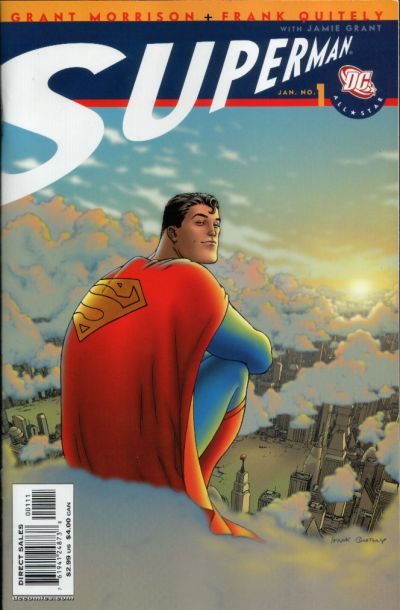
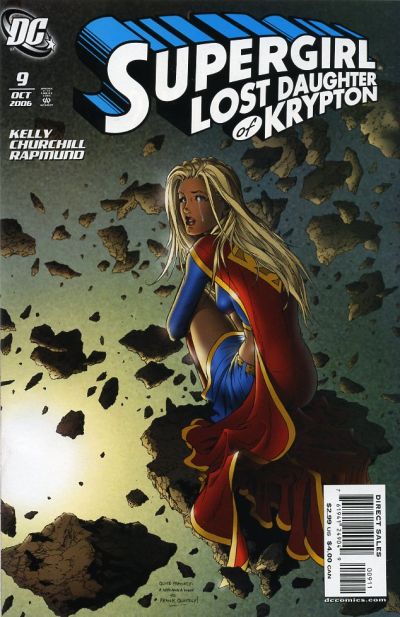
The cover starts the trend, itself a dark mirror image of the cover to All-Star Superman #1. Where the Superman cover is bright and calm, with its subject sitting contentedly over the sprawling city with the sun out on the horizon, the Supergirl cover is dark and morose, trading fluffy clouds for jagged rocks and a bright cityscape for empty desolation. Supergirl's single tear and pained expression are a bit melodramatic, but Churchill does a surprisingly good job of making her look lost and lonely as opposed to just generically sad. She is proclaimed to be the "Lost Daughter of Krypton," which is a nice turn on the familiar phrase, and that sets the theme for the rest of the issue.
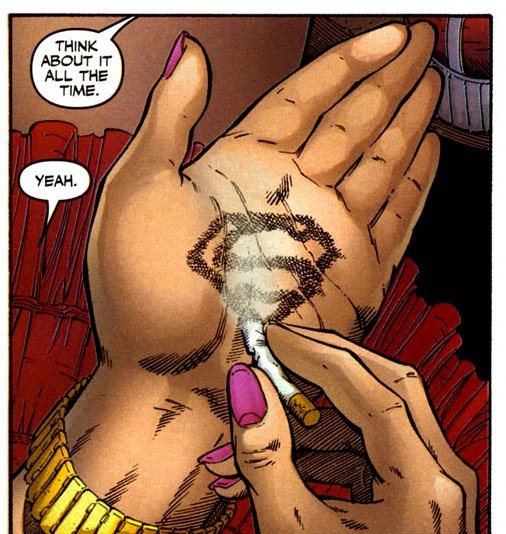
Inside, Supergirl slouches in a chair, dressed in Superboy's black t-shirt, smoking a cigarette as she bares her soul to Captain Boomerang (who, for some reason, is mostly obscured throughout the issue, to the point where I didn't even catch that it was him until I read it on another blog).
Kara sits in a manner that is blatantly masculine, displaying already a sense of alienation, of discomfort with her gender identity. She begins and quits smoking in the span of two pages, as part of an experiment to discover what works for her, what can be incorporated into her identity. Upon hearing her sudden decision to quit, Capt. Boomerang remarks that he did the same last year, but it was hard:
How can we sleep while our beds are burning?
Kara has not only quit smoking, but she's quit being Supergirl. The habit, as she demonstrates with her masochistic doodle, isn't quite so easy to break. She's fighting the 'S,' fighting her destiny, as she demonstrates on the next page by ignoring the signal watch.
The issue moves into a flashback, the first of many, in which Supergirl and Power Girl are fighting over this issue of quitting. It does well to remember that Supergirl and Power Girl are versions of the same character; in essence, Supergirl is grappling with herself, struggling with the responsibilities of the 'S' and what it means to her life. She's been told from day one who she should be and what she should do (as she discusses on the first page), and now she's trying to figure it out for herself.
This first flashback scene sets the stage for the ones that follow, in that it shows Supergirl in contrast to another character.

An aside: Power Girl deserves an S-shield. Etch it into the golden clasp of her cape or put one on her belt buckle, but she deserves one someplace.

Anyway, the next flashback depicts Supergirl and Wonder Girl mourning the loss of Paradise Island, and a flashback-within-a-flashback demonstrates how different WG and SG were from the Amazons. This serves to demonstrate that Supergirl was an outsider among the Amazons as well, despite being raised with them for awhile. In this matter however, she wasn't alone, and her relationship with Cassandra will become more important later.

Aside #2: Diana, Themyscira, Conner, Robin...Wonder Girl lost a lot in Infinite Crisis, more than most. Is it any wonder she's so moody and fragile these days?

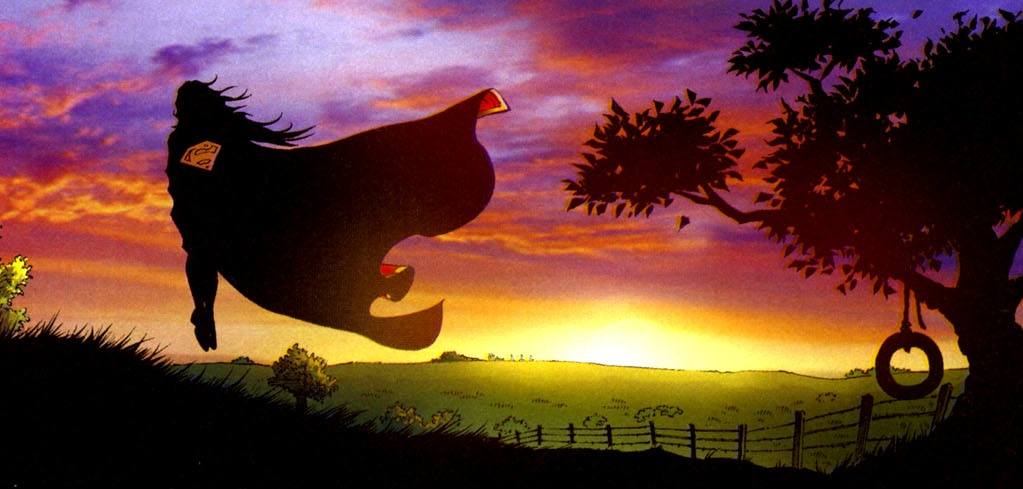
Our next flashback is the most important of the five, as Supergirl visits the Kent farm. This scene--and I never thought I'd say this about this Supergirl series--is brilliant. Kelly contrasts Jeph Loeb's Supergirl with Superman by referencing Jeph Loeb.
Sunshine / On my shoulders / Makes me happySunshine go away today / Don't feel much like dancin'
Why Jeph couldn't do that is beyond me. Even before we get to Supergirl's reaction to the sunrise, we see a fundamental difference between Clark and Kara; Clark is in his civilian clothes, feet firmly on the ground, in touch with the world, human. Supergirl lacks that connection. It's no wonder, then, that her response is "...I don't get it. It's just a lot of wheat...Does something happen?" She doesn't recognize the beauty, doesn't feel that connection with nature. Hell, she misses the whole point, she can't see the sunrise for the wheat.

The scene moves inside, into Conner's room, where Kara picks up his black t-shirt. There, she asks a fantastic question:
I wish I was / Homeward bound
Why didn't Clark invite her to live with him? Clark invited Conner to live with the Kents. Before him, Clark brought home a childlike blob of protoplasm called "Mae" to live with his parents. You know, Mae, short for Matrix, the last major Supergirl. Kara's the odd one out, and it shows.

In the fourth flashback, we see that Kara's Kryptonian home life might have been even weirder than previously thought, as Zor-El asks for her assistance to kill a person who we assume to be Alura (Kara's mother). Through this, and through the prior revelation that she was meant to kill Kal-El, we find that Supergirl is fighting her Kryptonian destiny as well as her terrestrial one, fighting against the 'S' both in terms of what the Superman family expects of her, and what her biological family expected of her.
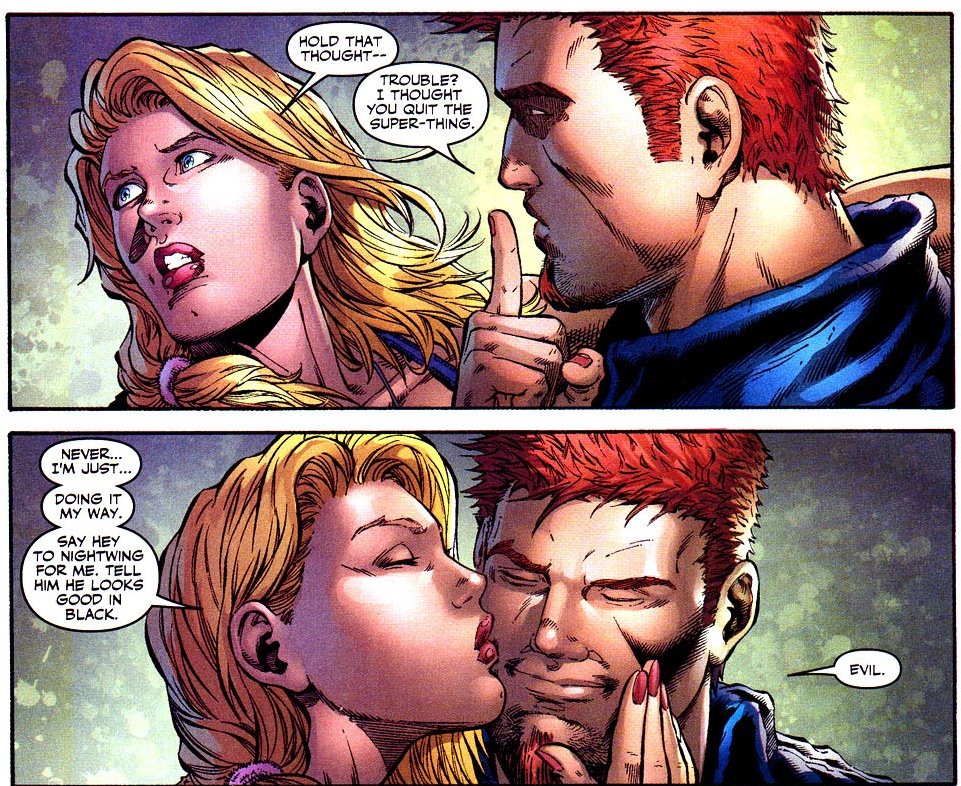
The fifth is a scene with Batman, in which she demonstrates a greater camaraderie with him than with her other 'parents,' neither of whom even appear in the book. This, coupled with her asking Owen to pass a message along to Nightwing, suggests that Kara feels more comfortable with Batman's squad of loners and orphans than with her own superheroic family.

She prepares to leave Owen, in the classic superhero fashion, leading to this scene:
Written on the pages / Is the answer to a Neverending Story
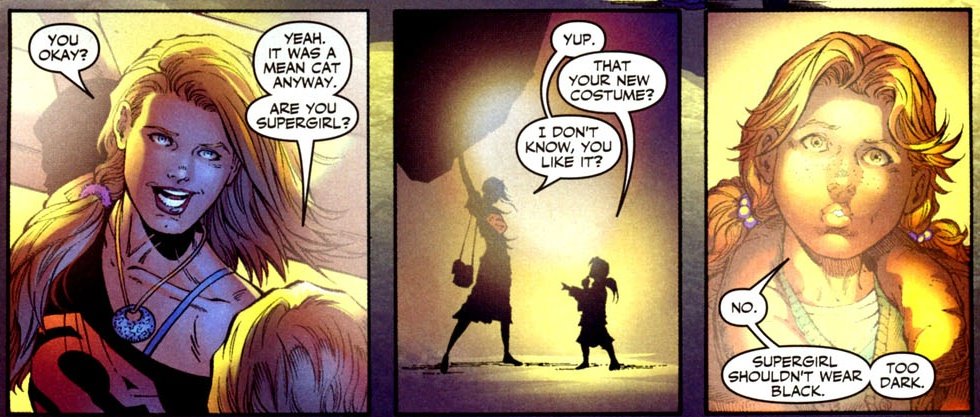
Notice how Supergirl answers Owen's question: "Never." There are several loaded words with regards to Superman, and "never" (more specifically "never-ending") is one of them. Kara rushes off to save a little girl from an oncoming truck, falling back into the Supergirl role, but doing it her way. Then, this exchange occurs:
No colors anymore / I want them to turn black
What's significant here is not the goofy look on Supergirl's face, it's not the "Supergirl shouldn't wear black" line which acts as a jab against Cir-El, a dismissal of Supergirl's "dark side" from Supergirl #5, and admonition against her current attitude. What's significant is that Kara is soliciting advice about her identity. Her whole life, people have been telling her how she ought to be, who she ought to be, and she's rebelled against it. Here, stepping more naturally into the superhero role--doing it "her way"--she can be comfortable taking that sort of advice. Now it's on her terms, not someone else's; she has taken control of her life and her identity, and is on her way to figuring out just who she actually is.

All that, and there's still time for a scene where Kara bonds with a grieving Cassie, passing Superboy's shirt to its more rightful owner.

So by the end of the issue, we have a Supergirl who feels like an outsider to her family, to her Amazon peers, to her adopted planet, and to her homeworld. This feeling is naturally underscored by the fact that she's spent the whole issue with an Outsider, one who occupies a similar position in terms of people's expectations. Both Kara and Owen are trying to define themselves as separate people from their families, but both also carry the weight of destiny and legacy on their shoulders. It's no wonder, then, that Supergirl would find herself more at home with Batman than Superman.
Of course, part of that is that Supergirl lacks Clark's sense of humanity, his ties to the planet. Kara has no civilian identity, she hasn't lived with the Kents, her only friends are other superheroes. With Superboy dead, she finds herself trying to fill his shoes (or shirt), but she finds that his life is no more a perfect fit to her than the life that was thrust upon her. It's really a shame that he's gone; a superpowered teenager trying to live up to a perfect legacy, with a history of identity crises and a secret darkness passed down genetically? They'd have oodles to talk about.
Yet it's clear from this issue that she's not just a clone of Superboy. She's facing similar problems, but unlike Superboy, she really doesn't have a support structure in place to help her solve them. She's a teenager, trying to find her place in the world, trying to fight her father's legacy of death while trying to define her place in her cousin's legacy of hope. She may have floundered for a couple of years, bouncing from personality to personality, expectation to expectation, but it's clear that she's finally made a decision about where she's going to go with her life, and her 'S'. With Wonder Girl and Captain Boomerang, she has the beginnings of a supporting cast, and hopefully she'll be slipping on a pair of glasses sometime in the near future. Then again, maybe not. What we have here is a Supergirl who doesn't fit so easily into a cape, a teenager who's still trying to figure out who she is, and not just who everyone wants her to be.

Do you see all that text? I couldn't have written that much analysis of any previous issue of this series. I'd be hard-pressed to find that much meaning in Loeb's whole arc. This is the first issue of Supergirl since David's run ended where I could consider using words like "subtle" and "nuanced." There's a lot of rough edges, to be sure, but this Supergirl has finally become someone I can care about. Even if Kara hasn't quite found her identity yet, the audience has, and watching her come into that identity should be an interesting trip. Looks like Supergirl is saved from the axe for another month.

Read More!