Friday, November 20, 2009

Bat-Month: "Almost Got 'Im"

Almost got this picture uploaded when I first published the post.This probably isn't a controversial statement, but I think "Almost Got 'Im" is the perfect Batman story. Forget "Year One," forget "Dark Knight Returns," even forget "The Dark Knight"--"Almost Got 'Im" is pure Batman, distilled down to the basic elemental components.

If you've never seen the episode, please stop reading this and go find it. I'm sure it's on YouTube or Hulu if you don't happen to own the entire Animated Series on DVD (in which case, I think that's grounds to take away your comic fan license--for shame!).

Anyway, the episode plays out as a series of vignettes told by Batman's rogues around a poker table in a seedy bar. The beauty of this setup is that it cuts right to the chase--Batman escaping from insane deathtraps--without trying to justify those deathtraps or those dire circumstances by building a whole plot around them. We don't have to know how Two-Face got Batman tied up to a giant penny on a giant penny-flipping device, and I think any story they tried to tell which led to that scenario would be disappointingly ridiculous. Instead, we get to see Batman pacify Poison Ivy's perilous pumpkin patch, survive the Penguin's Aviary of Doom, and earn the Batcave's second-most-famous prop. And of course, there's Croc's deathtrap, which while hilariously apt, is also probably the most likely to work.

Yeah, you know the scene I'm talking about.If the episode had just been Bat-villains sitting around and sharing war stories, it might have been entertaining, but it wouldn't have been great. What catapults this episode up to the legendary level is when the framing story takes over as the main plot, and there's that incredible, unforgettable reveal. That twist--and the one that follows it--present us with everything we need to know about Batman: master of disguise, world's greatest detective, and prepared for absolutely everything. This is Chessmaster Batman, achieved so perfectly and effortlessly by the Animated series staff.

And then Batman saves the day again, leaving us with just a taste of the Batman/Catwoman romance, and the perfect end to a perfect episode.

I'd worry about overhyping this story, about raising your expectations so high that they couldn't possibly be fulfilled, and that's certainly possible. It's also possible that you could watch ten seconds of this episode for one screen capture, having seen it dozens of times before, and still be unable to control the wide grin and giddily triumphant giggle at seeing Batman be Batman. I'll let you guess which camp I'm in.

Wednesday, November 18, 2009

Bat-Month: "On Leather Wings"

Fun Fact: Joel Schumacher's sequel to this episode was called 'On Rubber Nipples.'I watched the first-produced, second-aired episode of Batman: The Animated Series again recently, for the first time in quite awhile. I actually remember watching the episode--and, for that matter, "The Cat and the Claw" before it--when it first aired. Right off the bat--no pun intended--the main pieces are present: the jarring shifts between Batman and Bruce Wayne, the mesh of detective work and sci-fi superheroics, the jovially antagonistic relationship between Bruce and Alfred (even if Alfred does sound really weird in the pre-Efram Zimbalist days), Harvey Bullock's distrust of Batman--even Harvey Dent as the District Attorney and the first taste of the animal transformations that would become something of a motif for the series.

The story is a relatively simple one, and honestly a somewhat strange choice for a first episode. Man-Bat is a fairly minor villain, and only shows up once more in the series' entire run, as I recall. On the other hand, what this episode lacks in intricate plot and iconic battles, it makes up for by giving us a very well-rounded introduction to Batman. Not only do we get to see him playing the monster-battling superhero and the clue-analyzing detective, but we also get some great scenes of the bumbling playboy (and the genius who can use that persona to great effect), the fugitive vigilante on the wrong side of a tenuous relationship with the law, and the antidote-concocting super-scientist. While this episode doesn't do much to introduce the viewer to Batman's rogues gallery, it gives a fantastic introduction to Batman himself.

The episode is still just a little rough around the edges, as you might expect from a first episode (I hesitate to call it a "pilot," because I think it technically wasn't, and I can't call it a premiere, because it wasn't the first episode aired, so "first episode" is the best I have). One of the most jarring scenes is when Danny Elfman's Batman theme makes a prominent appearance, which seems somewhat out of place among the rest of the Shirley Walker orchestration. Obviously, that problem--if it could even be called that--would be worked out quickly, as evidenced by the series' amazing soundtrack. To date, I have a hard time thinking of any animated series that has had anything approaching music as incredible as B:TAS.

So, overall, a pleasant reminder of that afternoon in 1992, and a fantastic taste of the series' potential.

Thursday, November 12, 2009

A short spoilery thought

Spoilers ahead!
So, given Kyle's history, does this mean that he's been dating himself?

I'm more convinced now than ever that Blackest Night will end with a mass resurrection. And now we know what drives Guy over to the Red Side.

Tuesday, November 10, 2009

Bat-Month: "Snow"

"Snow" is an interesting story that brings a lot of great ideas to the Batman comic continuity. How successful it is at bringing those ideas is somewhat debatable. Running in "Legends of the Dark Knight" in 2005, "Snow" is ostensibly a means of bringing the Animated Series version of Mr. Freeze's origin into the DCU proper. What it ends up being, though, is an origin story for the Batman Family.

A simple click embiggens the smallest image.As with something like 84% of all Batman stories, this is set in Batman's early career--explicitly, "year one and a half." It begins with a nice scene of Alfred, checking the mansion for signs of Bruce, and finally finding him, sprawled and bloody, in the cave. This leads to an interesting scene where we learn that Bruce Wayne owns a hospital bed, and has at least one room of his mansion decked out in medical equipment. Sure, that makes sense, but it's interesting to see the contrast of medical equipment and posh hardwood floors.
Oh, I see he goes to the Final Fantasy stylist.The cuts over to Victor Fries present us with what we'd more or less expect. Victor is a distant and somewhat inattentive husband, and Nora is sick with an unknown illness. Victor is naïvely working on a cryogenics project for the military, believing that they would only use it as a deterrent, not a weapon. He also has the worst haircut this side of Egon Spengler and appears to be working for Groucho Marx. After an attack, Nora is diagnosed with Huntington's Disease.

Meanwhile, there's some friction between Batman and Gordon over the former's apparently crude and dangerous methods. After a tense and terse conversation with Harvey Dent, Batman realizes that he needs allies who aren't hampered by the red tape, regulations, and procedures of professional law enforcement, so he lays out a set of files and photos as if he's going to choose Brad Meltzer's next Justice League. Batman sets about recruiting a motley crew of civilians with a variety of personalities and skill sets, and giving them a headquarters in a well-stocked suite.

Nora is rapidly getting worse, so Victor takes her to the cryogenics facility, apparently hoping to put her in stasis. Unfortunately, the device doesn't react correctly, and it turns out that Fries's employers have been running the weapons testing protocol on the device behind his back. He shuts the process down, but Nora's left encased in a block of ice1. Distraught, Victor turns off the safety devices and lets the cryogenic device explode, hoping to commit suicide.

Quick question: has there ever been a successful suicide attempt in a comic book? It seems like any time it happens, it's the prelude to a heroic resurrection or superhero/supervillain origin story.

Of course, Victor survives. He's delerious now, hallucinating Nora as a weird sort of vengeful fairy. He goes after the coworkers who betrayed him, and inevitably his path crosses with Batman's team. Some ill-fated fights leave various members of the Bat-team injured and angry, until one of them goes rogue and tracks Mr. Freeze down himself. The rogue gets frozen and shattered, but not before shattering Nora's frozen body.

Eventually, thanks to the Bat-Team's ingenuity and some good old-fashioned punching, Batman stops Mr. Freeze, though he escapes to plague the Bat another day. Unfortunately, the danger, death, and dismemberment of the team has led Batman to cut them loose--although they were going to quit anyway.

Reflecting on the events, Bruce realizes that he does need backup, but a team presents the problem of conflicting personalities. Instead, he needs someone who can watch his back, someone he can train himself. And wouldn't you know it, there's an ad for Haly's Circus in the newspaper, featuring the Flying Graysons.

I liked the story when it first came out, and I think that it's pretty good overall. The "early Batman" stories are kind of hit-and-miss for me; I understand the appeal for the writers, but I think they tend toward redundancy. Ultimately, the "year one" stories are an extension of the same tactic that gets used throughout fiction where super-powerful characters must be written into dramatically tense situations. Superman gets his powers removed or gets exposed to Kryptonite; Spider-Man's web-shooters break or run out of fluid; the Star Trek away team gets cut off from the ship, the communicators, and the transporters; the slasher heroine's cell phone doesn't have any reception; and Batman gets his utility belt taken away. The "year one" stories go one step further, taking away all his vaunted experience and skill. I understand the need for these kinds of stories, and done well, they can be very good. But done poorly--or too often--and they look like a crutch, like an admission that the plot doesn't fit the characters, and so the characters must be changed to fit it.

But this story never feels like that. Instead, it forms a much-needed bridge between Batman-the-loner and Batman-the-father. Quite frankly, it makes little sense that Batman would jump straight from a solo mission to training a young boy as his partner. This story makes the process a more gradual one, where he tries to form a backup team, but runs into various problems with their individuality and lack of training. His conclusion toward the end feels a little forced, but this chapter in the Batman history explains why he'd be open to training a Robin and taking on a Batgirl.

The Mr. Freeze story fares less well, though. For Batman, Freeze exists here as a glimpse at the future of his crimefighting endeavors: no longer just mob bosses and grinning psychos, but also deranged supervillains with deadly weaponry out of science fiction stories. Freeze represents a further escalation of the Gotham villain, and shows Batman the need to expand his own operation. Freeze serves that purpose well, but the Freeze origin story falters a bit in the process. As with a lot of things, the Animated Series gave us the best Mr. Freeze, largely because it provided him with a touching and tragic origin and motivation. This story attempts to do the same, and hits most of the key points: Victor scientist, Nora sick, attempted freezing, process foiled by unscrupulous superiors, failure of cryogenic device creates Mr. Freeze, revenge. Unfortunately, there are some twists and turns that I'm less happy about, chief among them making Freeze delusional. I understand the parallel--in the beginning, Fries was inattentive and distant, not really paying attention to Nora, and assuming her agreement with his desires. After his transformation, Nora became an avatar for his desires once more, a hallucinatory guide to spur Victor on toward vengeance and to assure him that she could be revived.

I don't care for the idea of Mr. Freeze being crazy. The Animated Series version of the character was hyper-rational and totally emotionless...what's the word for that? Oh right, cold. The version of the character that this story is trying to evoke (at least in terms of the origin) was tragic and relatable precisely because he was so clearly sane, a man driven to do terrible things by remorseless anger and the desire to feel something again. He's the classic character with nothing left to lose, and I think some of that falls away if he's lost his grip on reality as well.

In a more nitpicky vein, I thought it was strange to give Nora a real-world ailment. I understand the desire to make the Batman mythos relatively believable, but I think there's always a danger in setting up real-world diseases as "incurable"--the same way that there's a danger in curing those diseases with sci-fi or magic within a superhero universe. I guess I just expect characters like Nora to be dying of some fictional ailment, not sharing a diagnosis with Thirteen.

Aside from the characterization missteps with Victor, though, I think the story is quite good. I really enjoy the characters in Batman's army, and I think it'd be interesting to see some of them make a return in the modern day.

And the art? Half of the reason I bought this when it first came out was Seth Fisher's art. I became a fan of Fisher through "Flash: Time Flies" and looked forward to his take on Batman. The art is everything you'd expect from Fisher: clean, incredibly detailed, and often bizarre. There are a couple of places where the art goes a little overboard on the cartoonish/presentational side of the continuum...
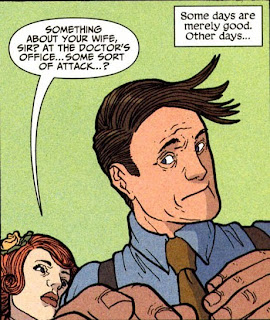
I see he's been hanging out with J. Jonah Jameson.

...but overall the book is absolutely gorgeous. Seth Fisher, like Mike Parobeck and Mike Wieringo, was one of those fantastically talented artists with an amazing style who left us far, far too soon. "Snow" is just a small example of the kind of things Fisher was capable of, and it's a real shame he didn't leave behind a more extensive bibliography.

In summary, "Snow" is an amazing-looking book with a slightly less amazing story, which nonetheless fills a new niche in the "early Batman" mythos. Taken all together, it's quite good, and it's among my favorite of the many stories in this era of the Dark Knight's career--even if I don't care for this version of Mr. Freeze.


1. Presumably to be rediscovered by the Sub-Mariner decades hence.

Bat-Month: Hard day at the office

Oh, hey, a blog! And a theme month! I probably ought to post stuff.

Sorry, I've been really busy with real-life concerns. And by real-life concerns, I largely mean that Season 5 of The Office has consumed every moment of my recent free time (and several moments that were expensive). But I've got a stack of Batman stuff and a day off, so once more into the cave!

Thursday, November 05, 2009

Bat-Month: Remember, Remember

"V For Vendetta" is an Elseworlds Batman story.

Discuss.

Monday, November 02, 2009

Five O'Clock Shadow in Four Colors

My copy is signed. And pierced.As I'm sure I've mentioned before (such as in the "where I buy comics" section on the right), I get my books from the fine folks at Stand-Up Comics, hands-down the best comic shop in Chicagoland. It's through the fine, fine people at Stand-Up Comics that I met the also fine, if stubbly, guys behind Unshaven Comics, a very independent comic company. Some time ago (the first Saturday in May, in fact), Marc Fishman (1/3 of the Unshaven crew) asked me to review their Free Comic Book Day offering, the "Disposable Razors Sneak Preview."

As with everything I do, naturally, it's taken me far longer than it should have to get around to it. I have some excuses, and I really did want to wait until I could give the book my full attention, but I really should have had this review done a considerably long time ago. So without further ado, I present "Disposable Razors: Sneak Preview."

The issue consists of six teasers and a couple of advertisements (one of which is for Stand-Up Comics, clearly the best comic shop in Illinois and Northern Indiana), of varying length and, frankly, quality. I'll tackle them in order, with some wrap-up thoughts at the end.

Saving the world from libido-quashing snacks since 2006.Our first story is near and dear to me, featuring Stand-Up Guy, the superheroic mascot of Stand-Up Comics, the greatest comic shop in the Midwest. Stand-Up Guy is in reality Stanley Dupgui, a mild-mannered reporter and frequent Stand-Up Comics patron and spokesperson. So far, he's appeared as an action figure (with chase variant!), a trading card, and the star of two comic book stories, in that (approximate) order. You can check out his backstory for yourself, as explained on the back of his official trading card.

This makes the Stand-Up Guy story in "Disposable Razors" interesting, because it seems to take place in an alternate continuity for the character--one in which he is a part-time weekend cashier, and his origin is somewhat different (or he's confused about it, which can be No-Prized away with an appeal to the whole mindwiping thing from his backstory). I can't help but be reminded of how the 1940 Superman radio program began with an origin story that wildly contradicted the established comic continuity, which had existed for less than two years. Perhaps this backstory dissonance is a subtle commentary on comic book continuity issues, who can say?

The story itself is built around an amusing premise, where Stand-Up Guy fights his nemesis, Improf Komedy, in the Stand-Up Comics shop, while the owners and proprietors watch (and comment). There are some good ideas here, but overall the story feels like it tries too hard. The humor is too forced, and I can't help but think it might have been better for the Unshaven guys to sit down with the Stand-Up guys and just toss out crazy ideas in conversation for a few hours until something resembing an absurd plot would gel. If nothing else, the humor would be more suited to the coveted 18-25 Illinois Comic Blogger demographic.

Moving on, the second story is an excerpt from "The March," Unshaven's first published graphic novel, about the immigrant experience in America. "The March" came out a few years ago, and just moving from the first story to the second makes that clear. The art is a lot rougher here, and while it's clear that the artist has a great eye for framing shots (whatever the comic book equivalent of direction is in movies), it's even more clear that he's grown quite a lot as an artist since the work was published. The facial expressions are awkwatd, the inking lacks nuance, being largely all-or-nothing, the coloring is inconsistent on the character's skin. Where the art isn't dealing with detailed people, it's spot-on, but the character work is pretty rough. Also, it's kind of weird to see the f-bomb done in comic book censorship style in an indie comic. That's nitpicky, but it kind of sticks out as odd; there's no Comics Code to hold you back, and the current trend seems more toward the "black bars" school of censoring.

That seems overly negative, but let me repeat: just by going back to the previous story (a more recent effort), it's clear to see how much the art has grown. There's still the same eye for well-staged panels, and while some of the faces and bodies are still a bit awkward, the art, coloring, and inking is far more polished in the Stand-Up Guy story.

I apologize, by the way, for doing this review without scans of any sort. I don't have access to a scanner at the moment, but I may come back and re-edit George Lucas the post when I do.

The next story is something called "The White," and the lettering and art lead me to believe it was produced between "The March" and "Stand-Up Guy." I feel like an evolutionary biologist, trying to organize fossils by their traits--it's comic book cladistics. The story--such as it is--follows a young comic fan hipster-type after he falls through some wormhole into a dimension that functions a bit like The Bleed, with portals looking into other worlds. Our nameless protagonist is guided (and mocked) by a Skeets-lookalike robot whose name can be acronymized to "AESOP" (though he's never actually called that--although they hang a lampshade or two on the Skeets appearance) There's some great art here, although the figures and faces are still awkward. Inconsistencies in the protagonist's clothes and hairstyle are handwaved away by an in-story appeal to infinite possibilities and limited perception, but the inconsistencies aren't quite frequent or extreme enough to look intentional. At the end of the story, AESOP changes his appearance to become a floating face instead of a floating robot thing, but the reasoning is kind of odd.

I imagine that this is the pilot story for an anthology-type series, where the protagonist and The White are vehicles for alternate-universe morality plays, making this a kind of Twilight Zone-meets-Sliders concept. That much is cool, and I hope to see Unshaven Comics expand on the idea. Unfortunately, "The White" reads like a brainstorming session rather than a story. It feels like the script and art were done largely together, while the actual universe was still being built, which would explain AESOP's skin change at the end and such--it had to fall in line with the next iteration of the story. It reminds me of stories I wrote as a kid--or portions of my NaNoWriMo novel from a few years back--where I just wrote without really knowing where I was going, and worked out the kinks of the universe through the characters' dialogue. It's not necessarily a bad idea, but it doesn't make for the most compelling read.

I keep ending these reviews on such down-notes, and feeling like I have to do the "criticism sandwich" thing. As I said, the idea is good, it's the execution that needs work, and I have little doubt that this idea will work when there's a story to tell, and not just a framing device to set up.

The next story is the one that stuck most solidly in my mind after first reading the comic months ago, and consequently it's the one I've most looked forward to reviewing: "Ironside: Living Will." The narration in the story is in the form of a somewhat (intentionally) rambling letter from aging World War II-era soldier-superhero Ironside, to his superhero son. Having watched his whole unit die of old age and disease, Ironside is prompted to power up and go down fighting. The characterization is spot-on, as the narrative letter moves from the news of his friend's death, to the realities of war, to advice on superhero costuming, and finally to grudging respect and a final goodbye. It's six pages, but just from the narration we get to see a nicely multifaceted protagonist.

While this is going on, the art is telling its own story. The art and narration are parallel for a page or so, but eventually diverge, as Ironside powers up and puts on his fatigues, then foils a bank robbery by some thugs from 1-800-GO-GOONS and a lame supervillain wearing the Power Glove and Mega Man's Mega Blaster. He brutally assaults the thugs, and it's at least implied that he kills the villain. I've talked about my love for this kind of storytelling device before--Robert Kirkman has used similar devices a couple of times--where the words and art tell separate stories. It's something that really only works in comic books, and it's nice to see the medium's idiosyncracies being used as an asset. The narrative/art divide drives home the apparent point: that Ironside is going to go out not like a hero, but like a soldier, brutally taking down the supervillain enemy one by one. There are some elements to the story--and not just the protagonist's metallic skin--which remind me of the "Tarnished Angel" story in Astro City, and that's a pretty positive connection to build.

The art here is black-and-white, in contrast to the rest of the book, and I think that's a good thing overall. The inking is a little heavy (as it is elsewhere in the issue), but that works out well here with the darker story and the metallic protagonist. Some work could be done on the faces in some panels, but overall this is the most artistically polished story in the book, and the most compelling one to boot. I hope Unshaven Comics follows up on this story in the future; they have at least one guaranteed customer if they do.

The next story is a four-panel comic strip called "Ra: the Happy Sun God." I really can't describe it without going far too long-winded, so I'll just say that it feels like it'd make a pretty fun webcomic. That's not meant to be a knock on it, by the way. The simplified art is well-done, and I think the rest of the stories (with the possible exception of "Ironside") might do well to take a page from this style. The linework is clean and simple, a stark contrast to the often sketchy linework of other chapters. Again, this sounds more negative than it's meant to be; "sketchiness" is a stylistic choice as well (see also: John Romita Jr., Tom Mandrake, Bill Sienkewicz), but I think a little cleanup in the inking stage would help out in a lot of places--and this little strip is proof of that. The one complaint I have is that there are a lot of faint horizontal lines in each of the panels, and I;m not sure if that's an artifact of the paper or the scanning or what. In any case, it almost makes it look like the strip was initially drawn on note paper, which doesn't look particularly professional.

"Chasing Daylight: Prologue" is a one-page introduction to what appears to be a vampire story, narrated from the vampire's point of view. The art is great here, with just the right amount of detail, just the right amount of inking, and some very good coloring. There aren't many faces here, which makes it hard to compare to the other stories' biggest trouble spots, but what's apparent looks like an improvement. The biggest flaw I notice is in some wonky perspective on a car door in the first panel, which is a pretty minor detail. There's not much to the story, just a guy abandoning his car to try to escape a vampire on foot (and naturally failing), so I can't really evaluate that. I can't say that the preview does too much for me; it's too short to provide any interesting twists or tweaks on the vampire genre that would draw me in, and I think the market on bloodsuckers is largely saturated right now. I'd certainly be willing to re-examine this opinion in light of longer stories, but I doubt I'd get as excited about this as I am about "Ironside."

The final page is an ad for "The All New Samurnauts," which looks like a spacefaring Power Ranger-style team led by "an immortal samurai monkey." I'd have to know a little more about the premise before I could say anything about the series--particularly how seriously it's going to take itself--but monkeys, astronauts, and evil dinosaurs sounds like the recipe for fun comics.

Oh, and before I forget, I really like the cover.

So, overall? It's a mixed bag. "Stand-Up Guy" is fairly fun, but with limited appeal. "The Stand" has some rough art, but I can't say much about the story based on this excerpt. "Chasing Daylight" has a nice look to it, but I'd need to read more before anything would hook me. "The White" looks and feels pretty rough, but I think it'll work well if/when it's not the focus. "Ra: The Happy Sun God" would make a fun backup feature or webcomic, though I'm not sure it could carry its own issue or series. Finally, there's "Ironside," which I recommend without reservation.

The bottom line is that the Unshaven Comics crew have quite a bit of potential. At times, that potential comes through full-force, and at times it feels rougher and less refined. You can piece together a pretty clear learning curve throughout the preview, and that bodes well for their next release.

Speaking of which, I've just received word from Unshaven Marc that said release, which follows through on "The White," "Chasing Daylight," and "Ironside," will be released in time for Christmas. "Ironside" alone would be enough to make me run out and purchase it, but I'm curious to see where "Chasing Daylight" ends up, and how well "The White" works as a framing device (by the way, I totally called that). If you're in Illinois or Indiana, it's only a short trip to Stand-Up Comics, the best comic shop in America, which is guaranteed to be carrying Unshaven Comics in December, or you can watch the Unshaven Comics website for further news. Based on the preview, I recommend giving their upcoming release a shot, and I'm curious to see where it all goes from here.

Sunday, November 01, 2009

Bat-Month: To Be Continued!

I figured, if I could give Superman a sixty-day-long "month" of celebration for his 70th birthday, it's only fair to do the same for Batman. I've been busy, so I haven't been posting as much as I'd like, and I've been caught up on a couple of reviews that I haven't quite finished. I've got half of a review of "Batman: Venom" that I wanted to finish before I tackled "Batman: Snow," so those are both coming up soon. I'm going to do some quick-ish reviews of various Batman: TAS episodes, running through some of my favorites. I also have grand plans to liveblog several Batman films, but we'll see how that works out.

Oh, and as a final note, I have an important, heavily belated non-Batman-related review to write that, if all goes well, will be out by Monday. Keep your fingers crossed.