Could it be?
Bat-Month - Over?
Our Dynamic Duo dropped from their spotlight?
The Fortress, lying fallow?
Movies unwatched? Comics unreviewed?
All this and more will be revealed in our next stunning installment!
So tune in next month: Same Bat-Time, Same Bat-Channel!

Saturday, October 31, 2009

Bat-Month: "Hi Diddle Riddle"/"Smack in the Middle"
I've always loved the Riddler, and I've very rarely seen a version that I didn't like1. I don't care for the design of the Riddler on "The Batman," but I've never watched enough of that series to know if I like the portrayal. But outside of that, I like the "private investigator" version of the character in the current comics, I generally liked the character even in "Hush," I loved solving his puzzles in "Batman: Arkham Asylum," and I'm not sure there's ever been a better Riddler story than "If You're So Smart, Why Aren't You Rich?"
So it's interesting to take a look back at Frank Gorshin's version of the character, who made "The Riddler" a household name, and "riddle me this" a common phrase. "Hi Diddle Riddle" and "Smack in the Middle" are the first two episodes of "Batman" '66, and there's really something to love in a Batman series that begins with a Riddler story.
The episode begins with a scene at the Gotham City World's Fair, where the Moldavian Prime Minister is about to unveil his country's greatest national treasure. Before he does that, though, he has to cut the traditional Moldavian friendship cake, which explodes. As the crowd panics, a police officer points to something that shot out of the cake and is now floating to the ground on a parachute.
We cut to Commissioner Gordon reading the para-riddle:
Which leads to what is, by now, a familiar scene: the Gotham City Police Department shamefacedly admitting total inability to solve children's puzzles and stop a criminal whose greatest weapon is a bowler hat, and turning toward the bright red phone under a serving dome that really only slows down the process.

Alfred answers the phone and goes to retrieve Bruce. Commissioner Gordon looks up from the phone and says, "We're in luck: he's at home." How many unfettered sprees have occurred while Batman was out getting groceries?
Anyway, this actually leads to a very unfamiliar scene in this series: Bruce Wayne speaking before a group of people, pledging his financial support for their enterprise. His reason:
It's one of very few callbacks to Batman's origin in this series, which is somewhat unsurprising given how dissonant that is with the lighthearted nature of the show. I admit, it's difficult to reconcile the modern Batman, whose persona clearly comes out of the Crime Alley tragedy, with this version, who takes time out of crimefighting to properly parallel park, but it's interesting to see that the origin wasn't excised (or ignored) entirely. Robin, on the other hand...
Bruce gives the excuse of taking Dick fishing, and I know it's not the only time he's used that same excuse in the half dozen or so stories I've recently watched. What does he say in the Winter? Ice fishing?
"Atomic batteries to power, turbines to speed..." yeah, it does give me a little geek thrill to hear that.
Perhaps the other half of the homophone was more well-known in 1966, but I still think the answer to the Joker's riddle could have used more explanation; it makes more sense in writing than it does out loud:
Sure, Batman, I get it, but I have a relatively large vocabulary.
Gee, Chief, it might be because you immediately gave up and called Batman, rather than even considering answers to the riddle.
Batman and Robin discuss the Riddler's modus operandi, explaining that he leaves confounding clues that may or may not direct them to the real crime, leading to this gem of a simile:

This screenshot is from the moment after he says "artichokes": it looks to me like Commissioner Gordon (in the back) is as shocked and confused at the comment as I am. Do tell, Batman:
Oh...okay. Batman's rambling eventually leads him to realize that the Riddler's target is the Peale Art Gallery--next to, I assume, the Steede Museum--but suspecting some trickery, he tells the cops to stay put while he and Robin mount their investigation. Upon arriving at the Gallery, Batman lets loose with this line that sounds like it's half-Middleman and half-fodder for Ambiguously Gay Duo jokes:
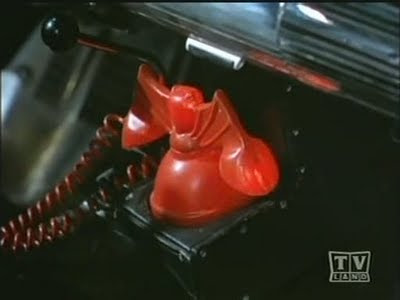
There are a couple of things I like about the Batmobile Phone. First, it reminds me of the old car phone my family used to have, which was bulky and unwieldy and corded. Second, I like that it's shaped like a bat, but the Bat-Phone isn't. Given that the Bat-Phone sits out in Bruce Wayne's sitting room, this demonstrates an uncharacteristic amount of subtlety and attempt to conceal his secret identity. I mean, sure he's got a translucent red telephone in his sitting room that looks identical to the one the police use to call Batman, but at least it isn't bat-shaped.
The sign on the wall behind the Bat-Poles more than makes up for that subtlety, though:
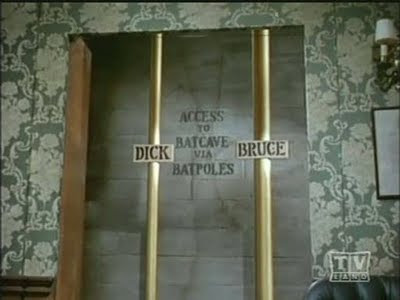
I mean, I understand labeling the poles themselves (making that mistake would be disastrous for all involved), but who is that sign for? Are Bruce and Dick afraid that they're going to forget what's at the bottom of the poles?
The phone call is from the Riddler--or rather, a recording of the Riddler2--giving them another riddle to solve:
Rather than solving the riddle, they decide to scale the building so as to ambush him. Robin is struggling to figure out the Riddle, and Batman suggests that it's because his mind's preoccupied with "that cute little teenager who waved to you on the way across town." I like that kind of good-natured ribbing between the Dynamic Duo; it's another instance of this series sneaking in a bit of character depth even when you wouldn't expect it.
Climbing up to a barred window, they find this scene--and doesn't the Riddler look dashing?
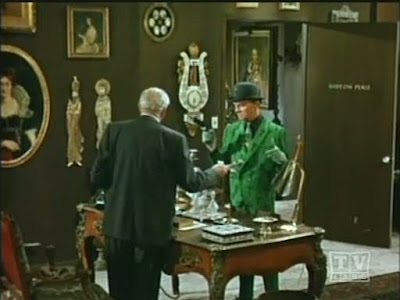
Seriously, that's a nice outfit, especially for a 1960s supervillain.
Batman cuts through the bars with some kind of laser torch, and then the duo crashes through the window to ambush the Riddler. They place him under arrest for armed robbery (as duly deputized officers of the law), at which point two goons come out and take a picture of the scene. The Riddler starts giggling and says he even tipped them off. Then, the curator chimes in:
Batman isn't quite convinced, noting that he saw Peale being held at gunpoint. The Riddler then demonstrates that the gun isn't a gun at all:

I like that one, but then I'm a fan of puns.
Mr. Peale explains that Batman and Robin saw Riddler lighting his cigarette while Peale gave him back the cross. It's a contrived set of circumstances, but then again, this is the Riddler we're talking about. He foresaw Batman's blunder, which is why he brought witnesses with cameras. He then poses this brilliant riddle:
Dare I say it? Yes, I dare:

Batman got served!
After the break, we find Bruce, Dick, and Alfred watching the news report, which addresses in somber tones the prospect that Batman and Robin will almost certainly have to unmask in court, thereby ending their crimefighting careers.
Bruce says here that he's been through all his father's old law books, which suggests that Thomas was a lawyer in this continuity, or perhaps some sort of polymath. He doesn't think they have a leg to stand on. Alfred, always one to find the dark cloud behind every silver lining, brings up the point that things will not be pleasant once Aunt Harriet finds out what Bruce and Dick have really been doing on their "fishing trips." This is a good point, though a sad one: given her comments and behavior, I wouldn't be surprised to see Aunt Harriet press charges for endangering a minor. Bruce could end up sued and imprisoned all in one fell swoop.

There is an awkward and somber silence for a moment, until Dick takes a look at the lawsuit itself. He remembers what the Riddler said when he handed it to them:
He and Bruce reason that he meant two other riddles, which must be on the legal document. They look at it with some blinking lights and what looks like a shiny rotary sander:

And discover riddles written between the lines. Curse those lawyers and their fine print!
Sure, they explain that one with Robin making train noises, but they leave the "peal" one up to the viewer to make sense of.
This leads them to an address: 222 Glover Avenue.
We cut to the underground subway lair of the Mole Hill Mob, where Jill St. John is eating caviar out of a jar3. One of the wiseguy gangsters tells her not to, because the caviar's full of calories and she'll blow up like a balloon. Good to see such equality among the criminal set. Quickly, the Riddler comes bounding down the stairs in a much less dashing outfit, proclaiming that Batman's had time to solve the riddle.

Now seems like as good a time as any to digress a moment. This story, like the Penguin one that follows it, shows the villains to be particularly brilliant by having them use Batman's own traits against him. The Penguin played on Batman's detective skills, knowing that he'd see connections and patterns where none existed. Here, the Riddler plays on Batman's overwhelming respect for the law, knowing that it trumps his need for secrecy. Riddler here even has the Duo down to a set pattern, knowing how long they typically need to find and solve his clues. What this does, compared to Batman's own methods of detection and deduction, is set the rogues up as his intellectual equals, just as able to deduce things about his life and find patterns in his methods as he does with theirs. This is, rather sadly, often missing in the modern Batman stories.
The Riddler and his Mob head through the tunnels, presumably to Glover Avenue. Meanwhile, the Batmobile speeds down the street to the address--the new discotheque, What A Way to Go-Go. Suspecting a plot to rob the wealthy patrons, they start to head inside, but the doorman says that Robin is underage. Batman's response? You guessed it: "It's the law." While he suspects that this may be a plot to separate them, the law trumps safety. Besides, Robin says he can take care of himself. Batman here takes Lawful Good to new extremes.
Incidentally, while Robin's too young to go into the club, he's old enough to drive the Batmobile:

He parks so he can watch the Bat-scope. What's he watching, you ask?

Typical teenager.
Batman looks really out of place inside the club, while Jill St. John (her character still hasn't gotten a name) watches him from the bar.

He orders a large fresh orange juice at the bar4, and Jill asks him a riddle:
Batman's OJ arrives, and we get this stunning exchange:
Bats, you're making it very difficult for me to avoid the gay jokes.
Batman and Molly dance, and you know what's coming next:

THE BATUSI!
Things start to go blurry for the Bat, and he realizes his drink was drugged. Robin sees him collapse on the Bat-Scope, but before he can get out of the car, he's shot with a hypodermic dart by the Riddler. Molly and the bartender head down the manhole back to their lair, while the Riddler accidentally triggers the Batmobile's anti-theft device--which is a bit of ingenuity cribbed straight from the Evil Overlord List:


Since he can't steal the car, he kidnaps Robin and throws a small bomb into the car to burn it up. This triggers naturally, the Batostat anti-fire device, which puts out the flame5. Cursing the car, Riddler escapes with his gang, Robin in tow. Batman rushes out of the club to the car, to go after Robin. The police officers won't let him out of the parking spot, though:
Again, the Riddler plays on Batman's adherence to the law to ensure that he won't be followed, even though he could neither steal nor destroy the car. Also, this scene is pure awesome.
Back at the Riddler's lair, Robin is trapped, unconscious, with his head in a vise. Naturally, it's on this cliffhanger that the episode ends, with a teaser for part two:

I'm a little curious here why the Riddler would even bother with the kidnapping scheme, as it would seem to undermine his ability to file the lawsuit. I would think that the best course of action would be to let the legal process do its work, rather than engaging in typical supervillainy. Then again, I don't have a compulsion to commit criminal acts and leave cryptic clues behind for the heroes to solve, so what do I know?
Either way, it's an excellent example of the core problem of Bat-villains: they may be Batman's intellectual equals, but their criminal compulsions consistently cause their capture.
Episode two begins with dawn at stately Wayne Manor, where Batman is in the Batcave (presumably having been up all night) telling Robin through some communicator to turn on his homing device. I have to imagine it's been awhile since we last saw the Boy Wonder, and Riddler was tightening that vise pretty quickly. On the other hand, it has to be pretty tough to crush someone's skull with a vise, maybe he gave up and decided to do something more practical.
Alfred calls from upstairs, saying that Miss Cooper noticed their beds hadn't been slept in, and was quite upset. Batman says to tell her that he and Dick are spending the night at his uncle's house. One problem, Bruce: if you had an uncle, why were you raised by your butler?
At the Riddler's hideout, Riddler and Molly pull a plaster cast off of Robin's face. Oh, I see, the vise was just to hold him still. While she goes off to get into costume, Riddler wakes Robin up (with an aerosol spray, thereby contributing to the hole in the ozone layer, that dastardly ghoul!):
And thus the Boy Wonder falls prey to the Riddler's tricky reverse psychology, calling Commissioner Gordon just as he was told to do. Gordon gets the call plugged into the Bat-line, and tells the operator to trace and record it. Batman answers the phone, which Riddler grabs rather quickly:
Robin tries to warn Batman that it sounds too easy, but Riddler gasses him unconscious again. Batman deduces the location--the old turtle mill at Orleans Cove--and speeds off in the Batmobile.
Meanwhile, Molly walks in, with the image that spawned a thousand fetishes and "sexy" DC Halloween costumes:
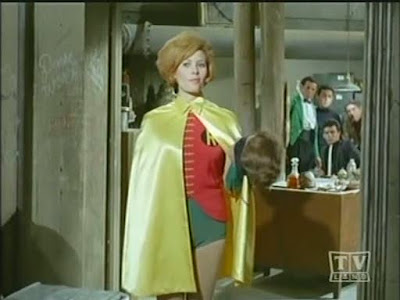
Somehow, by application of a rubber mask, that turns into this:

Batman drives recklessly to Orleans Cove (seriously, he's all over the road--I guess those laws don't matter), while Molly activates the homing beacon in Robin's belt. Batman chases after the Riddler's car, knocking out the ignition with headlight-mounted Bat-Rays. Riddler, of course, is prepared:

The car crashes, and Riddler runs for the hills, while Batman pulls up to find Robin, thrown from the wreckage and clutching at his throat. Batman understands that there's something wrong with his vocal cords, then takes Robin back to the Batcave, where he hopes to retrieve the universal drug antidote7.
Molly quickly shows her true colors.
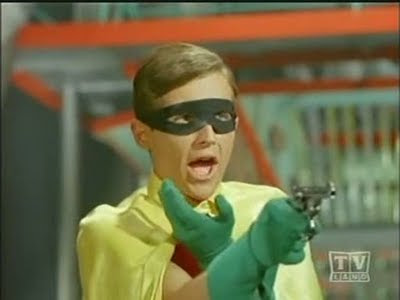
She pulls the trigger, but nothing happens. Batman informs her that he burned off the revolver's firing pin in the Batmobile with a hidden "Bat-Layzar beam." And yes, he pronounces it "lay-zar."
Molly throws the gun8 and runs away, climbing what appears to be a TARDIS console or warp core in the back of the cave:

Batman warns her to stop, that she's climbing into the Batmobile's nuclear power source. She looks down into the reactor and screams for help, while Batman pulls out a Batarang (or as it's spelled on his belt, Bat-A-Rang) to save her. He climbs up, but can't reach her. She slips, falling to her death in the nuclear reactor. Batman is dismayed:
Then, he's a dick.
Oh Batman, you and your incredibly inappropriate gallows humor.
At police headquarters, Batman, Gordon, and O'Hara analyze the tape of Robin's phone call. It cut off before they could get a trace, and O'Hara notes what a bad recording it is, due to all the rumbling noises. Batman notes that the noises are actually helpful (which comes as a surprise to the totally useless police officers, who have apparently never thought to listen to the background noise of an emergency call), and explains that they're subway trains. Batman asks for a timing on the tape and a subway schedule, which he plugs into the Batmobile's mobile crime computer. The computer spits out a paritcular platform, which is apparently located next to the entrance to CONTROL:

Using what appears to be a set of Bat-plastic explosives, Batman breaks into the Riddler's lair, where he snares the fiend in a Batrope. But the Riddler is still several steps ahead, separating himself from Batman and Robin with a sheet of bulletproof glass. He then proceeds to taunt the Bat:

Batman releases Robin, who explains that, by playing possum, he was able to listen in on the Riddler's big plan--and his new riddles:
With these clues, they are able to deduce that the Riddler is going to the head office of the Gotham National Bank, where he's going to take the money from the inside to the outside.
Narration informs us, however, that the Riddler and his gang are heading through the tunnels to the Moldavian pavilion at the Gotham City World's Fair, suggesting that Batman has goofed.
At said pavilion, the Prime Minister is showing off the Great Mammoth of Moldavia, which was found in ice and worshipped by his people. It's covered in various jewels, and stuffed entirely with used postage stamps from ancient Moldavia--"very cheap stuffing then, but now worth unspeakable fortune to stamp collectors." Um...yeah. This is strangely omitted from the Wikipedia entry on Moldavia
Underneath the pavilion, the Riddler's men are rigging up tanks of laughing gas--stealing the Joker's schtick!--presumably because Riddler's latest outfit isn't quite ridiculous enough:

Turquoise plaid and magenta accessories? Amazing.
Riddler breaks in (wearing an elephant-shaped gas mask), telling lame jokes to start everyone laughing until they're unconscious. He then signals his goons to break in, so they can steal the mammoth.
Suddenly, Batman and Robin burst forth from the creature! They sent the police to the bank as a ruse; Robin says he got the clues wrong, but Batman solved them.

Naturally, it's time for the fight scene, where Robin really takes it. First he's ambushed by three goons, then knocked for a loop by the Riddler. With Robin apparently out, the gang closes in on Batman, restraining him the same way. Robin breaks up the fray, allowing the Dynamic Duo to get the upper hand, but the Riddler escapes under the pavilion. Batman chases, Riddler shoots, and a laughing gas canister is punctured. Batman warns that if the gas ignites, it'll blow him to kingdom come. Batman climbs back out, just in time to avoid a huge explosion of colored smoke.
Back at Wayne Manor, Alfred shares the news from the wireless regarding the Riddler's lawsuit: apparently it was dismissed because the plaintiff failed to appear. Dick is oddly happy about the prospect of having killed the Riddler in an explosion, but Bruce reminds him that the police never found a body, so maybe he escaped. The scene at the end here is actually really good, so rather than quote it, I'll let you watch it:
I'm glad that was on YouTube, because I don't have access to any video editing software at the moment.
Overall, I really like this story. There's a lot of heart to it, with the Molly subplot, and the Riddler's plan is a great example of the way brilliance can be led astray by delusion and compulsion.
I compared these episodes to the Penguin story that followed, and I think they both do a great job of subverting common superhero storytelling tropes. The villains undermine Batman by using his own skills and compulsions against him, and that's a depth of storytelling that no one seems to give this series credit for. The real danger comes from doing this as a first episode. Subverting tropes and upending clichés is great, but the effect is lost if the audience isn't familiar with the tropes and clichés in the first place. It's like watching "Shrek" without ever having heard a fairy tale.
"Star Trek: The Next Generation" made that mistake with their second episode, "The Naked Now." A direct homage/ripoff of the Original Series episode "The Naked Time," the episode featured the crew acting uninhibited and out of character. Such episodes are often great ways to explore the characters' personalities and shock the audience with familiar people doing unexpected things. Unfortunately, the episode lost any impact it might have had because we'd only had one story to establish what "in-character" was.
These "Batman" episodes work in a way that "The Naked Now" didn't, but I'm quite familiar with the superhero tropes they're subverting; would the average audience member in 1966 have been as familiar?
It's possible that they would have. After all, "The Adventures of Superman"--which would have had such tropes--ended only eight years before, and the comic book market was much larger then. Still, it seems like it'd be prudent to start the series by establishing the tropes and then working to turn them on their heads.
As a final note, Gorshin's Riddler is fantastic. I was a little worried that his manic portrayal and high-pitched giggling would rub me the wrong way with the character, but the writing made him out to be a mastermind, and his (surprisingly nuanced) acting sold the story. While he's often mocking Batman for falling into his numerous traps, there are some great moments where his voice drops an octave or two and he becomes fairly genuinely menacing. Heck, there's a shot or two where he looks like Hannibal Lecter. For all his bouncing and giggling, there are scenes where he serenely allows the pieces to fall into place, and his calmly triumphant expressions are perfect:
I'd like to say that Gorshin's Riddler influenced other portrayals of the character--it probably did; his suit-and-bowler from early in the episode was definitely the genesis of the B:TAS version's costume--but more than that, I think Gorshin has influenced portrayals of the Joker. I can't help but see parallels to Mark Hamill in Gorshin's acting.
So there you have it, another surprisingly excellent installment of "Batman." I'm enjoying this series so much, I may have to continue it...
1. By "rarely," I mean "Jim Carrey."
2. Holy telemarketing, Batman!
3. The jar, incidentally, formerly contained moonbeams.
4. I like this, just because it has interesting resonance for the World's Finest team. Batman orders orange juice at the bar, but Superman (typically) orders milk. And I don't know about you, but milk and orange juice aren't tastes that go particularly well together, even though they both quench your thirst at breakfast.
5. In the future, Batman would avoid these problems by not driving a convertible.
6. Surprisingly enough, the answer is not "wood." Though I have it on very good authority that she weighed the same as a duck.
7. I leave it to you, readers: is withholding that formula from the public an act of Bat-uselessness, or Bat-evil?
8. Who does she think she's fighting? Superman?
So it's interesting to take a look back at Frank Gorshin's version of the character, who made "The Riddler" a household name, and "riddle me this" a common phrase. "Hi Diddle Riddle" and "Smack in the Middle" are the first two episodes of "Batman" '66, and there's really something to love in a Batman series that begins with a Riddler story.
The episode begins with a scene at the Gotham City World's Fair, where the Moldavian Prime Minister is about to unveil his country's greatest national treasure. Before he does that, though, he has to cut the traditional Moldavian friendship cake, which explodes. As the crowd panics, a police officer points to something that shot out of the cake and is now floating to the ground on a parachute.
We cut to Commissioner Gordon reading the para-riddle:
Why is an orange like a bell?
Which leads to what is, by now, a familiar scene: the Gotham City Police Department shamefacedly admitting total inability to solve children's puzzles and stop a criminal whose greatest weapon is a bowler hat, and turning toward the bright red phone under a serving dome that really only slows down the process.

Alfred answers the phone and goes to retrieve Bruce. Commissioner Gordon looks up from the phone and says, "We're in luck: he's at home." How many unfettered sprees have occurred while Batman was out getting groceries?
Anyway, this actually leads to a very unfamiliar scene in this series: Bruce Wayne speaking before a group of people, pledging his financial support for their enterprise. His reason:
Perhaps if there'd been anti-crime centers of the type you now propose when my own parents were murdered by dastardly criminals...
It's one of very few callbacks to Batman's origin in this series, which is somewhat unsurprising given how dissonant that is with the lighthearted nature of the show. I admit, it's difficult to reconcile the modern Batman, whose persona clearly comes out of the Crime Alley tragedy, with this version, who takes time out of crimefighting to properly parallel park, but it's interesting to see that the origin wasn't excised (or ignored) entirely. Robin, on the other hand...
Bruce gives the excuse of taking Dick fishing, and I know it's not the only time he's used that same excuse in the half dozen or so stories I've recently watched. What does he say in the Winter? Ice fishing?
"Atomic batteries to power, turbines to speed..." yeah, it does give me a little geek thrill to hear that.
Perhaps the other half of the homophone was more well-known in 1966, but I still think the answer to the Joker's riddle could have used more explanation; it makes more sense in writing than it does out loud:
Batman: Why is an orange like a bell?
Robin: Answer: because they both must be peeled!
Batman: Right, you peel an orange and you peal a bell! Get it?
Sure, Batman, I get it, but I have a relatively large vocabulary.
Chief O'Hara: What idiots we are! Now, why couldn't we have worked that out?
Gee, Chief, it might be because you immediately gave up and called Batman, rather than even considering answers to the riddle.
Batman and Robin discuss the Riddler's modus operandi, explaining that he leaves confounding clues that may or may not direct them to the real crime, leading to this gem of a simile:
Batman: The Riddler contrives his plots like artichokes:

This screenshot is from the moment after he says "artichokes": it looks to me like Commissioner Gordon (in the back) is as shocked and confused at the comment as I am. Do tell, Batman:
You have to strip off spiny leaves to reach the heart.
Oh...okay. Batman's rambling eventually leads him to realize that the Riddler's target is the Peale Art Gallery--next to, I assume, the Steede Museum--but suspecting some trickery, he tells the cops to stay put while he and Robin mount their investigation. Upon arriving at the Gallery, Batman lets loose with this line that sounds like it's half-Middleman and half-fodder for Ambiguously Gay Duo jokes:
Batman: Let's mosey up the back way.

There are a couple of things I like about the Batmobile Phone. First, it reminds me of the old car phone my family used to have, which was bulky and unwieldy and corded. Second, I like that it's shaped like a bat, but the Bat-Phone isn't. Given that the Bat-Phone sits out in Bruce Wayne's sitting room, this demonstrates an uncharacteristic amount of subtlety and attempt to conceal his secret identity. I mean, sure he's got a translucent red telephone in his sitting room that looks identical to the one the police use to call Batman, but at least it isn't bat-shaped.
The sign on the wall behind the Bat-Poles more than makes up for that subtlety, though:

I mean, I understand labeling the poles themselves (making that mistake would be disastrous for all involved), but who is that sign for? Are Bruce and Dick afraid that they're going to forget what's at the bottom of the poles?
The phone call is from the Riddler--or rather, a recording of the Riddler2--giving them another riddle to solve:
Before you trip over your cape, Batman, riddle me this: There are three men in a boat with four cigarettes but no matches. How do they manage to smoke?
Rather than solving the riddle, they decide to scale the building so as to ambush him. Robin is struggling to figure out the Riddle, and Batman suggests that it's because his mind's preoccupied with "that cute little teenager who waved to you on the way across town." I like that kind of good-natured ribbing between the Dynamic Duo; it's another instance of this series sneaking in a bit of character depth even when you wouldn't expect it.
Climbing up to a barred window, they find this scene--and doesn't the Riddler look dashing?

Seriously, that's a nice outfit, especially for a 1960s supervillain.
Batman cuts through the bars with some kind of laser torch, and then the duo crashes through the window to ambush the Riddler. They place him under arrest for armed robbery (as duly deputized officers of the law), at which point two goons come out and take a picture of the scene. The Riddler starts giggling and says he even tipped them off. Then, the curator chimes in:
Mr. Peale: Batman, you've made a mistake: He didn't steal that cross.
Robin: What?!
Curator:I tell you, it belongs to him! He lent it to me for a show!
Batman isn't quite convinced, noting that he saw Peale being held at gunpoint. The Riddler then demonstrates that the gun isn't a gun at all:

Robin: Holy ashtray, he did tip us off! There were three men in a boat with four cigarettes and no matches. How did they manage to smoke? They threw one cigarette overboard and made the boat a cigarette lighter!
I like that one, but then I'm a fan of puns.
Mr. Peale explains that Batman and Robin saw Riddler lighting his cigarette while Peale gave him back the cross. It's a contrived set of circumstances, but then again, this is the Riddler we're talking about. He foresaw Batman's blunder, which is why he brought witnesses with cameras. He then poses this brilliant riddle:
Riddler: Ho ho! What is it that no man wants to have, yet no man wants to lose?
Robin: A lawsuit!
Riddler: Correct, Boy Wonder!
Dare I say it? Yes, I dare:

Batman got served!
After the break, we find Bruce, Dick, and Alfred watching the news report, which addresses in somber tones the prospect that Batman and Robin will almost certainly have to unmask in court, thereby ending their crimefighting careers.
Bruce says here that he's been through all his father's old law books, which suggests that Thomas was a lawyer in this continuity, or perhaps some sort of polymath. He doesn't think they have a leg to stand on. Alfred, always one to find the dark cloud behind every silver lining, brings up the point that things will not be pleasant once Aunt Harriet finds out what Bruce and Dick have really been doing on their "fishing trips." This is a good point, though a sad one: given her comments and behavior, I wouldn't be surprised to see Aunt Harriet press charges for endangering a minor. Bruce could end up sued and imprisoned all in one fell swoop.

There is an awkward and somber silence for a moment, until Dick takes a look at the lawsuit itself. He remembers what the Riddler said when he handed it to them:
When you've chewed over this one, look for two others.
He and Bruce reason that he meant two other riddles, which must be on the legal document. They look at it with some blinking lights and what looks like a shiny rotary sander:

And discover riddles written between the lines. Curse those lawyers and their fine print!
Batman: When is the time of a clock like the whistle of a train?
Robin: When it's two to two--toot too tooo!
Sure, they explain that one with Robin making train noises, but they leave the "peal" one up to the viewer to make sense of.
Batman: What has neither flesh, bone, nor nail, but has four fingers and a thumb?
Robin: A glove, of course!
This leads them to an address: 222 Glover Avenue.
We cut to the underground subway lair of the Mole Hill Mob, where Jill St. John is eating caviar out of a jar3. One of the wiseguy gangsters tells her not to, because the caviar's full of calories and she'll blow up like a balloon. Good to see such equality among the criminal set. Quickly, the Riddler comes bounding down the stairs in a much less dashing outfit, proclaiming that Batman's had time to solve the riddle.

Now seems like as good a time as any to digress a moment. This story, like the Penguin one that follows it, shows the villains to be particularly brilliant by having them use Batman's own traits against him. The Penguin played on Batman's detective skills, knowing that he'd see connections and patterns where none existed. Here, the Riddler plays on Batman's overwhelming respect for the law, knowing that it trumps his need for secrecy. Riddler here even has the Duo down to a set pattern, knowing how long they typically need to find and solve his clues. What this does, compared to Batman's own methods of detection and deduction, is set the rogues up as his intellectual equals, just as able to deduce things about his life and find patterns in his methods as he does with theirs. This is, rather sadly, often missing in the modern Batman stories.
The Riddler and his Mob head through the tunnels, presumably to Glover Avenue. Meanwhile, the Batmobile speeds down the street to the address--the new discotheque, What A Way to Go-Go. Suspecting a plot to rob the wealthy patrons, they start to head inside, but the doorman says that Robin is underage. Batman's response? You guessed it: "It's the law." While he suspects that this may be a plot to separate them, the law trumps safety. Besides, Robin says he can take care of himself. Batman here takes Lawful Good to new extremes.
Incidentally, while Robin's too young to go into the club, he's old enough to drive the Batmobile:

He parks so he can watch the Bat-scope. What's he watching, you ask?

Typical teenager.
Batman looks really out of place inside the club, while Jill St. John (her character still hasn't gotten a name) watches him from the bar.

He orders a large fresh orange juice at the bar4, and Jill asks him a riddle:
Jill: Why is a quarrel like a bargain?
Batman: Well well, what master taught you to riddle?
Jill: The answer is it takes two to make it. Like beautiful music, like the dance...shall we?
Batman's OJ arrives, and we get this stunning exchange:
Batman: What's your name?
Jill: Molly [finally, a name!]
Batman: You interest me...strangely.
Bats, you're making it very difficult for me to avoid the gay jokes.
Batman and Molly dance, and you know what's coming next:

THE BATUSI!
Things start to go blurry for the Bat, and he realizes his drink was drugged. Robin sees him collapse on the Bat-Scope, but before he can get out of the car, he's shot with a hypodermic dart by the Riddler. Molly and the bartender head down the manhole back to their lair, while the Riddler accidentally triggers the Batmobile's anti-theft device--which is a bit of ingenuity cribbed straight from the Evil Overlord List:


Since he can't steal the car, he kidnaps Robin and throws a small bomb into the car to burn it up. This triggers naturally, the Batostat anti-fire device, which puts out the flame5. Cursing the car, Riddler escapes with his gang, Robin in tow. Batman rushes out of the club to the car, to go after Robin. The police officers won't let him out of the parking spot, though:
Officer: Hand me the key, Batman. I'm afraid you're in no condition to drive.
Batman: Yes, of course officer, you're entirely correct.
Again, the Riddler plays on Batman's adherence to the law to ensure that he won't be followed, even though he could neither steal nor destroy the car. Also, this scene is pure awesome.
Back at the Riddler's lair, Robin is trapped, unconscious, with his head in a vise. Naturally, it's on this cliffhanger that the episode ends, with a teaser for part two:

I'm a little curious here why the Riddler would even bother with the kidnapping scheme, as it would seem to undermine his ability to file the lawsuit. I would think that the best course of action would be to let the legal process do its work, rather than engaging in typical supervillainy. Then again, I don't have a compulsion to commit criminal acts and leave cryptic clues behind for the heroes to solve, so what do I know?
Either way, it's an excellent example of the core problem of Bat-villains: they may be Batman's intellectual equals, but their criminal compulsions consistently cause their capture.
Episode two begins with dawn at stately Wayne Manor, where Batman is in the Batcave (presumably having been up all night) telling Robin through some communicator to turn on his homing device. I have to imagine it's been awhile since we last saw the Boy Wonder, and Riddler was tightening that vise pretty quickly. On the other hand, it has to be pretty tough to crush someone's skull with a vise, maybe he gave up and decided to do something more practical.
Alfred calls from upstairs, saying that Miss Cooper noticed their beds hadn't been slept in, and was quite upset. Batman says to tell her that he and Dick are spending the night at his uncle's house. One problem, Bruce: if you had an uncle, why were you raised by your butler?
At the Riddler's hideout, Riddler and Molly pull a plaster cast off of Robin's face. Oh, I see, the vise was just to hold him still. While she goes off to get into costume, Riddler wakes Robin up (with an aerosol spray, thereby contributing to the hole in the ozone layer, that dastardly ghoul!):
Robin: Where am I? Where's...Riddler! You fiend! What's the meaning of this? Where's Batman?
Riddler: Hanging.
Robin: What?!
Riddler: Hanging by his phone, I hope. Call him. Get him through police headquarters on that famous hot-line: I wish to pose him another amusing problem.
Robin: You've flipped your lid. You think I'm going to help you in some rotten criminal scheme?
Riddler (laughing): You're scared! You're really scared that I'll outwit your Batman yet again, all right!
Robin: It'll be a cold day in August before we're scared of you, Riddler! Gimme that telephone!
And thus the Boy Wonder falls prey to the Riddler's tricky reverse psychology, calling Commissioner Gordon just as he was told to do. Gordon gets the call plugged into the Bat-line, and tells the operator to trace and record it. Batman answers the phone, which Riddler grabs rather quickly:
Riddler: Riddle me twice, Batman: What kind of pins are used in soup?
Robin: Terrapins, Batman!
Batman: Right!
Riddler: Very good. What was Joan of Arc made of6?
Robin: Joan of Arc was...
Batman: Maid of Orleans!
Riddler: That's where you'll find him. Happy hunting.
Robin tries to warn Batman that it sounds too easy, but Riddler gasses him unconscious again. Batman deduces the location--the old turtle mill at Orleans Cove--and speeds off in the Batmobile.
Meanwhile, Molly walks in, with the image that spawned a thousand fetishes and "sexy" DC Halloween costumes:

Somehow, by application of a rubber mask, that turns into this:

Batman drives recklessly to Orleans Cove (seriously, he's all over the road--I guess those laws don't matter), while Molly activates the homing beacon in Robin's belt. Batman chases after the Riddler's car, knocking out the ignition with headlight-mounted Bat-Rays. Riddler, of course, is prepared:

The car crashes, and Riddler runs for the hills, while Batman pulls up to find Robin, thrown from the wreckage and clutching at his throat. Batman understands that there's something wrong with his vocal cords, then takes Robin back to the Batcave, where he hopes to retrieve the universal drug antidote7.
Molly quickly shows her true colors.

Batman: Well Molly, I was wondering when you'd get around to that.
Molly: What?! You mean you saw through my disguise?
Batman: A criminal always makes one mistake, Molly. Those straws you gave Robin to breathe through? I spotted the defect in the mask instantly. That was the one hole in your plan.
Molly: There's gonna be some holes in you, Batman.
She pulls the trigger, but nothing happens. Batman informs her that he burned off the revolver's firing pin in the Batmobile with a hidden "Bat-Layzar beam." And yes, he pronounces it "lay-zar."
Molly throws the gun8 and runs away, climbing what appears to be a TARDIS console or warp core in the back of the cave:

Batman warns her to stop, that she's climbing into the Batmobile's nuclear power source. She looks down into the reactor and screams for help, while Batman pulls out a Batarang (or as it's spelled on his belt, Bat-A-Rang) to save her. He climbs up, but can't reach her. She slips, falling to her death in the nuclear reactor. Batman is dismayed:
Batman: Poor deluded girl; if only she'd've let me save her.
Then, he's a dick.
Batman: What a terrible way to go-go.
Oh Batman, you and your incredibly inappropriate gallows humor.
At police headquarters, Batman, Gordon, and O'Hara analyze the tape of Robin's phone call. It cut off before they could get a trace, and O'Hara notes what a bad recording it is, due to all the rumbling noises. Batman notes that the noises are actually helpful (which comes as a surprise to the totally useless police officers, who have apparently never thought to listen to the background noise of an emergency call), and explains that they're subway trains. Batman asks for a timing on the tape and a subway schedule, which he plugs into the Batmobile's mobile crime computer. The computer spits out a paritcular platform, which is apparently located next to the entrance to CONTROL:

Using what appears to be a set of Bat-plastic explosives, Batman breaks into the Riddler's lair, where he snares the fiend in a Batrope. But the Riddler is still several steps ahead, separating himself from Batman and Robin with a sheet of bulletproof glass. He then proceeds to taunt the Bat:

Batman releases Robin, who explains that, by playing possum, he was able to listen in on the Riddler's big plan--and his new riddles:
Robin: How many sides has a circle? Answer: two--inside and outside, right?
Batman: Right!
Robin: Here's the second one: what President of the United States wore the biggest hat? It's easy, Batman: the one with the biggest head!
With these clues, they are able to deduce that the Riddler is going to the head office of the Gotham National Bank, where he's going to take the money from the inside to the outside.
Narration informs us, however, that the Riddler and his gang are heading through the tunnels to the Moldavian pavilion at the Gotham City World's Fair, suggesting that Batman has goofed.
At said pavilion, the Prime Minister is showing off the Great Mammoth of Moldavia, which was found in ice and worshipped by his people. It's covered in various jewels, and stuffed entirely with used postage stamps from ancient Moldavia--"very cheap stuffing then, but now worth unspeakable fortune to stamp collectors." Um...yeah. This is strangely omitted from the Wikipedia entry on Moldavia
Underneath the pavilion, the Riddler's men are rigging up tanks of laughing gas--stealing the Joker's schtick!--presumably because Riddler's latest outfit isn't quite ridiculous enough:

Turquoise plaid and magenta accessories? Amazing.
Riddler breaks in (wearing an elephant-shaped gas mask), telling lame jokes to start everyone laughing until they're unconscious. He then signals his goons to break in, so they can steal the mammoth.
Suddenly, Batman and Robin burst forth from the creature! They sent the police to the bank as a ruse; Robin says he got the clues wrong, but Batman solved them.

Batman: The biggest head? The fabulous Mammoth of Moldavia, with jewels on the outside and priceless postage stamps inside.
Naturally, it's time for the fight scene, where Robin really takes it. First he's ambushed by three goons, then knocked for a loop by the Riddler. With Robin apparently out, the gang closes in on Batman, restraining him the same way. Robin breaks up the fray, allowing the Dynamic Duo to get the upper hand, but the Riddler escapes under the pavilion. Batman chases, Riddler shoots, and a laughing gas canister is punctured. Batman warns that if the gas ignites, it'll blow him to kingdom come. Batman climbs back out, just in time to avoid a huge explosion of colored smoke.
Back at Wayne Manor, Alfred shares the news from the wireless regarding the Riddler's lawsuit: apparently it was dismissed because the plaintiff failed to appear. Dick is oddly happy about the prospect of having killed the Riddler in an explosion, but Bruce reminds him that the police never found a body, so maybe he escaped. The scene at the end here is actually really good, so rather than quote it, I'll let you watch it:
I'm glad that was on YouTube, because I don't have access to any video editing software at the moment.
Overall, I really like this story. There's a lot of heart to it, with the Molly subplot, and the Riddler's plan is a great example of the way brilliance can be led astray by delusion and compulsion.
I compared these episodes to the Penguin story that followed, and I think they both do a great job of subverting common superhero storytelling tropes. The villains undermine Batman by using his own skills and compulsions against him, and that's a depth of storytelling that no one seems to give this series credit for. The real danger comes from doing this as a first episode. Subverting tropes and upending clichés is great, but the effect is lost if the audience isn't familiar with the tropes and clichés in the first place. It's like watching "Shrek" without ever having heard a fairy tale.
"Star Trek: The Next Generation" made that mistake with their second episode, "The Naked Now." A direct homage/ripoff of the Original Series episode "The Naked Time," the episode featured the crew acting uninhibited and out of character. Such episodes are often great ways to explore the characters' personalities and shock the audience with familiar people doing unexpected things. Unfortunately, the episode lost any impact it might have had because we'd only had one story to establish what "in-character" was.
These "Batman" episodes work in a way that "The Naked Now" didn't, but I'm quite familiar with the superhero tropes they're subverting; would the average audience member in 1966 have been as familiar?
It's possible that they would have. After all, "The Adventures of Superman"--which would have had such tropes--ended only eight years before, and the comic book market was much larger then. Still, it seems like it'd be prudent to start the series by establishing the tropes and then working to turn them on their heads.
As a final note, Gorshin's Riddler is fantastic. I was a little worried that his manic portrayal and high-pitched giggling would rub me the wrong way with the character, but the writing made him out to be a mastermind, and his (surprisingly nuanced) acting sold the story. While he's often mocking Batman for falling into his numerous traps, there are some great moments where his voice drops an octave or two and he becomes fairly genuinely menacing. Heck, there's a shot or two where he looks like Hannibal Lecter. For all his bouncing and giggling, there are scenes where he serenely allows the pieces to fall into place, and his calmly triumphant expressions are perfect:
I'd like to say that Gorshin's Riddler influenced other portrayals of the character--it probably did; his suit-and-bowler from early in the episode was definitely the genesis of the B:TAS version's costume--but more than that, I think Gorshin has influenced portrayals of the Joker. I can't help but see parallels to Mark Hamill in Gorshin's acting.
So there you have it, another surprisingly excellent installment of "Batman." I'm enjoying this series so much, I may have to continue it...
1. By "rarely," I mean "Jim Carrey."
2. Holy telemarketing, Batman!
3. The jar, incidentally, formerly contained moonbeams.
4. I like this, just because it has interesting resonance for the World's Finest team. Batman orders orange juice at the bar, but Superman (typically) orders milk. And I don't know about you, but milk and orange juice aren't tastes that go particularly well together, even though they both quench your thirst at breakfast.
5. In the future, Batman would avoid these problems by not driving a convertible.
6. Surprisingly enough, the answer is not "wood." Though I have it on very good authority that she weighed the same as a duck.
7. I leave it to you, readers: is withholding that formula from the public an act of Bat-uselessness, or Bat-evil?
8. Who does she think she's fighting? Superman?
Friday, October 30, 2009
Bat-Month: Blackest Night Musings
I haven't been able to keep up with Blackest Night quite as much as I'd like to, particularly the tie-in miniseries. Even so, I have some thoughts about where the series might be going. I'm still pretty well convinced that the story's going to end with Hal Jordan becoming the (temporary) White Lantern, uniting the emotional spectrum with the power of life. The effect of this, I imagine, will be the undoing of a whole bunch of superhero deaths, and probably a moratorium on the "revolving door of death" in the DCU--at least for a little while.
The question I have is who'll be coming back? First priority, I think, are the people who have died in the course of the story: Hawkman and Hawkgirl, Gehenna, Tempest, Damage, and so forth. After that, I suspect it'll be the really significant characters: Aquaman and Martian Manhunter will be back in some way or another, Ronnie Raymond, and the other obvious ones. I'm curious, though, how far the resurrections will go. Might we see a return for obscurer characters like Azrael and Conduit? Could Ted Kord and Max Lord--and other characters with significant event-specific deaths be on the way back? What about civilians, like Tim Drake's parents?
The real ballsy move on DC's part, the twist that would make a real interesting impact on the DCU and would show a commitment to shaking up the status quo (in the same way that New Krypton and Dick-as-Batman do), would be to resurrect everyone. We've already established that the only corpses which become Black Lanterns are ones who have particular emotional connections to our heroes, so it's not as if we'd have billions and billions of people returning (with the exception of resurrected planets like Xanshi)--that would make for a very crowded Earth. This would be an interesting way to lead into the "legacies" event that Dan Didio has talked about for next year--though they could do that with just a hero/villain resurrection as well.
But imagine a world where Thomas and Martha Wayne are alive again decades after being gunned down in an alleyway. Would Alfred tell them about Bruce's secret life? Would they get to meet their grandson? What would they think if they, knowingly or unknowingly, found the cave? What would they think if they found out that their son was dead and hadn't been among those resurrected? The same could be said for the Flying Graysons...how would Dick react to having his parents in his life again? How would they react to finding that their son had been adopted by a multimillionaire?
I think that would make for some interesting drama--although it'd kind of derail whatever independent paths the Bat-books (and several other books--what about Jor-El and Lara? Zor-El? Coast City?). It'd especially be intriguing to see what happens when Batman finally returns. How would the resurrection of his parents affect him? We've already seen him work to stop it (in "Tower of Babel"), so presumably he thinks it'd be an overall bad thing, but would it cause him to give up his crusade? Would he even be able to face them, given how their deaths have affected him?
Or would he return to find that they'd been quietly murdered again by the man who's wearing his face, Tommy Eliot?
In any case, I imagine that Blackest Night, if not leading directly into the return of Batman, will cause more than just Tim Drake to think that he must still be alive. At least some of the heroes will have to be wondering why Bruce wasn't among the resurrected/Black Lanterns, especially when his grave was among the first to be defiled by Black Hand. Obviously a Black Lantern Batman would be a great asset to the undead hordes, so it doesn't make sense that they'd leave him be. Someone is going to notice his absence and draw the likely conclusion that he must not actually be dead.
And if no one does, then I imagine that the heroes of the DCU are a lot denser than previously suspected. Come on, Detective Chimp? The ghost of Ralph Dibny? Someone will have to connect the dots.
The question I have is who'll be coming back? First priority, I think, are the people who have died in the course of the story: Hawkman and Hawkgirl, Gehenna, Tempest, Damage, and so forth. After that, I suspect it'll be the really significant characters: Aquaman and Martian Manhunter will be back in some way or another, Ronnie Raymond, and the other obvious ones. I'm curious, though, how far the resurrections will go. Might we see a return for obscurer characters like Azrael and Conduit? Could Ted Kord and Max Lord--and other characters with significant event-specific deaths be on the way back? What about civilians, like Tim Drake's parents?
The real ballsy move on DC's part, the twist that would make a real interesting impact on the DCU and would show a commitment to shaking up the status quo (in the same way that New Krypton and Dick-as-Batman do), would be to resurrect everyone. We've already established that the only corpses which become Black Lanterns are ones who have particular emotional connections to our heroes, so it's not as if we'd have billions and billions of people returning (with the exception of resurrected planets like Xanshi)--that would make for a very crowded Earth. This would be an interesting way to lead into the "legacies" event that Dan Didio has talked about for next year--though they could do that with just a hero/villain resurrection as well.
But imagine a world where Thomas and Martha Wayne are alive again decades after being gunned down in an alleyway. Would Alfred tell them about Bruce's secret life? Would they get to meet their grandson? What would they think if they, knowingly or unknowingly, found the cave? What would they think if they found out that their son was dead and hadn't been among those resurrected? The same could be said for the Flying Graysons...how would Dick react to having his parents in his life again? How would they react to finding that their son had been adopted by a multimillionaire?
I think that would make for some interesting drama--although it'd kind of derail whatever independent paths the Bat-books (and several other books--what about Jor-El and Lara? Zor-El? Coast City?). It'd especially be intriguing to see what happens when Batman finally returns. How would the resurrection of his parents affect him? We've already seen him work to stop it (in "Tower of Babel"), so presumably he thinks it'd be an overall bad thing, but would it cause him to give up his crusade? Would he even be able to face them, given how their deaths have affected him?
Or would he return to find that they'd been quietly murdered again by the man who's wearing his face, Tommy Eliot?
In any case, I imagine that Blackest Night, if not leading directly into the return of Batman, will cause more than just Tim Drake to think that he must still be alive. At least some of the heroes will have to be wondering why Bruce wasn't among the resurrected/Black Lanterns, especially when his grave was among the first to be defiled by Black Hand. Obviously a Black Lantern Batman would be a great asset to the undead hordes, so it doesn't make sense that they'd leave him be. Someone is going to notice his absence and draw the likely conclusion that he must not actually be dead.
And if no one does, then I imagine that the heroes of the DCU are a lot denser than previously suspected. Come on, Detective Chimp? The ghost of Ralph Dibny? Someone will have to connect the dots.
Thursday, October 29, 2009
Bat-Month: Pilot
I found what is purportedly the pilot/teaser for Batman: The Animated Series on YouTube. It's pretty cool, though I think the show ultimately ended up looking a lot better by erring on the side of "stylized" rather than "cartoonish."
I am curious about where it's taken from, because I'm pretty sure I've never seen it, and I'm similarly pretty sure I've watched all the special features on all the Batman DVD sets, so I wonder where it's from. If anyone knows, please share.
Otherwise, enjoy!
I am curious about where it's taken from, because I'm pretty sure I've never seen it, and I'm similarly pretty sure I've watched all the special features on all the Batman DVD sets, so I wonder where it's from. If anyone knows, please share.
Otherwise, enjoy!
Sunday, October 25, 2009
Bat-Month: PSA


Friday, October 23, 2009
Bat-Month: "Mayhem of the Music Meister"
I'd thought about liveblogging this installment of Batman: The Brave and the Bold, but that would take too much of my attention away from the episode. So instead I wrote on the commercials.
I've only seen a handful of episodes of the series so far; while I seriously enjoy its less serious take on the Dark Knight and its unabashed love of the DCU, I rarely seem to find it when it's on. And when I do, it's always the first episode with Blue Beetle or Red Tornado, or the "Incredible Journey" one with Aquaman and Atom. I've seen maybe five episodes outside of that, but when I found out that the musical episode with Neil Patrick Harris was going to air when I could watch it--and during Bat-Month no less!--I couldn't resist.
I'm going to restrict the commentary to moments and thoughts, avoiding plot summary as much as I can. You should watch it yourself; it was a blast.
So, I'd seen episodes with Green Arrow and Aquaman before, but this was my first exposure to BatB's version of Black Canary--who I didn't know had even appeared in the show before. She's one corner of a love...well, it's not even a love polygon, and I'd prefer not to draw a diagram at the moment, but she's got an unrequited crush on Batman, which is a romantic pairing that I hadn't thought about before. Somehow, despite being a comic geek and ostensibly a fan of both Black Canary and Green Arrow, I didn't consider why I'd never thought of that pairing before.
There is nothing quite like seeing Aquaman and Grodd waltzing. It's like the Silver Age coming to life.
The villain of the piece (well, aside from cameos) is the Music Meister, who is kind of a combination of the Fiddler and Pied Piper--which makes it a little sad/strange that the Flash didn't show up in this episode. He can control people's minds by singing, and wields a staff that seems to be based on the musical weapons of Bluegrass and Melodia.
There's a great scene when Batman shows up (on the Bat-Gyro1, no less!) where those under the Music Meister's thrall approach him while snapping in the classic "West Side Story" style.
Arkham Asylum makes an appearance, looking surprisingly similar to how it looked in the old Animated Series--I'm pretty sure even the jagged font on the gate is the same.
The song set (largely) in Arkham also manages to mention the Batusi and Shark Repellent. Fantastic.
Black Canary has a ballad about her love for Batman--which is interrupted by Music Meister's ballad about his love for Black Canary--that reminds me quite a bit (something about the scansion and tune) of "I'm Not a Killer" from "Evil Dead: The Musical." It kind of makes me want to compare the writing/composing staffs for both shows.
While Batman and Black Canary are trapped in Music Meister's deathtrap, the walls are covered with band stickers and posters, all named after DC properties. They range from the obvious (Metal Men) to the obscure (Inferior 5) to the surprising (Trenchcoat Brigade). I wish I'd been able to get down more; it's a reason for freeze-frame when the show makes it to DVD. Speaking of which, the DVD release schedule for this series is really obnoxious--three-plus volumes of four episodes each, with no season set on the horizon? That's ridiculous.
This episode contains the only use of the word "unfurled" in song that I've ever heard outside of the Pinky and the Brain theme song.
I won't spoil the climax, but I'll tell you that it contains a line that I don't think anyone ever expected to hear Batman say.
Don't tell Jay-Z, but even Batman uses auto-tune. Specifically, a "Bat auto-tuning amplifier." Now, since Jay-Z compares himself to Superman, what does this mean for the World's Finest team? Or does Batman keep the auto-tune in the same way that he holds onto the kryptonite ring, as a failsafe?
Getting back to my sudden fan amnesia, the episode ends with Black Canary lamenting her unrequited love, as Green Arrow shows up to declare his own crush on her. And so she settles for a cheerful Batman knock-off, which is funny on a variety of levels.
Bottom line: it was a fun episode, though I wish Batman had gotten a song instead of just an operatic warm-up. After all, we already know he can sing:
But I hope they're just saving that for a sequel.
1. Which I assume is made from a mix of bat-beef and bat-lamb, placed on a bat-pita with bat-tzatziki sauce.
I've only seen a handful of episodes of the series so far; while I seriously enjoy its less serious take on the Dark Knight and its unabashed love of the DCU, I rarely seem to find it when it's on. And when I do, it's always the first episode with Blue Beetle or Red Tornado, or the "Incredible Journey" one with Aquaman and Atom. I've seen maybe five episodes outside of that, but when I found out that the musical episode with Neil Patrick Harris was going to air when I could watch it--and during Bat-Month no less!--I couldn't resist.
I'm going to restrict the commentary to moments and thoughts, avoiding plot summary as much as I can. You should watch it yourself; it was a blast.
So, I'd seen episodes with Green Arrow and Aquaman before, but this was my first exposure to BatB's version of Black Canary--who I didn't know had even appeared in the show before. She's one corner of a love...well, it's not even a love polygon, and I'd prefer not to draw a diagram at the moment, but she's got an unrequited crush on Batman, which is a romantic pairing that I hadn't thought about before. Somehow, despite being a comic geek and ostensibly a fan of both Black Canary and Green Arrow, I didn't consider why I'd never thought of that pairing before.
There is nothing quite like seeing Aquaman and Grodd waltzing. It's like the Silver Age coming to life.
The villain of the piece (well, aside from cameos) is the Music Meister, who is kind of a combination of the Fiddler and Pied Piper--which makes it a little sad/strange that the Flash didn't show up in this episode. He can control people's minds by singing, and wields a staff that seems to be based on the musical weapons of Bluegrass and Melodia.
There's a great scene when Batman shows up (on the Bat-Gyro1, no less!) where those under the Music Meister's thrall approach him while snapping in the classic "West Side Story" style.
Arkham Asylum makes an appearance, looking surprisingly similar to how it looked in the old Animated Series--I'm pretty sure even the jagged font on the gate is the same.
The song set (largely) in Arkham also manages to mention the Batusi and Shark Repellent. Fantastic.
Black Canary has a ballad about her love for Batman--which is interrupted by Music Meister's ballad about his love for Black Canary--that reminds me quite a bit (something about the scansion and tune) of "I'm Not a Killer" from "Evil Dead: The Musical." It kind of makes me want to compare the writing/composing staffs for both shows.
While Batman and Black Canary are trapped in Music Meister's deathtrap, the walls are covered with band stickers and posters, all named after DC properties. They range from the obvious (Metal Men) to the obscure (Inferior 5) to the surprising (Trenchcoat Brigade). I wish I'd been able to get down more; it's a reason for freeze-frame when the show makes it to DVD. Speaking of which, the DVD release schedule for this series is really obnoxious--three-plus volumes of four episodes each, with no season set on the horizon? That's ridiculous.
This episode contains the only use of the word "unfurled" in song that I've ever heard outside of the Pinky and the Brain theme song.
I won't spoil the climax, but I'll tell you that it contains a line that I don't think anyone ever expected to hear Batman say.
Don't tell Jay-Z, but even Batman uses auto-tune. Specifically, a "Bat auto-tuning amplifier." Now, since Jay-Z compares himself to Superman, what does this mean for the World's Finest team? Or does Batman keep the auto-tune in the same way that he holds onto the kryptonite ring, as a failsafe?
Getting back to my sudden fan amnesia, the episode ends with Black Canary lamenting her unrequited love, as Green Arrow shows up to declare his own crush on her. And so she settles for a cheerful Batman knock-off, which is funny on a variety of levels.
Bottom line: it was a fun episode, though I wish Batman had gotten a song instead of just an operatic warm-up. After all, we already know he can sing:
But I hope they're just saving that for a sequel.
1. Which I assume is made from a mix of bat-beef and bat-lamb, placed on a bat-pita with bat-tzatziki sauce.
Thursday, October 22, 2009
Bat-Month: Bromance
 One thing I forgot to mention in the last post is another viable possibility1, a gay/bi Batman. Despite the jokes, I don't think there's any existing--or at least active or recent\--continuity where the evidence supports a gay Batman. It's something I'd be interested in reading (or writing, for that matter) as an Elseworlds or Earth-Whatever story.
 In particular, I'm imagining a long-term (but ultimately not permanent) relationship between Batman and Superman (and before anyone mentions it, I'm aware of Midnighter and Apollo, but what I've read of The Authority hasn't really made me interested in reading more). It'd be an interesting mirror to modern portrayals of the World's Finest team, where despite initially distrusting each other and disliking each other's methods, they grow closer and forge a strong, solid friendship. In my scenario, they meet "on the job," and initiate the romantic relationship at the outset. The relationship would persist over the years, waxing and waning a bit in intensity, but ultimately ending with the duo having grown too far apart, having become too different to maintain the pairing. It wouldn't be a bitter ending--I don't think Justice League meetings would be particularly awkward--but it'd be an ending.
One interesting theme I think a story like that could explore would be the complicated politics of superhero dating--and the superhero "closet." It's one thing for people to realize (whether or not it was intentionally made public) that Batman and Superman were lovers; it's quite another for billionaire playboy Bruce Wayne to suddenly start dating farm-raised reporter Clark Kent. I think both would perceive the need to keep their relationship secret in order to preserve the masquerade. This would naturally cause tension, which would be a major contributing factor to the breakup.
There could be other intriguing elements as well...would this universe have a Robin? I envision a scene--a scene which ultimately leads to the "we need to keep this relationship a secret" talk--where Bruce and Clark are at the circus together, and Superman appears just in time to save the Graysons from falling to their deaths. Superman's sudden appearance in Gotham would raise questions, and with the papparazzi constantly hounding Bruce Wayne, it'd only be a matter of time before someone put the pieces together. Lois Lane's role in the story would necessarily be altered; while I think it'd be easy enough for her and Clark to develop the same friendly rivalry, once the news came out that Superman was the last homosexual of Krypton, I can imagine her putting the pieces of his identity together relatively quickly--unfettered by the blinders of unrequited love. Maybe there'd be the threat of a Lana Lang--or Pete Ross--tell-all book, revealing all of Clark's secrets to the public.
The more I think about this, the more ideas I get, and the more interesting I think this story could be. I guess this is how people become slash fic writers.
1. There's also the possibility that Batman is asexual, which again I don't think is
borne out by the evidence. It also would make the last couple of posts relatively short.
Monday, October 19, 2009
Bat-Month: Romancing the Bat
 Weighing in on my own question, there's only one romantic interest I can see for Batman1: Catwoman. I suppose it's a bit pedestrian, but I think they belong together. In fact, about the only good thing to come out of "Hush" was the strengthening of their relationship and Selina learning Batman's identity. Hell, I was even able to swallow the most ridiculous aspects of "Heart of Hush"--including giving Hush a backstory that made him into Kenny Braverman--because of the Bat/Cat 'shipping.
 But let me briefly run through my reasoning.
- Vicky Vale, Jezebel Jet, Silver St. Fox: In other words, the normal people. I don't see any of these relationships working out, largely because they start with Bruce Wayne. I'm a firm believer in the school of Bat-thought that Batman is the real identity and Bruce Wayne is the disguise, so these relationships are all ultimately built on lies. Besides that, with any civilian, the basic problem is that they'll never really be part of his vigilante life, even if they discover his identity. They'll end up living the life of the cliché superhero spouse, the one always compared to police officer's and firefighters' wives and husbands, waiting up late hoping that he'll come home safe. Except with Batman, the stakes are a little higher (given the kind of scrapes he gets into) and the nights are far later (methinks Mrs. Bruce Wayne wouldn't sleep often. If at all). No, the only Bat-relationship that could work is one that incorporates both vigilantism and millionaire playboyism, with the focus on the former.
- Talia al Ghul: Let's break this one down. Pros: mother of Batman's son, accepts Batman's double-life, no pesky civilian life to get in the way, intellect to match the World's Greatest Detective's. Cons: evil, willing and repeated accessory to genocide, crazy in-laws. Next.
- Zatanna Zatara: I'll admit, Zatanna is tough for me. I love the B:TAS episode she appears in, and I've enjoyed all their back-and-forth in Dini's "Detective" issues. My only real problem with the two of them is Batman's frequently-avowed dislike and distrust of magic. While it would be interesting, I don't think the world's most rational2, self-driven person would be able to stand being with a woman so steeped in magic and the supernatural.
- Catwoman: Another driven vigilante, another person who can mix in high society (though also as a disguise), another strong personality with particular obsessive tendencies...about the only dissonance I really see between Batman and Catwoman is her dalliances on the wrong side of the law and her more flexible sense of morality (e.g., killing when necessary, such as with Black Mask) causing friction, and that's certainly a concern. Whether or not Batman's crushing loneliness and quest for family would permit forgiveness somewhat depends on the writer.
1. For the comic continuity, anyway. If we're talking about the Animated Universe, I'd say Wonder Woman--I thought their relationship (much like John and Shayera's) developed really well and really naturally.
2. Presupposing a world where "dressing up as a bat to fight crime as a way of coping with death" is a rational decision.
Subscribe to:
Posts (Atom)