Wednesday, August 30, 2023

Ender Bender 14: Chapter 9, "Locke and Demosthenes" (Part 1)

God, could you have a more pretentious chapter title?

Says the guy whose NaNoWriMo novel chapter titles were all quotes from T.S. Eliot poems. Glass houses, Tom.

This chapter is another eight pages longer than the last chapter, and it's an interlude following Peter and Valentine. And they're talking about global politics. Combining the politics of Orson Scott Card with the politics of preteens is truly a heretofore undiscovered circle of hell, way to go. 

So our opening dialogue between people who are still unnecessarily unidentified explains that Ender is so good at computer games that he found a place that wasn't programmed!
And since the game is designed to be a mind game for the specific player, we get some thrilling conversation about the possible symbolic meanings of the levels. It's always good to have your characters trying to analyze the text in the text, right? That's why there's that conversation between Nick and Gatsby where Jay's like "hey, man, I think you're putting me on an unreasonable pedestal and overlooking my flaws in much the same way that I do with Daisy oh wait I need to rethink some things."

Anyway, they also talk about how the game is connected to the Future Internet and pulled up a more recent picture of Peter from the Guilford County North Carolina school system, and that's the first of a couple of times that this chapter decides to get really, really specific about geography. Once the chapter starts in earnest, we learn that the Wiggin family has moved to Greensboro, North Carolina, which is, entirely coincidentally, also where Card lives. It's fine to set stories in real places and to pull from real-life experience when you're writing, but it's weird to start developing this sense of place when you're more than halfway through the book. 

I've talked about this in earlier posts, but going back to read the book all in one go made the problem so apparent that it's hard to believe there's any other explanation: I don't think Card ever went back and changed anything significant in earlier sections once later sections were written. He talks in the introduction about "the necessity of being harsh with your own material, excising or rewriting anything that doesn't work" and that he "fix[ed] the errors and contradictions and stylistic excesses" of the first edition, but I see little evidence of that. What I see, throughout an introduction where his smarmy self-assuredness reminds me of no one so much as Dilbert scribe Scott Adams and throughout a text where he is constantly introducing plot elements only immediately before they are relevant rather than when they might more naturally occur in the narrative, is a guy who can't be harsh with his own material because he can't recognize when something doesn't work (or when something else might work better). 

The establishment of the Wiggin home only after they have moved is like so many of those details, ones that could have easily been dropped in description or flavor text or exposition sometime earlier, but instead end up in awkward "as you know Bob" paragraphs peppered through the text. It's hard to see these as any kind of deliberate stylistic choice; like the ever-increasing chapter length (two thirds of the chapters make up roughly half of the book's overall text), it feels like a matter of poor planning or poor editing, or both. 

Moving to Greensboro was meant to be therapy for Peter, hoping that nature would curb his violent impulses. The degree to which authorities are aware of Peter's violence varies wildly throughout the book; here, it's severe enough to uproot the family but also nobody ever really follows up on it. Much of this is chalked up to Peter's manipulativeness, but it ends up being one of a variety of places where we just have to accept that the Wiggin kids aren't just gifted, aren't just mature for their ages, but are vastly more intelligent than everyone around them. It's one of several places where some Ayn Rand seems to seep through the text, not just that the vague eugenics of the Genetically Perfect Chosen One narrative, but the sneering contempt for anyone outside of an elite inner circle. 

Anyway, instead of getting better, Peter is ticking off the serial killer checklist by torturing and dissecting various woodland creatures. He's also a student of Google University, and beloved by the faculty as a result, which is probably a consequence of this book being written before the modern Internet. A violent reactionary conservative teenager who thinks he knows everything because of what he's read online? Oh yeah, that's every teacher's favorite student.

We're told that Peter studies the "binding of cells into organisms through the philotic collation of DNA," and...
 
Okay, I know, criticizing the science fiction book for its fictional science is nitpicky. But the thing is, we know how cells bind together. We know how DNA works. Neither of those things was particularly mysterious in 1985. The "philotic" thing is Card's Unobtanium; we learn later that it's the branch of physics derived from studying Bugger tech that allows for faster-than-light communication and gravity manipulation. And I don't really have much problem with any of that (though I think the term is goofy and an otherwise-mostly-hard-SF book like this one could have more easily gotten to this point through discussing existing physics concepts like quantum entanglement and gravitons). My problem is invoking it to explain something we already understood. It'd be like Qui-Gon saying that the Midichlorians are what allow people to tap into the Force and are what keep the planets in orbit around the sun.

With an interminable back-and-forth, Peter explains that he's decided not to kill Valentine because Russia is mobilizing their military, in advance (he thinks) of some change in the Bugger War that will lead to a dissolution of the tenuous world peace. Between this and Watchmen, it's interesting that "an alien invasion is all that can bring the world's governments together peacefully" was apparently such a common idea in 1985.

Peter points out that he and Valentine don't think or talk or write like other children, hanging a lampshade on the obvious. If there were any children who did talk or write like other children in this book who could provide a contrast, this might be interesting. Instead, it just feels like it's handwaving how every character has the same damn voice.

Long story short, Peter is good at intimidation, Valentine is good at persuasion, and Peter wants her help to say the right things to the right people to preserve world peace, because on the Internet nobody knows you're a dog or a 12-year-old psychopath.

Also, they call it "the nets," and that is hilarious.

Valentine's internal monologue lays the entire exchange out on the table, analyzing her character and Peter's so that the reader doesn't have to.
In a way, she actually preferred Peter to other people because of this. He always, always acted out of intelligent self-interest.

And...

"Think what Pericles did in Athens, and Demosthenes—"
"Yes, they managed to wreck Athens twice."
"Pericles, yes, but Demosthenes was right about Philip—"
"Or provoked him—"
"See? This is what historians usually do, quibble about cause and effect when the point is, there are times when the world is in flux and the right voice in the right place can move the world."

Keep quotes like that in mind when I bring up the deeply conservative, anti-intellectual, Ayn Randian influences on this book in the wrap-up post.

There's no need for metaphor or interpretation because Card tells you the exact subtext and context for every line of dialogue, and exactly what Valentine's motivations are and what she thinks Peter's must be, in enough detail that it occasionally reads like Vizzini working through the Iocane gambit. It's thoroughly telling-not-showing, and it would have a greater impact if it left something up to the reader. For all that this book is praised as not talking down to gifted kids, it sure does hold your hand through any situation that might have any ambiguity to it.

Which brings us back to the conversation at the beginning, where two characters analyze the text so the reader doesn't have to. No sense trying to imagine what a character's motivation is, they'll tell you, and if your point-of-view character doesn't know for sure what another character's motivation is, they'll exhaustively examine all the possibilities. It's like the book is reading itself for you.


Hey, remember in the introduction when Card scoffed at critics who thought "anything that the general public can understand without mediation is worthless drivel"? When he said that he "designed Ender's Game to be as clear and accessible as any story of [his] could possibly be"? This, I think, is what he meant. He didn't set out to avoid allegory and dense symbolism—quite the opposite, given all his bloviating about military history and the great generals who inspired the story. He didn't set out to tell a complete and clear story that was compelling even if you didn't understand the deeper layers. He set out to tell a story that left nothing to chance, that spoonfed every bit of meaning to the reader so they couldn't possibly miss the meanings and messages. It's a story that doesn't trust the reader to get anything that isn't explicitly stated. 

It's extremely condescending. Which is ironic, given that the book is often specifically praised for not talking down to its reader base. 

Monday, August 28, 2023

47% → 73% → 100%

Remember 2013?

I know, it feels like several lifetimes ago. Let me help. "The Wolverine" was in theaters (remember theaters?), but we were all still coming down from our collective "Pacific Rim" high, still using that jaeger generator. Doge memes blanketed the Internet as thickly as discourse about the sketchy gender politics of "Blurred Lines." Ted Cruz was ascendant, about to shut down the government over Obamacare and not yet reduced to picking proxy fights with Ron Perlman or stoking sieges on his workplace. 

And I started reading beloved children's sci-fi novel Ender's Game

Between August, 2013 and July, 2017, I read and wrote about the book for a series I called Ender Bender, which (like every series I've tried to do for this blog—remember when I tried to watch every episode of "Silverhawks"?) started out with regular posts and an ambitious plan that petered out into very occasional posting as I got busy with other things and lost interest. I returned to draft a few more posts in early 2018, intending to finally finish the series, but never published them. 

I'm not a person who leaves books unfinished often. I've thought about the books I've abandoned for one reason or another, and I don't think there's more than two dozen across my whole life. On the Road, Stranger in a Strange Land, The Heart is a Lonely Hunter, I remember nearly all of them. Some of them I intend to return to someday. 

I left Ender's Game at 47% complete on my iPad. 


Seeing a percent next to the word "game" triggers something deep in me. I'm the guy who completes every Riddler challenge in an Arkham game. So when I found myself thinking about Ender's Game recently, I decided to see if anyone else out there was talking about how much of this book is about bigoted children who are constantly naked. I understand there's a genocide later that probably dominates most people's memories, but, like, I went into It knowing about the preteen orgy, you'd think someone would have mentioned something

In searching for discourse, I came across a series by Will Wildman, also started in 2013 (and, improbably finished in 2013 like some kind of responsible blog series), at the blog Something Short and Snappy, doing something similar to what I would start a few months later. Reading the first few posts there and rereading my own posts got me to decide that I should occasionally try to finish something.

So I'm bringing Ender Bender to a close, for real this time. You can go back and read those old posts like I did, and marvel at how extremely of their times they are (I used the word "transgendered" like it's a verb! I made several references to "Welcome to Night Vale"!). And then feel free to plow ahead, because it's finally happening. The book is finished, the posts are written, and everything is scheduled (or will be before I publish this post). I hope you enjoy it, person who still reads blogs in 2020 2021. 

As you might be able to guess, I didn't write that recently. Back in 2020, when we were all going a little stir crazy, I decided to try to revive and finish Ender Bender. Obviously, I didn't succeed. I left the book at 73%  and don't have a handy screenshot because between then and now, I upgraded to a different version of Marvin on my iPad. 

This year, I've been trying to finish more things. I'm staring down the barrel of one of those round number birthdays and feeling some kinds of existential way. I don't know why Ender Bender is the project I settled on to finish this year. Maybe it's because I noticed that my first attempt to read Ender's Game was precisely ten years ago and that's another round number. Maybe it's because the culture war is currently engaged in genocidal moral panics involving book banning and accusations of child grooming, and this creepy-ass book's never going to enter the conversation because the author is on the same side as the Inquisitors. Maybe it's because of the rule of threes. 

Whatever the reason, I did it, and I did it right. I went all the way back to the beginning this time, rather than trying to rely on memories and my own posts like I did three years ago. And I'm glad I did, because I noticed so much more this time than I did before, both because I had some idea what to expect, and because I'm just more mature and knowledgeable than I was at 29.

And so, I have finished reading Ender's Game. 

Which means I need to finish writing about it. I wrote several posts back in 2020 and 2021, getting all the way up to Chapter 13: Valentine, and leaving myself cryptic notes like "remember the magicians." I'm going to lightly revise those and then bring the series to a close over the course of the next several weeks, aiming for a post each week, and wrapping up with some kind of summary. I might even watch the dingdang movie. If anyone's still out there, I hope you'll join me on this overlong journey, or at least that you'll come back when it's over. 

Thursday, March 09, 2023

Dawn happens every day

It is 2004. I am cautiously optimistic about the bold new direction for the Superman titles after a long period of floundering.

It is 2006. I am cautiously optimistic about the bold new direction for the Superman titles after a long period of floundering.

It is 2011. I am cautiously optimistic about the bold new direction for the Superman titles after a long period of floundering.

It is 2014. I am cautiously optimistic about the bold new direction for the Superman titles after a long period of floundering.

It is 2016. I am cautiously optimistic about the bold new direction for the Superman titles after a long period of floundering.

It is 2018. I am cautiously optimistic about the bold new direction for the Superman titles after a long period of floundering.

It is 2021. I am cautiously optimistic about the bold new direction for the Superman titles after a long period of floundering.

It is 2023. I am cautiously optimistic about the bold new direction for the Superman titles after a long period of floundering.

 
I'm just saying, I've been here before. 
 
I've actually generally enjoyed the Superman comics of the last couple of years. The Warworld Saga was quite good, even if it maybe dragged on a little longer than necessary and definitely needed a recap page, maybe with some character headshots, at the start of each issue. Son of Kal-El has been less good, mostly because Jon has yet to develop anything resembling a personality, but I've been vocal about my issues with that on worse sites.

On paper (which is how comics are printed), this is kind of exactly what I want. Action is now a Superman Family anthology book, and while a Power Girl spotlight and Danny J. rehashing the post-Convergence Lois & Clark status quo aren't exactly what I would have pegged for the initial backups, I'm happy that the former is getting a spotlight and that we're getting to spend more time with bearded Clark and young Jon. And I'm even happier that the Steels and Kong Kenan are in the main group. With Kon, Jon, and the adopted Phaelosians, it's probably hoping too much that we'll eventually see the return of Lor-Zod, but I can be optimistic. Phillip Kennedy Johnson has earned my trust for this run, and I hope he sticks it out for awhile. 

I was a lot more worried about Superman. I thought Williamson's Flash series went off the rails pretty quickly, and the entire Dark Crisis saga was bad even on a purely technical level, let alone as a satisfying story or crossover event. My experience with Williamson of late has felt like he's been reheating Geoff Johns' and Scott Snyder's leftovers, and that has not made for entertaining comics. So I was blown away by Superman #1, which managed to strike precisely the right balance of getting back to basics while introducing enough new story hooks and conflict points to make things feel fresh. The way Superman's secret got put back in the bottle was dumb (and also the second time Manchester Black has been used to do precisely that thing, two_nickels.gif) but they gloss past it nicely here to get to a situation where Lex Luthor is the sinister voice in the back of Superman's head, voicing all of his anxieties and doubts. Lois chafing under the restrictions of being the Planet's temporary Chief makes for some good character beats, and repurposing LexCorp into SuperCorp (which feels like a knowing nod to CW fans) puts Superman in a fascinating position. There's a lot of promise here, and it reminds me a lot of the Busiek/Johns "Up, Up, and Away" story from the post-Infinite Crisis era, which kicked off a pretty decent run of comics, all things considered. I hope Jamal Campbell is in it for the long haul; I'm not particularly familiar with his work prior to this, but this book looks fantastic. 

Adventures of Superman: Jon Kent...remains probably the weakest link in the bunch. Giving Jon a secret identity is a good idea, and something that should have been done back at the start of Son of Kal-El (or, more accurately, should have been done for more than a few pages). Giving him the electric blue suit and powers is an even better idea (even if they keep dragging it out for no clear reason), I've been on the "give someone else in the Superman family that costume" bandwagon longer than anyone. And the series sets up some good drama in Jon's changing powers, his ability to be a civilian for the first time, and how that affects his relationship with Jay, who is publicly recognized as Superman's boyfriend. 

Except that it's ditching all of that to send Jon on a multiversal trip to battle Ultraman because they finally remembered what his backstory was, and have decided that Ultraman is just Gog now. And it's all leading up to a crossover with the Tryhard Injustice universe, and I cannot roll my eyes hard enough. It's honestly nice to see Val-Zod, a character I missed out on but who has a nice design, but Jon's current problem has a lot to do with the fact that he has no clear anchor and few connections to the regular universe, and removing him from it yet again isn't going to fix that problem. Doing it so that Tom Taylor can take a little victory lap around Superman characters he's written just feels like a major disservice to a character who's already being effectively demoted and sidelined. It's a good looking book, and I welcome the chance to see my second-favorite Superman costume on somebody again, but I kind of hope this is Tom Taylor's swan song on the Son of Steel so that someone else can give the kid a real chance at being a star.

Where does that leave us in the long run? It's hard to say. I was just musing recently about what an amazing accomplishment it was that the post-Crisis brain trust managed to churn out a weekly comic of pretty consistently high quality for the better part of a decade, and how unique that is in the history of comics as a medium. We're unlikely to ever see anything like that again, but that doesn't mean we can't have a few years of the Superman comics being Good, Actually. You could say I'm cautiously optimistic, but [calculates average] I guess we'll check back in 2.375 years and see whether or not we're onto another bold new direction.

Sunday, December 18, 2022

FElony

Apropos of nothing, here's my Linktree - https://linktr.ee/tf1983 with all the places you can follow me.

Saturday, March 05, 2022

My Revelations

I want to talk about "Masters of the Universe: Revelation." But I can't. Not yet. Because as I made my way through Part 2 of the series a few weeks months ago, I figured out why it wasn't quite clicking with me. And in order to talk about that, I'm going to have to tell a story. 

Way back in 1998, my eighth grade English/Language Arts teacher, the late great Mr. McKissick, assigned us a project: Write a pitch for a TV series. I'm sure it will surprise you to learn that I was just as much of a dork-ass nerd at 14 as I am now, so naturally my pitch was...
The words "The Power of GRAYSKULL" written in way too many Windows 95 fonts.

"The Power of Grayskull," a weekly hour-long animated series that would serve as a sequel to the original He-Man and She-Ra cartoons, while also introducing the adventures of He-Ro, the hero of Preternia, who fought King Hiss long before the time of He-Man. "The Power of Grayskull" was designed as a kind of anthology series, where each hour-long block would include two to three shorter stories following one of the three main casts, with the Sorceress and the Book of Living Spells as a framing device.

It's worth remembering that in 1998, reviving a cancelled cartoon felt considerably more outlandish than it does today. There were a handful of soft-sequel reboots like "Beast Wars" and "Extreme Ghostbusters" (and "The New Adventures of He-Man" a few years earlier), but they rarely had much connection to their predecessors, for obvious reasons. 

To cast this series, I relied heavily on the original casts, with John Erwin and Melendy Britt reprising their roles as He-Man and She-Ra, respectively, and I filled in the rest of the roles as best I could with the information available on the pre-IMDb Internet. 

But not every character I wanted to use had a consistent voice actor in the original series, and not every voice actor was still around (RIP, Linda Gary). So to flesh out the cast, I looked to other prominent voice actors (i.e., the cast of "Beast Wars"). And when I exhausted that resource, I pulled a "Gargoyles" and filled in the rest with actors from "Star Trek."

In the end, I think I made some ambitious choices (Leonard Nimoy as King Hiss? Sure!), some inspired choices (Nana Visitor and Dana Delaney as Evil-Lyn and Teela? Sounds good!), some choices so on-the-nose that even a Wizard Magazine Casting Call would consider them lazy (Brent Spiner as Roboto? Didn't have to think too hard about that one, did you?), and some really, really ill-considered choices (Jennifer "Kes" Lien as the Sorceress? Oh honey, no). 

Oh! And of course I included Mark Hamill...as Tung Lashor and Twistoid.

I even started writing a pilot script, which I guess would have been one of my earliest pieces of He-Man fanfic. It's clearly an attempt to be a more mature take on the characters, beginning on the eve of Prince Adam and Princess Adora's 25th birthday, with Adora and her OTP Sea Hawk expecting twins. Adam and Teela are in a romantic relationship, and Skeletor returns after a long absence to an Evil-Lyn who is infatuated with him since he magically transformed her hate into love. 

So. Spoilers for "Masters of the Universe: Revelation" follow.

Saturday, January 01, 2022

Good Riddance to 2021

Let's do a year-end roundup! Every year, I feel like I remember less and less of what media I consumed, and the fact that I haven't set foot in a movie theater since January of 2020 doesn't help. So consider this list less a "best of" and more a "most memorable of the stuff I got around to." 

Best Comics
  • The Immortal Hulk by Al Ewing, Joe Bennett, Ruy José, Belardino Brabo, Paul Mounts, Cory Petit, and others: with the caveat about the artist being a gross bigot, this series really went out with a bang this year. 
  • Power Pack: Outlawed by Ryan North, Nico Leon, Rachelle Rosenberg, and Travis Lanham: a really fun and smart comic about my favorite young super-team, which deals with the "why don't superheroes use their powers to solve real-world problems?" question in a more innovative way than Bruce Wayne cutting checks or Superman going to a climate protest.
  • Kent State by Derf Backderf, technically released in 2020 but I read it this summer. An absolutely infuriating exploration of a tragic injustice, the causes of which have not been addressed in any way whatsoever. 
  • The Nice House on the Lake by James Tynion IV, Álvaro Martínez Bueno, Jordie Bellaire, & Andworld Design: Between this, Batman, DC vs. Vampires, and Something is Killing the Children, Tynion has kind of had the best year ever. 
  • The Avengers by Jason Aaron, Javier Garrón, Ed McGuinness, Aaron Kuder, Carlos Pacheco, Alex Sinclair, David Curiel, Matt Hollingsworth, Rachelle Rosenberg, Cory Petit, and others: I know this series is somewhat controversial, but month in and month out it's the kind of wild, over-the-top action I want from a team like the Avengers. 
  • The 6 Sidekicks of Trigger Keaton by Kyle Starks & Chris Schweizer: Shocking, I know, but Starks and Schweizer, individually and as a team, have yet to miss in my experience. This series was fantastic. Read it if you haven't. 
  • Superman and the Authority by Grant Morrison, Mikel Janin, Jordie Bellaire, Tom Napolitano, and others: Morrison somehow manages to cram more good ideas into four issues than most writers manage in three times that. One of the few comics this year that consistently left me wanting more. 
  • Eat the Rich by Sarah Gailey, Pius Bak, Roman Titov, & Cardinal Rae: Gailey is rapidly becoming one of my favorite authors, and this series helps to illustrate why. When most novelists turn to comics, they have a tendency to struggle with the medium a little, over-narrating or failing to remember it's a visual medium. Gailey and Bak, however, do some seriously innovative things, in service of a story that's interesting, relevant, and breezing right along. 
  • Captain America Infinity Comic by Jay Edidin and Nico Leon: Jay shows that he isn't just an X-pert on the X-Men with this X-cellent turn on a timely Captain America story. 
  • Witch Hat Atelier by Kamome Shirahama: Continues to be the most gorgeous book I read on a regular basis, with a more interesting and original take on the "kids at magic school" concept than certain other popular series I could name. Over the last few volumes, the centering of disability in the narrative has become significant and fascinating. 
  • It's Jeff Infinity Comic by Kelly Thompson & Gurihiru: Best comic of the year, finpaws down.
Best Books
  • Across the Green Grass Fields by Seanan McGuire: This might be the only book I read this year that was actually published in 2021, but when a new Wayward Children book drops, it moves to the top of the TBR pile. This one was fantastic because they're all fantastic. 
  • Ever Cursed by Corey Ann Haydu: A fairy tale for the #MeToo era that frequently drops lines which feel like they should be on the poster for the movie. The one real drawback to this one is that we don't spend enough time on the protagonist's sisters. 
  • The Escape Room by Megan Goldin: A bunch of rich jerkwads get put in a deathtrap for revenge (and class war) reasons. It's not exactly what I wanted it to be (moar deathtraps pls) but it's solid.
  • Pride and Prejudice by Jane Austen: Hot take: this book is great. Just a bunch of people who are so rich and sheltered that they have no idea how not to be awkward and overdramatic, and it was shockingly relatable. 
Best Movies

One of my goals for 2022 is to actually keep track of the things I watch (on Letterboxd) the way I do for books & comics. Since I don't actually remember everything I watched this year, I'm restricting this list to the stuff that actually did come out in 2021. So, uh, it's going to be short, because unless it came out on streaming or home video, I didn't see it. 
  • Mortal Kombat: A lot of people complained that this movie didn't have a fighting tournament, and I guess that's legitimate, but it found multiple opportunities to force two people to fight like they were limited to two dimensions of motion, and that's kind of amazing? This was exactly the level of stupid fun and special effects that I wanted from a Mortal Kombat movie. All it was missing for me was the "toasty" guy.
  • Gunpowder Milkshake: The second film I've watched that could be dismissively called "John Wick but with a woman," and the better of the two (sorry, Peppermint). It's a good, fun action movie that never takes itself too seriously. 
  • The Suicide Squad: Speaking of not taking itself too seriously. I'll never quite manage to accept characters from Detective Comics Comics dropping f-bombs, and there was an unnecessary amount of gore in this one for me, but I enjoyed it otherwise. If nothing else, it captured a lot of what I feel like the Suicide Squad should be: bad people doing bad things for bad reasons, but it all kind of comes out okay and the real villain is imperialism?
  • Black Widow: Better than I expected! Kind of a shame we won't be seeing any more of Natasha.
  • Dune: I also read Dune this year and enjoyed both the book and the movie reasonably well. But I found them both, if you'll excuse the accidental pun, kind of dry. Gorgeous, though. 
Best Songs

If I'm bad at keeping track of the new movies I've watched, I'm terrible about music. I don't know what came out this year, pretty much all I know is what I bought ("Book" by They Might Be Giants, have not listened to it yet) and what came up on Spotify. As far as I can tell, there's no way to sort my Liked Songs by release date. 
  • "Gimme! Gimme! Gimme! (A Man After Midnight)" by Brian David Gilbert: It's probably a shame that, in a year where ABBA dropped their first new album in decades, I spent a lot more time listening to Brian David Gilbert covering ABBA songs from the perspective of horror movie characters. This may be the only adaptation of Frankenstein I've ever encountered that acknowledges the creepy sister-wife dynamic. 
  • "Big Big Friend" by Cheekface: I discovered Cheekface this year, and while "Big Big Friend" isn't quite as fun a jam as "I Only Say I'm Sorry When I'm Wrong Now," it's still pretty great. I don't know how to describe Cheekface; the best I've got is "halfway between Cake and The Presidents of the United States of America" but that just feels really incomplete. 
  • "Build a B*tch" by Bella Poarch: Somehow this didn't make it into my Spotify wrapped playlist, despite the fact that I listened to it like three dozen times this year. I just love the nonchalant attitude Poarch has here, and I'm very interested to hear her next single. 
  • "Haunted Mansion" by Demi Adejuyigbe as Ray Parker, Jr.: Not just the best song I heard this year, but a song that practically became a belief system for me. I have never been so happy to have a song stuck in my head for weeks on end.
  • Other things I listened to and liked but didn't listen to enough to have a take on: the new Halsey album, the new ABBA album, some of Lil Nas X, Doja Cat, Dua Lipa, & Ariana Grande's new stuff, Orville Peck's "Fancy," Lizzo & Cardi B's "Rumors," and apparently a ton of stuff that came out in 2016-2018 but is totally new to me. 
And that's the end of 2021, and the start of 2022. Coming Soon: My thoughts on "Masters of the Universe: Revelation."

Wednesday, August 11, 2021

Guttor #5 - You Can't Do That on Television!


As someone whose main connection to the Masters of the Universe franchise is through the original cartoon, it was a breath of fresh air to be able to crack this first Marvel/Star issue and read dialogue that felt like it was in those familiar character voices. It's not completely consistent on that front, but the characters feel right to me in a way they didn't in the earlier stories. 

But, like the DC Comics, this series exists in its own strange liminal space. Sure, it draws mostly from the cartoons in terms of characterization and design, but occasionally a location or a character looks like the toy version instead of the animated version. 

Toy Snake Mountain...

...and cartoon Eternos...

...and a kind of hybrid Grayskull, with the toy playset's handle visible.

This series started in 1986, while new episodes of He-Man and the Masters of the Universe had ceased production the year before, and instead She-Ra: Princess of Power was the spotlight series for new toys in the sibling lines. As a result, the new characters introduced in this Filmation-inspired setting—which is to say, the new toys that get a spotlight—are ones that only showed up on She-Ra's cartoon, if at all. Which results in strange things like stories that reference Etheria, She-Ra's adopted homeworld, but not the Princess of Power herself.

And, to be clear, that's how it was in the toy pack-in minicomics as well. Hordak and the Horde come from Etheria, but any other denizens of that world are unmentioned. That’s one of several reasons why this series feels like extended versions of the minicomics—right down to getting more creative with the storytelling and continuity just before they end. 

The consequence is that characters like Hordak, Stonedar, and Rokkon get three separate introduction stories between the Marvel/Star comics, the minicomics, and their spotlight episode of She-Ra. Meanwhile, Extendar’s appearance in these pages feels like a follow-up to his minicomic origin. 

Basically, if you think Donna Troy and Hawkman are complicated, try making sense out of He-Man’s continuity.

These first issues follow a story structure that would be familiar to viewers of the cartoon: there’s a scene early on with Prince Adam and Orko, where Orko demonstrates some childish character flaw, the inciting incident occurs, and then the resolution requires Orko to acknowledge and overcome his mistakes. With that in mind, these should go fairly quickly. 


Issue #1 introduces us to Hordak, and does a pretty solid job of making Hordak seem like a serious threat—Skeletor is afraid of him, and decides he needs to break into Castle Grayskull so he can increase his power to keep Hordak away. To do this, he breaks out the Terror Claws!


Which are considerably less impressive than their toy counterpart. 


Though using them to basically try to dig through the wall of Grayskull like a skull-faced mole certainly is an interesting application of the accessory. 


Meanwhile, Adam and Teela are training, and this is one of those instances where Adam is the one being irresponsible. Orko’s magic goes wrong, endangering Adam when he tried to help, but there’s no time to dwell on that because the Sorceress shows up in her guise as Zoar to summon He-Man. 


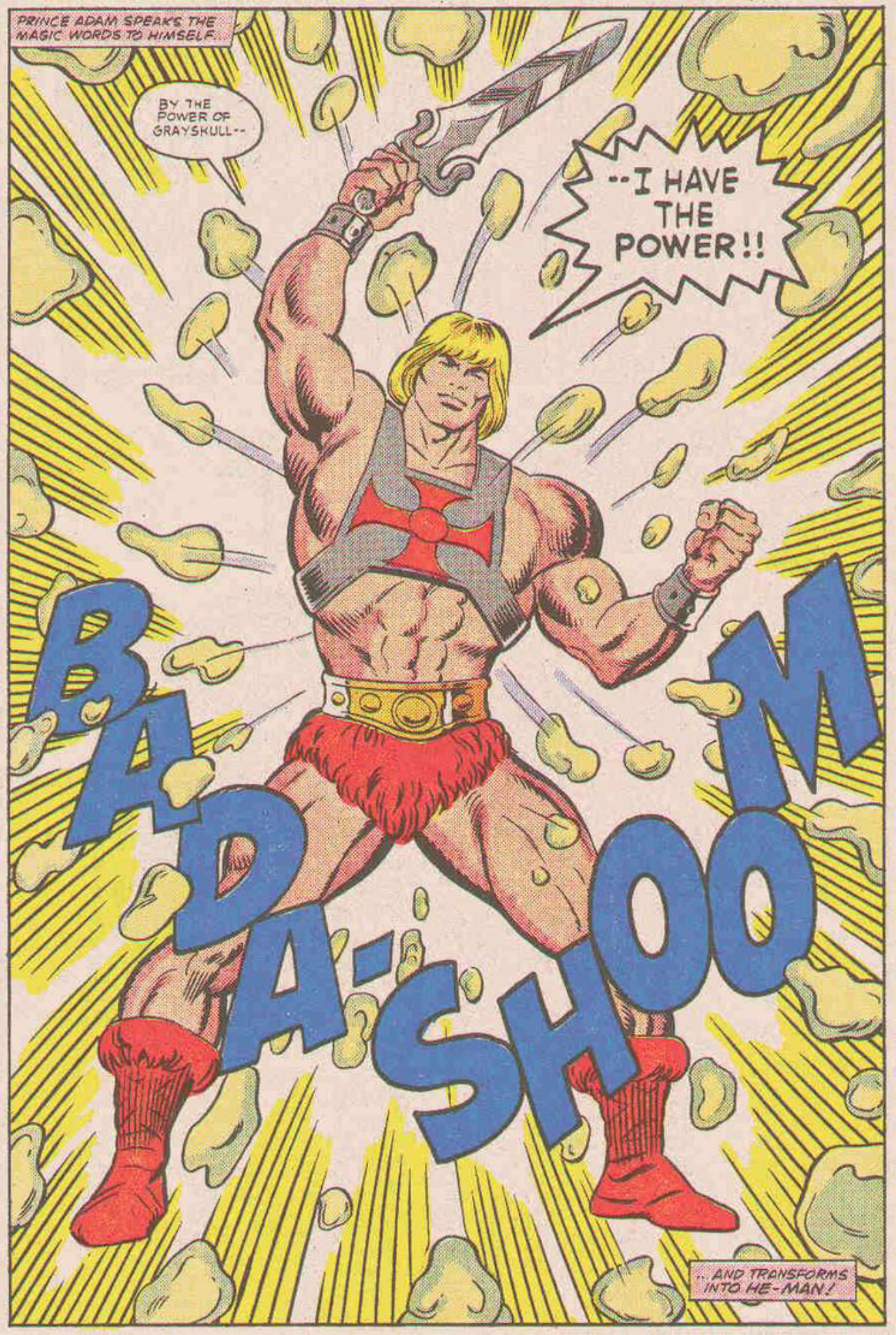
One thing that really stands out about Ron Wilson’s art in these issues is the transformation sequences; being freed from the confines of Filmation’s budget restrictions means we get to see new variations on the transformation, and every one of them is stunning. 


He-Man, Battle Cat, and Orko race to stop Skeletor, and the interaction is actually pretty good, with Skeletor treating He-Man as an annoyance rather than a threat. For once, his plan to take over Castle Grayskull isn’t so he can defeat He-Man, which changes the dynamic. 


Skeletor manages to capture Zoar, and Orko uses a spell to summon additional help, which turns out to be exactly the boost Hordak needs to break through Skeletor’s protective magic. 


The Horde attacks He-Man and Skeletor, which puts them both in the unfortunate position of being on the same side.


Orko eventually puts his spell from earlier to better use. 

This is notable, because the structure of subsequent issues will make “Orko learns a lesson” pretty central to each plot, but it doesn’t quite gel here in that same way. We come back to his original problem here and at the end of the story, but not in a way that feels like a problem’s been resolved. 


Skeletor challenges Hordak to one-on-one combat, so Hordak teleports everyone else to the prison in the Fright Zone on Etheria, where no one has ever gotten out alive! But apparently no one had thought to just cut through the wooden bars of the prison cell before.

It’s implied that maybe the further traps our heroes encounter are the really deadly threats, but they’re all dispatched fairly quickly, and then Orko teleports them back to Eternia. 

Skeletor and Hordak battle…


…but Hordak gets the upper hand, until our heroes—including a cavalry in the form of Man-at-Arms and Teela—arrive to turn the tides. 


Hordak runs away, and Skeletor follows suit, but we haven’t seen the last of them. 


Next!

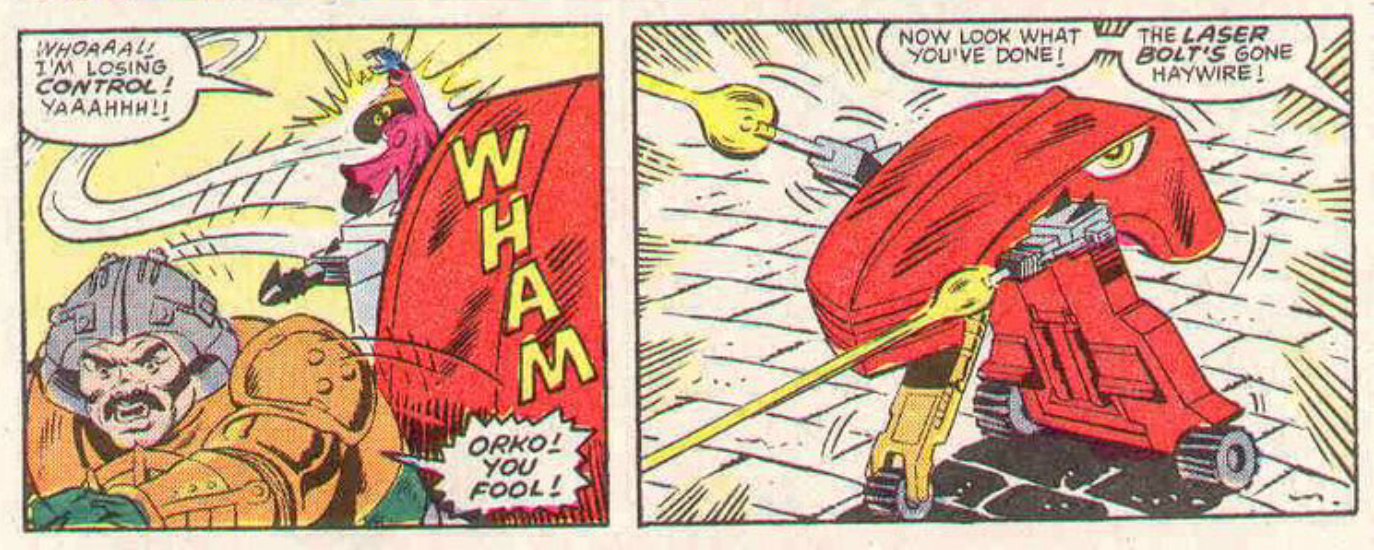
In issue #2, Orko screws around and causes the Laser Bolt (one of my personal favorite He-Man vehicles) to go haywire, which shoots a meteor out of the sky. Adam, Cringer, and Orko investigate, encountering the Evil Meteorbs for the first time.


I like Gore-illa's little pirouette.

It is wild to me that two entirely different toy companies decided in 1986 that the best way to compete with Transformers was to introduce figures that turned into rocks or eggs. Were the Rock Lords the direct inspiration for that scene in "Big" where they have a skyscraper Transformer? Both the Meteorbs and Rock Lords use Bandai figures, but He-Man's Rock Warriors are their own thing. 

And the thing that Orko shot out of the sky is secretly the Rock Warrior Rokkon, a real "4:59 on Friday" name. 


Turns out Rokkon, like Orko, just loves to fool around and have fun, and that's what got him hurt. He-Man sends the Rock Warriors and the Heroic Meteorbs to a rendezvous at the Palace, but Skeletor and the Evil Meteorbs are invisibly lying in wait, and attack the newcomers. They retaliate, thinking the attack came from the palace, and Man-at-Arms re-retaliates, escalating things until He-Man arrives. Neither side will relent until Rokkon and Orko use their combined abilities to reveal the actual threat, uniting the heroes against a common foe. 

It's at this point that I should probably point out that all these rock creatures come from a planet they call Granite, which I have to imagine was only in order to make this joke:


The villains are defeated, and we get a nice sitcom ending. 


Issue #3, inexplicably titled "The Garden of Evil," begins with Adam and Orko sparring. Orko expresses jealousy about the Power Sword, especially after Adam is able to use it to turn his magic back on him. 


Meanwhile, Hordak is assembling an army of robotic Horde Troopers to travel to Eternia and bring back He-Man. Instead, they capture Adam, which leads to a very interesting scene that I don't think happens elsewhere in the mythos:


So, first, we have direct confirmation that despite appearing similar to the viewers, He-Man and Adam look nothing alike. But we also have confirmation that He-Man's sword is distinctive enough to be recognized by Hordak.

Back in the day, I proposed two different headcanons about these issues, the first somewhat tongue-in-cheek, the second very serious. For the first, I suggested that cultures on Eternia and Etheria both lacked commonplace stories about characters with secret identities, or even characters in disguise. For whatever reason, it just wasn't part of their shared story traditions. This would help to explain why every disguise on either world, no matter how flimsy, always seemed to be almost completely effective. It would also fit nicely with my belief that Queen Marlena definitely knew that Adam and He-Man were the same person, since she's from Earth where we are all about people in disguise.

The more serious theory is that the reason no one notices that He-Man and Prince Adam have the same sword is because the Sword of Power is so plain, like the Holy Grail in "Indiana Jones and the Last Crusade." While we don't see any swords exactly like He-Man's in the series, the basic sword design we frequently see is similar enough that you could understand why someone would mistake the two, especially if they've only seen it in fast-paced battle situations. 

The Sword of Power

Similar to, but legally distinct from, the Sword of Power

Hordak tries to take the sword, but it defends itself, so he sends Adam to the Slime Pit, a torture chamber where...eventually he'll be covered in slime!


Like, the slime isn't poisonous or anything as far as I can tell. Adam just gets to experience what it's like to be to be on the Nickelodeon Kids Choice Awards. For comparison, here's what happens when He-Man gets slimed in the mini-comic:


That red-eyed mind-controlled He-Zombie is burned into my brain. According to the footnote in the Mini-Comic Collection, this was the intent for victims of the Slime Pit. 

Meanwhile, only Cringer and Orko know what's happened to Adam, but Orko knows that they don't need help to save him. They travel to Etheria and find Adam trapped, but Adam tries to warn Orko not to touch the sword. 


Orko, though, has other ideas...


...but instead he decides that his magic is good enough, and levitates the sword over to Adam, who gives very little thought to his secret identity. 


Or Cringer's, for that matter. 


Not that it matters, because Hordak is kind of an idiot. He shows off a couple of additional toys, but there aren't enough pages left, so Orko teleports our heroes back to Eternia. He-Man compliments Orko on making a mature decision, and the story ends. 


To sum up these first issues, I think the strong focus on spotlighting several specific toys each issue—the Terror Claws, Horde members, and Fright Zone in #1; the Rock Warriors, Meteorbs, and Laser Bolt in #2, and Hurricane Hordak, the Mantisaur, the Slime Pit, and Horde Troopers in #3—is a big part of what makes these stories feel more like the mini-comics than the cartoon. While the cartoon certainly existed to sell toys, most episodes were less transparent about it, or at least wove them into the plot more naturally. Some of that is down to the amount of space for storytelling, some of that is from animation budget restrictions that limited how many new designs a given story could have, but I think it ended up working in the show's favor.

Next time, issues #4-6!

Wednesday, August 04, 2021

Guttor #4 - Enter...The Marvel Age!


Before we dig into the series proper, there was an issue of Marvel Age promoting this series, including an interview with the creative team written by Sholly Fisch, who has apparently had a much longer history in comics than I was aware of. There’s not a ton to say about the interview; it feels very effusive in that promotional enthusiasm sort of way. 

The issue starts with a note from editor Jim Salicrup about why Marvel features so many licensed characters on Marvel Age covers. In short, comics based on licensed characters bring in a new audience:

When Marvel buys the rights to license characters from a movie, TV show, or even a toy, we usually try to find characters that are incredibly popular—that have a huge following of their own. That way, when we publish the comic book based on such a character we're hoping to reach thousands of people who may not have picked up a comic book in years!

That passage starts with a potshot at their competition, which is both kind of funny since He-Man started at DC, and kind of fitting since (for whatever reason) DC didn't hang onto the license. 

Before we cover the cover feature, there's an issue I need to head off at the pass: Mike Carlin is the writer on the first eight issues of this series, and I feel like I’d be remiss if I didn’t mention his history as a (credibly alleged) sexual harasser. It sucks, and if I’d realized when I started this project that he was the main guy for a bit here, I might have had second thoughts. 

Fisch begins with a brief summary of the He-Man concept and characters, then gets into an interview with writer Mike Carlin and penciller Ron Wilson, who had previously been working on Ben Grimm's solo title, and editor Ralph Macchio. "He-Man will be a mixture of fun and adventure that won't just be for kids!" Fisch says, (the "biff! pow!" is presumably implied) before Carlin promises not to "write down" to the readers. That's a comment I'm going to come back to over Carlin's tenure on the book, because so far in my reading, it feels like it's increasingly untrue as the series progresses. 

Macchio compares Wilson's art style to Jack Kirby and John Buscema, which is high praise that I'm not sure comes through in this series. Then there's this baffling comment:

While it [Wilson & Janke's art] will be slightly different from that of the HE-MAN cartoons, it will be every bit as down to earth!" 

Nothing says "down to earth" like the show about a man in furry shorts fighting a skull-faced wizard for control of a castle shaped like a head. 

Carlin compares the simplicity of the He-Man comics to Silver Age storytelling, with "clear-cut stories without plot complications that carry on for years." He also says that the biggest shift from previous collaborations with Wilson is that now Carlin is doing full-script with panel layout thumbnails, presumably in contrast to a more Marvel Method approach to The Thing. I wonder if this change was necessary in order to get stories cleared by the people at Mattel in a timely fashion. Macchio discusses later how the stories have to be cleared by Mattel, something that's true even with modern licensed comics, but "so far, the stories have been so good that Mattel hasn't asked for any major changes!" 

Unspoken in that is how much input Mattel had on the stories before they were written, particularly in terms of which characters/vehicles get the spotlight in each issue. I suspect the answer is "a great deal."

The sample sketches Wilson did were apparently good enough that Mattel wanted to hire him on the spot. 

And then Fisch goes into a description of upcoming issues, including erroneously claiming that #2 introduces the Slime Pit. That would end up being the story for issue #3, and #4 has a slight credit change, with Wilson on breakdowns and Dennis Janke finishing, which makes me wonder what behind-the-scenes shuffling and deadline stuff was going on. 

The meat of the exuberantly effusive article (wherein nearly every sentence and quote ends with an exclamation point) ends with the claim that "Ralph was so overcome talking about HE-MAN that he leaped on his desk, pulled out a tennis racket, and cried, 'By the power of Cresskill!' (invoking the name of his hometown)." I'm trying to pinpoint exactly what makes me feel like that story absolutely did not happen as described, and I think it's the tennis racket. 

Fisch ends, as each episode of the He-Man cartoon does, by offering a moral:

Listen to your mother and father, brush your teeth after every meal, look both ways before crossing the street, never take candy from a stranger with a blue hood and a skull face, and most of all, accept no imitations!

I'll follow suit by offering this moral: sponsored content and promotional writing hasn't really changed in 30 years. Reading that gives me flashbacks to the SEO-infused content I was once paid to write for online stores. 

The next article in the issue is a promo for Doctor Who Monthly, published by "Marvel's British division," and then a new talent spotlight for the late, great Tom Lyle. 

Huh, I did not expect to fill a whole installment of this with just the Marvel Age promo, but here we are. Next time, we dig into the wild world of Marvel's Star imprint.