So, on a whim today (because I ended up in a comic shop and don't like leaving empty-handed), I bought Metal Men #1. Everything was going fine, quite well actually, for the first 2/3 or so. We got some crazy action, a neat little Julie Schwartz-esque bit of science for the villain-takedown, and even some tie-in material to "The Obsidian Age." Last time I checked, I was the only person in comics blogging who liked that story, so you'd think this comic might be written directly at me.
Then, I got to page...okay, so the pages aren't numbered. I got past the iffy mad scientist-type science without bristling too much. I grumbled a little over Platinum's statement--"where an element can change its atomic structure as easily as a girl can change her shoes"--since technically to change the atomic structure of the element would turn it into a different element, or at least an isotope or ion, but figured there's enough ambiguity in the term "atomic structure" that she might be talking about spin number or orbitals or something. Then, I rammed headlong into this brick wall:

No, no, no. Oh man, I haven't even been able to finish the comic because of that line. Every time I try, my eyes just slide off the page; it's like the book's equipped with an
SEP field. First, Newton had laws of
Mechanics, not Thermodynamics. The law which became the Second Law of Thermodynamics was coined by Sadi Carnot. Second, the Second Law of Thermodynamics states that all
closed systems tend to move toward greater entropy; an important distinction. While the universe as a whole is a closed system and thus the overall system of the universe is moving toward greater entropy, I still count this as a mistake; Magnus seems to suggest that
no system can result in greater order, which is patently false. And "decay" is really a
terrible term to use there, because it really doesn't describe the concept of entropy. Entropy is a measure of disorder, usually in the form of heat or otherwise useless energy.
It only gets worse from there. Oh, Will Magnus, what the hell is your doctorate in? Certainly not Quantum Physics, Chemistry, or Particle Physics. Were the Metal Men crafted by a mad dentist with delusions of grandeur?
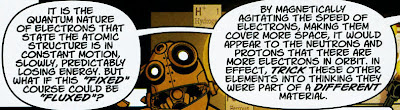
He's almost not wrong with that first bit. The "quantum nature of electrons" is their wave-particle duality. Like all particles, electrons exhibit both the properties of waves and particles, depending on what you're looking for. The modern atomic model depicts electrons not as discrete particles in specific orbits, but as a field of probabilities around the nucleus. At each point in an electron cloud, there is a calculable probability of finding an electron...sort of. It's been awhile since I played with particle physics, so I'm a bit rusty. The problem is that I'm reasonably certain that the wave behavior of electrons doesn't lose energy at any appreciable rate.
In any case, there's no "fixed" course; electrons don't travel in orbits like planets, but are confined to specific orbital clouds until energy enters or leaves the system (in which case the electrons may jump up into higher orbitals, or drop down into lower ones) or until a chemical reaction occurs (in which electrons may be shed to or shared by another atom). To ask if the course could be "fluxed" is nonsense.
Anyway, there's no way, so far as I know, to make an electron faster, or to make it cover more space. Again, in an orbital cloud electrons behave more as waves and probabilities rather than discrete particles. They don't "cover space" in any meaningful way, and even if they could, what Magnus suggests here would require that the nucleus somehow be capable of being fooled. Being entirely devoid of sentience, this is rather impossible.
To pare down what Magnus suggests here to the real science, he's suggesting that by increasing the speed of the electrons (whatever that means), he could fool the nucleus (whatever
that means) into thinking there are more electrons in the cloud around it. This isn't nearly so groundbreaking as Magnus thinks; when an atom has more electrons in the cloud around it than it should (in order to remain electrically neutral), it becomes an anion, a negatively-charged ion. Usually, this entails the creation of some cation, a positively-charged ion, and the two form an ionic bond.
Chemistry 101 here, folks: a neutral Sodium atom has one electron in its outer electron shell (its
valence shell). A neutral Chlorine atom has seven electrons in its valence shell. When the two combine, the sodium loses an electron, which the Chlorine gains. The result is a positively-charged sodium ion attracted electrically to a negatively-charged chlorine ion, and they form NaCl, or common table salt.
Now, it's entirely possible to have an ion outside of an ionic bond; when you dissolve salt crystals in water, the ionic bonds are broken by the polar water molecules. All Magnus is suggesting is the roundabout way toward ionizing elements, which, while it has some effect on the element's properties (usually resulting in greater stability), is not all that amazing, and doesn't require increasing electron speeds.
So, in fact, having more electrons doesn't "trick" the atoms into thinking they're part of a different material, it jst makes them less reactive. What determines the material properties of an element is the number of protons (and to a lesser degree, neutrons). Altering the number of electrons or neutrons really just makes the atom more or less stable or reactive; altering the number of protons changes the element entirely. The main difference between inert gas helium and metallic lithium is a single proton.
Which is where Magnus makes his next big blunder:

Atomic weight is the average of the atomic masses of the various isotopes of a chemical element, weighted by abundance (thanks, Wikipedia). To say you could "raise or lower a material's atomic weight" is like saying you could "raise or lower the average height of Americans;" it implies that the change you're making applies to all the isotopes worldwide, or to a large portion of isotopes, in order to have an effect on the global average. What I think Magnus must mean, then, is that you can change a material's
atomic mass as if it were on a dial, a significantly easier and more useful concept. The atomic mass is simply the rest mass of the protons and neutrons in the nucleus of a given atom (electrons' mass, by comparison, is negligible).
Now, there are two ways in which you can alter an atom's atomic weight: you can change the number of neutrons, or you can change the number of protons. When you change the number of neutrons, you create new isotopes of the element. Larger, heavier isotopes tend to be unstable, and thus tend to be radioactive. Different isotopes of an element may have different properties from the common isotope, but aside from some differences in reactivity and radioactivity, they're pretty similar.
Changing the number of protons, however, changes the element; an element is
determined by its number of protons. Given the other content of Magnus's speech, this seems the most likely conclusion of what he's trying to say: using his crackpot hypothesis, you could transmute one element into another. Unfortunately, he thinks this process A) is novel and B) might somehow leave the element's "essence" intact, or somesuch. No, Will, you can't make lead behave like gold while still being lead; not by changing the atomic mass, anyway. The only way you'll make lead behave like gold is by subtracting three protons and making it into gold.
And this process is not a new one; it's called
nuclear fusion. Yes, yes, I know you have some crazy scheme about tricking the nucleus, but that's
insanity. What you're suggesting is no less than fusion and fission, the real-world equivalent of alchemical transmutation. All fusion is is the addition of protons to an atom's nucleus; it's going on in every star in the sky all the time. It's just a little difficult to get that sort of thing going in the laboratory.
Toward the end of the issue, Will is despondent that the scientists were more impressed by his robots than his ramblings. T.O. Morrow tells him that the mumbo-jumbo went over their heads; I tend to think Morrow just didn't have the heart to tell him that his grasp on basic scientific concepts is tenuous at best, and he really ought to stick to his strength: engineering.

BATMAN/SUPERMAN: SAGA OF THE SUPER SONS TP


