Yes, I realize I'm way behind at this point. I'd set aside this past weekend to catch up, but a combination of illness and a bunch of schoolwork has absorbed my time like a bathroom rug. I will finish the next 11 entries, and in fact I've started all of them, but it won't be until after Wednesday. I started the month with a deficit of posts, and that gap has only grown. Sorry, folks.

Monday, February 26, 2007

Saturday, February 24, 2007

Tuesday, February 20, 2007
Interlude and Inquiry
This is an honest question, presented with no snark or agenda: at what point does masculine pride become sexism and/or misogyny?

Black Comics Month: Day 16
I love Vixen. And unlike some, I've never really read any of the Detroit era Justice League.
 I know where you think this is going. "No, I first encountered Vixen in Justice League Unlimited, where she was John Stewart's rebound girl after Shayera left. This put Vixen at an immediate disadvantage; the viewers wanted John to be with Shayera, they were supposed to be together, and Vixen was standing in the way of that. She was a usurper; she could have been a cop-out character. But instead she was a strong, likable character; in a lot of ways, she was more likable than Shayera. She certainly wasn't as abrasive or combative, and she had this calm, effortless elegance about her. You got the feeling that she could be in pitched battle with Kalibak, and when it was all said and done, she wouldn't have a hair out of place. It's not that she'd be worried or concerned about such a shallow thing, just that when she was the only one left standing, she'd still look pristine. We wanted her to be the "bad guy," the "other woman," the vicious harpy who stole John away from his true love. But instead, she was a nice, normal, charming person, and we could all see what John saw in her. She won us over, and it takes a strong character to do that."
But that's not at all what I'm going to say. No, in fact, I first found Vixen in the pages of Grant Morrison's Animal Man. And like every guest star in that book (with the possible exception of Freedom Beast, but that's a post for another day), I thought she was fantastic. Moore's Swamp Thing drew connections between DC's magical and horror characters, Gaiman's Sandman had a way of uniting the DCU's different mythological and religious elements, and Morrison's Animal Man united the animalistic elements. Vixen was basically co-headliner for several issues. She was a stark contrast against Buddy Baker. Vixen was more confident, more competent, and more practical than the book's star.
 In a very real way, she was the "comic book" counterpart to Buddy. Animal Man was a fairly normal guy with a normal family. He wore a jacket over his costume so he could carry things; he drew his powers from a Sheldrakian newage morphogenetic field. He fumbles in battle, often stumbling on something that works rather than following through on a plan or engaging in clever banter. On the other hand, Vixen is a supermodel with a perfect body, who wears little more than a spandex superhero outfit, is great in battle, and derives her abilities from an ancient magical artifact. Mari has essentially the same powers as Buddy, but her appearance, her attitude, and her power source all adhere to more traditional comic book conventions.
Having set up the dichotomy of character, Morrison puts them into separate simultaneous situations. While Buddy's busy dealing with the weird yellow metafiction aliens, Vixen is locked in combat with a doppelganger of sorts. She is repeatedly injured in ways that ought to kill her, but heals immediately and continues to fight, without any fanfare whatsoever. The point of the juxtaposition is clearly to make a statement about traditional superhero comics, and about how Animal Man diverts from and subverts those conventions (and it foreshadows Buddy's meeting with Grant at the end of the arc, where he also fights a transparent doppelganger as an example of traditional comics storytelling). Superhero comics, Morrison seems to say, are all about endless battle without consequence. The heroes and villains are based on a black-and-white view of the world; the characters operate on a formula--one pure, flawless hero, one villain who is a corrupted version of that hero. The battle never addresses any real issues, except symbolically. Meanwhile, Buddy is a normal guy; when he's injured, or when his family dies, it has a real effect on him. When his history is rewritten on the fly, it has a major effect on his life. He assaults social and ecological issues more often than megalomaniacal supervillains. He's not your average superhero, and maybe the average superhero shouldn't be either.
Then again, Vixen's not exactly the "average superhero" either. Sure, compared to Buddy she's a lot more traditional, but that doesn't make her Captain Cliché. She's a firebrand, she's strong and independent, and hopefully when Brad Meltzer stops writing her, she won't look like an idiot who has to announce what powers she's using.
According to a variety of websites, she's also DC's first black superheroine. They got themselves off to a very good start.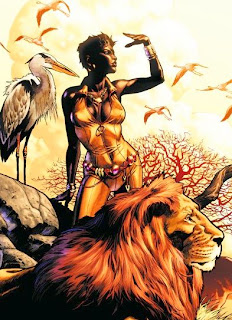
 I know where you think this is going. "No, I first encountered Vixen in Justice League Unlimited, where she was John Stewart's rebound girl after Shayera left. This put Vixen at an immediate disadvantage; the viewers wanted John to be with Shayera, they were supposed to be together, and Vixen was standing in the way of that. She was a usurper; she could have been a cop-out character. But instead she was a strong, likable character; in a lot of ways, she was more likable than Shayera. She certainly wasn't as abrasive or combative, and she had this calm, effortless elegance about her. You got the feeling that she could be in pitched battle with Kalibak, and when it was all said and done, she wouldn't have a hair out of place. It's not that she'd be worried or concerned about such a shallow thing, just that when she was the only one left standing, she'd still look pristine. We wanted her to be the "bad guy," the "other woman," the vicious harpy who stole John away from his true love. But instead, she was a nice, normal, charming person, and we could all see what John saw in her. She won us over, and it takes a strong character to do that."
But that's not at all what I'm going to say. No, in fact, I first found Vixen in the pages of Grant Morrison's Animal Man. And like every guest star in that book (with the possible exception of Freedom Beast, but that's a post for another day), I thought she was fantastic. Moore's Swamp Thing drew connections between DC's magical and horror characters, Gaiman's Sandman had a way of uniting the DCU's different mythological and religious elements, and Morrison's Animal Man united the animalistic elements. Vixen was basically co-headliner for several issues. She was a stark contrast against Buddy Baker. Vixen was more confident, more competent, and more practical than the book's star.
 In a very real way, she was the "comic book" counterpart to Buddy. Animal Man was a fairly normal guy with a normal family. He wore a jacket over his costume so he could carry things; he drew his powers from a Sheldrakian newage morphogenetic field. He fumbles in battle, often stumbling on something that works rather than following through on a plan or engaging in clever banter. On the other hand, Vixen is a supermodel with a perfect body, who wears little more than a spandex superhero outfit, is great in battle, and derives her abilities from an ancient magical artifact. Mari has essentially the same powers as Buddy, but her appearance, her attitude, and her power source all adhere to more traditional comic book conventions.
Having set up the dichotomy of character, Morrison puts them into separate simultaneous situations. While Buddy's busy dealing with the weird yellow metafiction aliens, Vixen is locked in combat with a doppelganger of sorts. She is repeatedly injured in ways that ought to kill her, but heals immediately and continues to fight, without any fanfare whatsoever. The point of the juxtaposition is clearly to make a statement about traditional superhero comics, and about how Animal Man diverts from and subverts those conventions (and it foreshadows Buddy's meeting with Grant at the end of the arc, where he also fights a transparent doppelganger as an example of traditional comics storytelling). Superhero comics, Morrison seems to say, are all about endless battle without consequence. The heroes and villains are based on a black-and-white view of the world; the characters operate on a formula--one pure, flawless hero, one villain who is a corrupted version of that hero. The battle never addresses any real issues, except symbolically. Meanwhile, Buddy is a normal guy; when he's injured, or when his family dies, it has a real effect on him. When his history is rewritten on the fly, it has a major effect on his life. He assaults social and ecological issues more often than megalomaniacal supervillains. He's not your average superhero, and maybe the average superhero shouldn't be either.
Then again, Vixen's not exactly the "average superhero" either. Sure, compared to Buddy she's a lot more traditional, but that doesn't make her Captain Cliché. She's a firebrand, she's strong and independent, and hopefully when Brad Meltzer stops writing her, she won't look like an idiot who has to announce what powers she's using.
According to a variety of websites, she's also DC's first black superheroine. They got themselves off to a very good start.

Sunday, February 18, 2007
Black Comics Month: Day 15
.png "Get ready to look SOOOO good!") I loved Young Justice. The book ended tragically the same month as Peter David's Supergirl, and within a year of Superboy and Impulse, all comics I loved dearly. In fact, I was ticked that YJ was being killed to make way for Teen Titans. Sure, TT was great in the beginning, but it was a completely different book. Young Justice was fun, and while Teen Titans was good (up until right after "Titans Tomorrow," I'd say), it wasn't as fun as Young Justice. Somewhere in the angst and the epic plots, it lost the fun character interactions and the sense of innocence that characterized Young Justice.
I loved Young Justice. The book ended tragically the same month as Peter David's Supergirl, and within a year of Superboy and Impulse, all comics I loved dearly. In fact, I was ticked that YJ was being killed to make way for Teen Titans. Sure, TT was great in the beginning, but it was a completely different book. Young Justice was fun, and while Teen Titans was good (up until right after "Titans Tomorrow," I'd say), it wasn't as fun as Young Justice. Somewhere in the angst and the epic plots, it lost the fun character interactions and the sense of innocence that characterized Young Justice.It lost something else, too: half the cast. Slobo died, Secret lost her powers, and Arrowette and Empress have been floundering in comic book limbo. Which is really a shame.
See, Anita Fite's father is one-half of Fite & Maad, agents of the All Purpose Enforcement Squad (A.P.E.S.); her mother was a vodoun priestess; her name is a pun; naturally, she had a fantastic combination of combat skills and magic. According to Wikipedia, she also has a bit of the Anti-Life Equation floating around her brain, but either I didn't read that issue or I blocked it out along with the rest of "Our Worlds at War," one of very few major crossovers to which I own every single part. She's got a funky costume, she's got a staff that turns into two swords, she has that 'cheerful personality that masks the disturbing parts of her past and the nature of her powers" thing going on. In other words, she's a very versatile character. So why isn't she on some team?
Hey, Titans, you know Ravager and Raven? Why clutter up your team with two girls whose names are so similar, when you could have Empress? She's a more efficient use of character, combining Ravager's fighting skills and desire to be accepted with Raven's magic and angst! You'd be stupid not to take her!
Hey, Shadowpact, Nightmaster and Blue Devil are cool and all, but you really need a woman who can hold her own in hand-to-hand magic combat. Enchantress and Nightshade are cool and all, but they never really get their hands dirty. Recruit a girl who can tussle with the best of them!
 Hey, Batman, aren't you miffed that there are all these teams running around without someone working for you? Don't you want to keep tabs on the new Suicide Squad? What about the Secret Six? How about (Rao forbid) the Outsiders? Sure, you kind of screwed the pooch with Cassandra, but there's a perfectly good Empress around, just waiting for your phone call. She's got the stealth skills, the fighting prowess, and I know how much you hate magic, but it certainly gives her an edge. Plus, she's not really well-known enough to be spotted as a hero. She could be your whited-out eyes and pointy black ears in any of these teams, and we all know that you know how to reach her.
 Oh, Catwoman, are you looking for a babysitter? I know someone with oodles of experience! Poor Anita Fite lost her parents, but they were reincarnated as infants! They're a little bit older than Helena by this point, but she could sure use some playmates her own age, don'cha think? Plus, what better security could you have than a girl with vodoun guardian spirits watching over her? I'm sure you can work out a fair pay schedule, just give her a call!
Okay, if you want to know how awesome Empress is, if you really want to see why she deserves a spot in any team in the DCU (have we seen her picture on the JLA table at all?), I really only need to recount one of her adventures to you. See, Anita? She survived a date with Lobo.

Friday, February 16, 2007
Black Comics Month: Day 14
Something a bit different for this post. Even though it's a couple of days late, numerically this falls on Valentine's Day, and so it seemed appropriate to discuss a couple. And no black comics couple has received more attention recently than Storm and Black Panther. This works well for a couple of reasons: I haven't done a Marvel character in a few posts, and while I've been trying to keep things pretty even between the big two, I tend to know more about DC characters, and more DC characters in general. Also, while I like both Storm and Black Panther individually, I don't know enough about either one (at least, from the comics) to do a full single post on each of them.
 So, we'll begin with Black Panther. I remember the first comic I read with him: Avengers #356 (well, technically he appeared in #327, which I had earlier, but only for a panel). I think the only person I knew in that incarnation of the Avengers was Thor, and maybe Hercules. Everyone else was a cipher to me. At the time, a good portion of the members were wearing brown leather jackets, Thor was bearded while Hercules was clean-shaven, and the Vision was plain off-white. Okay, so I actually prefer the white Vision to the more motely version, but even so, out of that group, it's not hard to see why someone with a costume so simple as the Black Panther's would stand out. Jack Kirby knew what he was doing.
But I never really followed him. I mean, I was intrigued by the mystery of the Coal Tiger, I thought the Black Panther was cool, but I never really followed any of his series. I've read the first five issues or so of Christopher Priest's run, and I enjoyed it, but that's about the extent of my exposure to Black Panther. That, and going out of my way to unlock him in Marvel: Ultimate Alliance, only to be sorely disappointed in how such a badass character could be so easily and consistently killed by cronies. But I like Black Panther; I like BP in the same way I like Aquaman: the idea of a superhero who is also the leader of his own nation is really, really intriguing, but the actual comics about it just don't quite hook me. I'm going to continue reading the Priest stuff, and hopefully I will eventually feel that hook (suck it in suck it in suck it in if you're Rin Tin Tin or Anne Boleyn), but it just seems like the narrator character and the funky chronology of the book is keeping me from connecting.
 I'd like to say that I'm more familiar with Storm, and when I started this post, I thought I was. But despite following various incarnations of the X-Men in various eras, it seems I always manage to pick it up when she's not on the team, or in the book that I'm reading. On the plus side, this means I missed out on the whole leather-and-mohawk phase, but on the minus side, it means I've missed out on the comic book Storm. I know she led the "Uncanny" team while I was reading the adjectiveless book (I have an issue with the Shadow King to prove it). I feel immensely sorry for Ororo that she was laboring under Chris Claremont in the horrendously-named X-Treme X-Men while the rest of her team was experiencing the Morrison renaissance. And so far, despite the name of one of her Marvel: UA costumes, she hasn't shown up in Astonishing X-Men yet.
But I like Storm. I think she suffers a bit from the Of Course She Is syndrome, what with being a street thief and a princess and worshipped as a goddess and a Mutant and the child of sorcerers and from a special African tribe and a good fighter, oh but she's flawed because of her claustrophobia. Of course she is. But Storm has the regal attitude to back it up, and they usually gloss over her days as a street urchin.
Most of my knowledge of Storm, I realize, comes out of the old animated series (because if it came out of the movies, I'd conclude that Storm was a stiff actress who has a habit of chewing scenery). There, Storm was regal without being unapproachable or naïve, and powerful without being unsympathetic. One of my favorite elements from that series was her romance with Wolverine, not because it necessarily fit the characters, but because it developed so naturally and so gradually, and by the time it became explicit, it just felt right.
And in my estimation, that's really the key to a good fictional relationship. It has to feel natural. Take, for instance, John Stewart and Shayera Hol in the Justice League cartoon. The relationship between the two built up slowly, the tension increased, the attention paid to their friendship increased, until it seemed inevitable. Batman and Wonder Woman had a similar thing in the same series (though it never quite became explicit), and in the Joe Kelly run on JLA (where it did, but didn't become serious). I think when it comes down to it, there are a few factors which increase the length necessary for a relationship to feel natural:
But I haven't read much at all of their relationship, except during the big deference kerfuffle from a few months back. And since it doesn't look like this will be retconned into a ploy orchestrated by Starfox anytime soon, I wish the best of luck to Marvel's most regal couple.
 So, we'll begin with Black Panther. I remember the first comic I read with him: Avengers #356 (well, technically he appeared in #327, which I had earlier, but only for a panel). I think the only person I knew in that incarnation of the Avengers was Thor, and maybe Hercules. Everyone else was a cipher to me. At the time, a good portion of the members were wearing brown leather jackets, Thor was bearded while Hercules was clean-shaven, and the Vision was plain off-white. Okay, so I actually prefer the white Vision to the more motely version, but even so, out of that group, it's not hard to see why someone with a costume so simple as the Black Panther's would stand out. Jack Kirby knew what he was doing.
But I never really followed him. I mean, I was intrigued by the mystery of the Coal Tiger, I thought the Black Panther was cool, but I never really followed any of his series. I've read the first five issues or so of Christopher Priest's run, and I enjoyed it, but that's about the extent of my exposure to Black Panther. That, and going out of my way to unlock him in Marvel: Ultimate Alliance, only to be sorely disappointed in how such a badass character could be so easily and consistently killed by cronies. But I like Black Panther; I like BP in the same way I like Aquaman: the idea of a superhero who is also the leader of his own nation is really, really intriguing, but the actual comics about it just don't quite hook me. I'm going to continue reading the Priest stuff, and hopefully I will eventually feel that hook (suck it in suck it in suck it in if you're Rin Tin Tin or Anne Boleyn), but it just seems like the narrator character and the funky chronology of the book is keeping me from connecting.
 I'd like to say that I'm more familiar with Storm, and when I started this post, I thought I was. But despite following various incarnations of the X-Men in various eras, it seems I always manage to pick it up when she's not on the team, or in the book that I'm reading. On the plus side, this means I missed out on the whole leather-and-mohawk phase, but on the minus side, it means I've missed out on the comic book Storm. I know she led the "Uncanny" team while I was reading the adjectiveless book (I have an issue with the Shadow King to prove it). I feel immensely sorry for Ororo that she was laboring under Chris Claremont in the horrendously-named X-Treme X-Men while the rest of her team was experiencing the Morrison renaissance. And so far, despite the name of one of her Marvel: UA costumes, she hasn't shown up in Astonishing X-Men yet.
 But I like Storm. I think she suffers a bit from the Of Course She Is syndrome, what with being a street thief and a princess and worshipped as a goddess and a Mutant and the child of sorcerers and from a special African tribe and a good fighter, oh but she's flawed because of her claustrophobia. Of course she is. But Storm has the regal attitude to back it up, and they usually gloss over her days as a street urchin.
Most of my knowledge of Storm, I realize, comes out of the old animated series (because if it came out of the movies, I'd conclude that Storm was a stiff actress who has a habit of chewing scenery). There, Storm was regal without being unapproachable or naïve, and powerful without being unsympathetic. One of my favorite elements from that series was her romance with Wolverine, not because it necessarily fit the characters, but because it developed so naturally and so gradually, and by the time it became explicit, it just felt right.
And in my estimation, that's really the key to a good fictional relationship. It has to feel natural. Take, for instance, John Stewart and Shayera Hol in the Justice League cartoon. The relationship between the two built up slowly, the tension increased, the attention paid to their friendship increased, until it seemed inevitable. Batman and Wonder Woman had a similar thing in the same series (though it never quite became explicit), and in the Joe Kelly run on JLA (where it did, but didn't become serious). I think when it comes down to it, there are a few factors which increase the length necessary for a relationship to feel natural:
- The importance of the characters: Are these a couple of supporting cast members, or multi-title headliners? Hooking up Obsidian and Damon Matthews, a C-list superhero and a supporting cast member, respectively, is one thing. Hooking up Wolverine and Elektra would be quite another. If the latter relationship happens without at least a few months of buildup, it's going to look like a stunt.
- The previous relationship: Have these characters worked together before? It's a lot easier to make a relationship look natural if it could have been going on behind-the-scenes in the past. A few flashback panels highlighting the sexual tension can take the place of quite a lot of lengthy justification.
- The Mary Sue factor: We've all seen the people who show up suddenly and very quickly enter into relationships with long-time established characters. In fact, I was tempted to call this "Terry Long syndrome," though I could easily see it applying to Pete Wisdom or Trevor Barnes. The perfect counterexample is Pug, from She-Hulk. He was a new character when the book started, but will anyone be surprised if they hook up? You have to ease into that sort of thing.
- The seriousness of the relationship: A date is one thing, and can happen with only a little lead-up. A marriage, on the other hand, needs a lot of buildup, several months if not a year or more, to make it feel really natural.
But I haven't read much at all of their relationship, except during the big deference kerfuffle from a few months back. And since it doesn't look like this will be retconned into a ploy orchestrated by Starfox anytime soon, I wish the best of luck to Marvel's most regal couple.

Black Comics Month: Day 13
I honestly don't have much to say about Cyborg. This is not due to a lack of familiarity with the character. Nor is it due to a lack of affection for the character. No, quite the contrary. I don't have much to say about Vic Stone because words fail to describe his supreme awesomeness. In my experience, there are three Cyborgs:
 Cyborg, Flash supporting character: This was probably my first long-term exposure to the character. Left more or less floundering after the end of Titans (or leaving the team, I'm not totally clear on which is correct), Vic was pretty close to having it all. His new Omegadrome body was a mixture of a clone of his original self and a liquid metal alien technological form, which meant he could switch easily between being almost totally human, and being almost totally mechanical, with all the benefits of both worlds. The liquid metal tech granted him amazing versatility and adaptability, and even allowed him to take a form similar to his classic look when in battle (except upgraded from silver to gold). This fact proved tragic when Vic got infected by the Thinker (along with most of Keystone), which deactivated the Omegadrome and brought him back to the old status quo. You had to feel for Vic, to have all that taken away from him yet again. But he soldiered on, helping to found the new Teen Titans and guide a new generation of heroes.
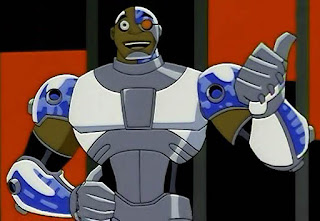 Cyborg, Christopher Turk: The animated Cyborg is far and away the most entertaining character on the show. Most of the time he's got a happy-go-lucky (if overly competitive) attitude, but he's also a loyal friend and a brave warrior. While I haven't seen all of the episodes of the series, it seems to me that Cyborg's the focus of most of the poignant, heartfelt episodes. Whether he's dealing with his own perceived inadequacies and physical limitations, infiltrating H.I.V.E. and befriending some of the members, or falling in love in the distant past, Cyborg is the go-to guy for emotional gravitas. Part of it certainly stems from his tragic beginnings, but part of it comes from the same understanding which fuels most episodes of "Scrubs": there is a balance between comedy and tragedy, and achieving that balance increases the emotional impact of both. No other character on the show, not goofy Beast Boy or brooding Robin or withdrawn Raven or bubbly Starfire, walked the line between comedy and tragedy more often and more effectively than Cyborg.
 Finally, there's Cyborg the Titan: no longer a teen, Vic Stone has become the mentor to the Titans; even when elder members Starfire and Beast Boy were on the team, Cyborg was clearly the guiding hand, the mentor figure, the veteran. He's not so much a father to the younger members as a coach and a friend, which fits well with his athletic background. He's showing these kids how to be heroes, and moreover, how to be a team. When he was offline, comatose for the One-Year Gap, the team was lost, and still they came to him for guidance. They say that the Martian Manhunter is the heart and soul of the Justice League, but the League can still function and exist without him. The Titans simply don't work without Cyborg there to guide them. When he joined the team, he needed them for the security and support they provided. Now, they need him for the same reasons.
Vic Stone is part man, part machine. Sometimes one part has dominated the other, and he has long feared that he was no longer truly human. Yet he shows time and time again that he is the most human member of the Titans. Perhaps it's a bit cliché, but it never seems to get old.
I guess I had more to say about Cyborg than I thought.
 Cyborg, Flash supporting character: This was probably my first long-term exposure to the character. Left more or less floundering after the end of Titans (or leaving the team, I'm not totally clear on which is correct), Vic was pretty close to having it all. His new Omegadrome body was a mixture of a clone of his original self and a liquid metal alien technological form, which meant he could switch easily between being almost totally human, and being almost totally mechanical, with all the benefits of both worlds. The liquid metal tech granted him amazing versatility and adaptability, and even allowed him to take a form similar to his classic look when in battle (except upgraded from silver to gold). This fact proved tragic when Vic got infected by the Thinker (along with most of Keystone), which deactivated the Omegadrome and brought him back to the old status quo. You had to feel for Vic, to have all that taken away from him yet again. But he soldiered on, helping to found the new Teen Titans and guide a new generation of heroes.
  Cyborg, Christopher Turk: The animated Cyborg is far and away the most entertaining character on the show. Most of the time he's got a happy-go-lucky (if overly competitive) attitude, but he's also a loyal friend and a brave warrior. While I haven't seen all of the episodes of the series, it seems to me that Cyborg's the focus of most of the poignant, heartfelt episodes. Whether he's dealing with his own perceived inadequacies and physical limitations, infiltrating H.I.V.E. and befriending some of the members, or falling in love in the distant past, Cyborg is the go-to guy for emotional gravitas. Part of it certainly stems from his tragic beginnings, but part of it comes from the same understanding which fuels most episodes of "Scrubs": there is a balance between comedy and tragedy, and achieving that balance increases the emotional impact of both. No other character on the show, not goofy Beast Boy or brooding Robin or withdrawn Raven or bubbly Starfire, walked the line between comedy and tragedy more often and more effectively than Cyborg.
  Finally, there's Cyborg the Titan: no longer a teen, Vic Stone has become the mentor to the Titans; even when elder members Starfire and Beast Boy were on the team, Cyborg was clearly the guiding hand, the mentor figure, the veteran. He's not so much a father to the younger members as a coach and a friend, which fits well with his athletic background. He's showing these kids how to be heroes, and moreover, how to be a team. When he was offline, comatose for the One-Year Gap, the team was lost, and still they came to him for guidance. They say that the Martian Manhunter is the heart and soul of the Justice League, but the League can still function and exist without him. The Titans simply don't work without Cyborg there to guide them. When he joined the team, he needed them for the security and support they provided. Now, they need him for the same reasons.
 Vic Stone is part man, part machine. Sometimes one part has dominated the other, and he has long feared that he was no longer truly human. Yet he shows time and time again that he is the most human member of the Titans. Perhaps it's a bit cliché, but it never seems to get old.
I guess I had more to say about Cyborg than I thought.
Subscribe to:
Posts (Atom)